From Concept to Production: Framework-Agnostic AI Agent Architecture Patterns and Practical Guide


Author: Wayland Zhang · Project Homepage: shannon.run · GitHub: ai-agent-book
What Is This Book About?
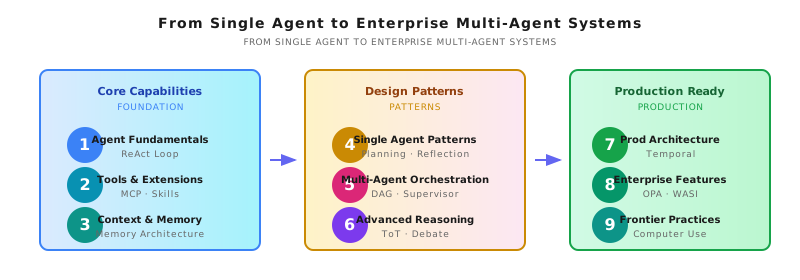
Not framework documentation—a practical guide to understanding Agent system design patterns.
Most Agent tutorials out there stop at:
- Calling APIs to build a chatbot demo
- Configuration docs and API translations for specific frameworks
- Collections of prompt engineering tricks
These only teach you to use Agents, not to build production-grade Agent systems.
Real production systems need answers to:
- How do multiple Agents collaborate? DAG, Supervisor, or Handoff?
- How do you control token budgets? Per-call or across the entire workflow?
- What happens when tool execution fails? Retry, fallback, or human intervention?
- How do you ensure security? Sandbox isolation, permission control, audit logs
This book answers these questions, with the open-source project Shannon providing complete code references.
Target Audience
| Reader Type | What You'll Gain |
|---|---|
| Backend Developers | Complete path to building Agent systems from scratch |
| Architects | Design patterns for multi-Agent orchestration and enterprise governance |
| Tech Leads | Decision framework for evaluating and implementing Agent solutions |
Prerequisites
- Required: Basic programming ability (Go/Python/Rust, any one)
- Required: LLM fundamentals (Token, Prompt, Temperature)
- Helpful: Familiarity with REST/gRPC APIs
- Not Required: No need to know any specific Agent framework
This Book May Not Be For You If:
- You just want to quickly call the ChatGPT API (go read the official docs)
- You need a collection of Prompt Engineering tricks (there are more specialized resources)
- You've never encountered LLM concepts (recommend learning the basics first)
Content Structure
The book is divided into 9 parts and 30 chapters:
| Part | Topic | Core Content |
|---|---|---|
| Part 1 | Agent Fundamentals | Agent essence, ReAct loop |
| Part 2 | Tools and Extensions | Function Calling, MCP, Skills, Hooks |
| Part 3 | Context and Memory | Context management, Memory architecture, Conversation design |
| Part 4 | Single Agent Patterns | Planning, Reflection, Chain-of-Thought |
| Part 5 | Multi-Agent Orchestration | DAG, Supervisor, Handoff |
| Part 6 | Advanced Reasoning | Tree-of-Thoughts, Debate, Research |
| Part 7 | Production Architecture | Three-layer design, Temporal, Observability |
| Part 8 | Enterprise Features | Token budgets, OPA policies, WASI sandbox, Multi-tenancy |
| Part 9 | Frontier Practices | Computer Use, Agentic Coding, Background Agents |
Part1-Agent-Fundamentals/     Agent concepts, ReAct loop
Part2-Tools-Extensions/       Tools, MCP, Skills, Hooks
Part3-Context-Memory/         Context management, Memory architecture
Part4-Single-Agent-Patterns/  Planning, Reflection, CoT
Part5-Multi-Agent/            DAG, Supervisor, Handoff
Part6-Advanced-Reasoning/     ToT, Debate, Research
Part7-Production-Architecture/ Three-layer, Temporal, Observability
Part8-Enterprise-Features/    Budget control, OPA, WASI sandbox
Part9-Frontier-Practices/     Computer Use, Agentic Coding
Appendix/                     Cases, templates, framework comparison
Reference Implementation: Shannon
This book uses Shannon as its reference implementation. Shannon is a three-layer architecture multi-Agent system:
Production-Grade Multi-Agent Orchestration with Temporal - Built with Rust, Go, and Python for deterministic execution and enterprise-grade observability.
Orchestrator (Go)    - Orchestration, budgets, policies
Agent Core (Rust)    - Execution, sandbox, rate limiting
LLM Service (Python) - Inference, tools, vectors
Shannon isn't the only choice. LangGraph, CrewAI, and AutoGen can all do similar things. This book's goal is to teach you design patterns, not how to use Shannon.
Writing Philosophy
Patterns first, frameworks second.
Frameworks become outdated, but patterns don't. Every chapter follows this structure:
- Start with the problem — What scenario needs this capability?
- Then the pattern — What's the general design pattern? (Framework-agnostic)
- Then the implementation — Using Shannon as an example of one implementation
- Finally, comparisons — How do other frameworks solve the same problem?
If after reading a chapter you can implement the same pattern in any framework—that chapter succeeded.
Reading Paths
Quick Start (2-3 days)
All of Part1 → Chapter 03 → Chapter 13 → Chapter 20Goal: Agent fundamentals → Tool calling → Multi-Agent orchestration → Production architecture
Systematic Learning (2-3 weeks)
Read Parts 1-8 in order, practicing with Shannon codeGoal: Complete mastery from single Agent to enterprise multi-Agent systems
Hot Topics (1-2 days)
Chapter 04 (MCP) → Chapter 27 (Computer Use) → Chapter 28 (Agentic Coding)Goal: Learn about the hottest Agent topics in 2025-2026
Throughout the Book: Hands-On Project
Project: Intelligent Research Assistant (Research Agent)
From Part 1 to Part 9, we'll progressively build a complete research assistant Agent:
| Part | Project Evolution | Capability Upgrade |
|---|---|---|
| Part 1 | Simple Q&A Agent | Basic ReAct loop |
| Part 2 | + Tool calling | Search, file reading |
| Part 3 | + Memory system | Multi-turn conversations, history recall |
| Part 4 | + Autonomous planning | Task decomposition, reflective improvement |
| Part 5 | + Multi-Agent collaboration | Search + Analysis + Writing Agents |
| Part 6 | + Advanced reasoning | Multi-source comparison, debate synthesis |
| Part 7 | + Production architecture | Temporal persistence, observability |
| Part 8 | + Enterprise governance | Token budgets, permission control |
| Part 9 | + Frontier capabilities | Browser operations, code generation |
About Timeliness
The AI Agent field evolves extremely fast. This book clearly marks high-volatility content:
Timeliness Note (2026-01): This section is based on MCP spec v1.0.
Core architectural patterns are relatively stable, but specific APIs and tools may change. When in doubt, refer to official documentation.
Quick Navigation
| Link | Description |
|---|---|
| Preface | Why this book, writing philosophy, who should read it |
| Chapter 1: The Essence of Agents | Start reading |
| Shannon OSS | Reference implementation code |
License
Book content is licensed under CC BY-NC-SA 4.0.
Companion code Shannon OSS is licensed under Apache 2.0.
"The best way to learn is to build."