Multi-turn conversation isn't as simple as "stringing messages together." State management, privacy protection, deduplication and retrieval—any of these can derail your Agent. But don't overthink it either—the core is "sessions must be continuous, data must be secure, retrieval must be precise."
A user chatted with your Agent for 20 rounds.
Suddenly refreshed the page.
Came back to see—the entire conversation was gone.
That's what happens when Session management isn't done right.
Or an even worse scenario:
User A's conversation history appears in User B's session.
That's what happens when tenant isolation isn't done right.
9.1 Challenges of Multi-Turn Conversation
The previous two chapters covered context windows and memory systems. This chapter is about implementing them in real conversation scenarios.
A production-grade conversation system needs to solve these problems:
| Challenge | Consequence | Solution Direction |
|---|---|---|
| Session state | Conversation lost on refresh | Persistent storage |
| Message growth | History too long | Sliding window + compression |
| Privacy protection | Sensitive information leakage | PII redaction |
| Session identification | Can't find previous conversation | Auto-generated titles |
| Semantic deduplication | Duplicate retrieval results | MMR reranking |
| Tenant isolation | Data leakage | Strict permission checks |
Let's go through them one by one.
9.2 Session Management
Two-Level Cache Architecture
HTTP is stateless, but conversations are stateful. Every request needs to load the session, and latency is sensitive.
Solution: In-memory cache + Redis persistence.
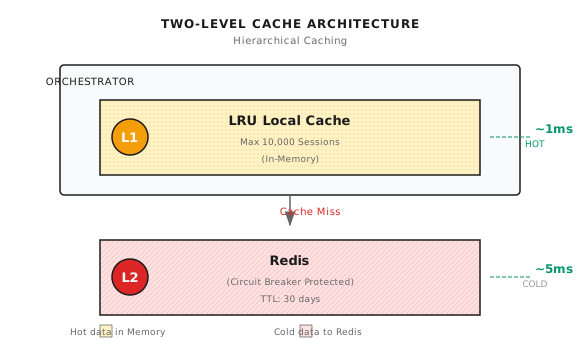
Local cache hits are at the 1ms level, Redis at the 5ms level. Hot data stays in memory, cold data falls back to Redis.
Session Structure
Shannon's Session structure:
type Session struct {
    ID        string
    UserID    string
    TenantID  string                    // Multi-tenant isolation
    CreatedAt time.Time
    UpdatedAt time.Time
    ExpiresAt time.Time                 // TTL expiration
    History   []Message                 // Message history
    Context   map[string]interface{}    // Session variables (title, preferences, etc.)
    Metadata  map[string]interface{}    // Metadata

    // Cost tracking
    TotalTokensUsed int
    TotalCostUSD    float64
}

type Message struct {
    ID        string
    Role      string     // "user", "assistant", "system"
    Content   string
    Timestamp time.Time
    TokensUsed int
}
A few key fields:
- TenantID: Multi-tenant isolation, different tenants' sessions cannot access each other
- ExpiresAt: TTL expiration mechanism, auto-cleanup after 30 days idle
- TotalTokensUsed: Cost tracking, supports budget control
Tenant Isolation
This is easy to overlook but extremely important:
func (m *Manager) GetSession(ctx context.Context, sessionID string) (*Session, error) {
    session := m.loadFromCache(sessionID)

    // Tenant isolation check
    userCtx := authFromContext(ctx)
    if userCtx.TenantID != "" && session.TenantID != userCtx.TenantID {
        // Don't leak that Session exists
        return nil, ErrSessionNotFound  // Note: not ErrUnauthorized
    }

    return session, nil
}
Why return ErrSessionNotFound instead of ErrUnauthorized?
Security principle: don't leak information.
If you return ErrUnauthorized, an attacker knows "this Session ID exists, I just don't have permission." They can slowly enumerate, find valid Session IDs, then try other attacks.
Returning ErrSessionNotFound means attackers can't distinguish between "doesn't exist" and "no permission."
Hijacking Prevention
The Session ID passed by the user might belong to someone else:
func (m *Manager) CreateSessionWithID(ctx context.Context, sessionID, userID string) (*Session, error) {
    // Check if it already exists
    existing, _ := m.GetSession(ctx, sessionID)
    if existing != nil {
        if existing.UserID != userID {
            // Session exists but belongs to someone else—possible hijacking attempt
            m.logger.Warn("Attempted session hijacking",
                zap.String("session_id", sessionID),
                zap.String("attacker", userID),
                zap.String("owner", existing.UserID),
            )
            // Generate new ID, don't reuse
            return m.CreateSession(ctx, userID, "", nil)
        }
        // Same user, return existing
        return existing, nil
    }
    // Doesn't exist, create normally
    return m.createNewSession(sessionID, userID)
}
Scenario: An attacker guesses a Session ID and tries to impersonate that user. The system detects the mismatch, refuses to reuse it, and generates a new ID.
9.3 Message History Management
Sliding Window
Conversations might have hundreds of rounds. Can't store everything, need to set a limit:
func (m *Manager) AddMessage(ctx context.Context, sessionID string, msg Message) error {
    session, _ := m.GetSession(ctx, sessionID)
    session.History = append(session.History, msg)

    // Sliding window trim
    if len(session.History) > m.maxHistory {
        session.History = session.History[len(session.History)-m.maxHistory:]
    }

    return m.UpdateSession(ctx, session)
}
maxHistory is typically set to 500. When exceeded, the oldest messages are trimmed.
Why 500?
- Too small (e.g., 50): History too short, not enough context
- Too large (e.g., 5000): Redis storage pressure, slow loading each time
500 is a balance point. Normal conversations don't exceed 500 rounds.
Token Budget Filling
Even within maxHistory, you might exceed the token budget. Fill from most recent backward, stop when full:
func (s *Session) GetHistoryWithinBudget(maxTokens int) []Message {
    result := []Message{}
    currentTokens := 0

    // Start from most recent messages
    for i := len(s.History) - 1; i >= 0; i-- {
        msg := s.History[i]
        msgTokens := estimateTokens(msg.Content)

        if currentTokens + msgTokens > maxTokens {
            break  // Budget exhausted
        }

        // Prepend to maintain order
        result = append([]Message{msg}, result...)
        currentTokens += msgTokens
    }

    return result
}
This ensures:
- Most recent messages are prioritized
- Doesn't exceed token budget
- Message order is correct
9.4 PII Redaction
This is an easily overlooked but extremely important issue.
Problem Scenario
User input: "My credit card number is 4532-1234-5678-9012"
    │
    ▼
[LLM compresses to summary]
    │
    ▼
Summary: "User queried balance of credit card 4532-1234-5678-9012"
    │
    ▼
[Stored in vector database, permanently saved]
    │
    ▼
[May be retrieved in subsequent conversations]
    │
    ▼
[Leaked to other users or logging systems]
The credit card number was permanently stored. This is a serious privacy breach.
Solution: Redact Before Storage
Shannon does PII redaction in two places:
- During compression summaries
- During storage to vector database
func redactPII(s string) string {
    if s == "" {
        return s
    }

    // Email
    emailRe := regexp.MustCompile(`(?i)[a-z0-9._%+\-]+@[a-z0-9.\-]+\.[a-z]{2,}`)
    s = emailRe.ReplaceAllString(s, "[REDACTED_EMAIL]")

    // Phone
    phoneRe := regexp.MustCompile(`(?i)(\+?\d[\d\s\-()]{8,}\d)`)
    s = phoneRe.ReplaceAllString(s, "[REDACTED_PHONE]")

    // SSN
    ssnRe := regexp.MustCompile(`\b\d{3}-\d{2}-\d{4}\b`)
    s = ssnRe.ReplaceAllString(s, "[REDACTED_SSN]")

    // Credit card
    ccRe := regexp.MustCompile(`\b(?:\d{4}[-\s]?){3}\d{4}\b`)
    s = ccRe.ReplaceAllString(s, "[REDACTED_CC]")

    // IP address
    ipRe := regexp.MustCompile(`\b(?:\d{1,3}\.){3}\d{1,3}\b`)
    s = ipRe.ReplaceAllString(s, "[REDACTED_IP]")

    // API Key
    apiKeyRe := regexp.MustCompile(`(?i)(api[_-]?key|token)[\s:=]+[\w-]{20,}`)
    s = apiKeyRe.ReplaceAllString(s, "[REDACTED_API_KEY]")

    // Password
    secretRe := regexp.MustCompile(`(?i)(password|secret|pwd)[\s:=]+\S{8,}`)
    s = secretRe.ReplaceAllString(s, "[REDACTED_SECRET]")

    return s
}
PII Types Covered
| Type | Example | Replaced With |
|---|---|---|
user@example.com | [REDACTED_EMAIL] | |
| Phone | +1-234-567-8900 | [REDACTED_PHONE] |
| Credit card | 4532-1234-5678-9012 | [REDACTED_CC] |
| SSN | 123-45-6789 | [REDACTED_SSN] |
| IP | 192.168.1.1 | [REDACTED_IP] |
| API Key | api_key=sk-xxx | [REDACTED_API_KEY] |
| Password | password=abc123 | [REDACTED_SECRET] |
Limitations
Regex redaction isn't perfect:
- False positives:
192.168.1.1might be a constant in code, not a real IP - False negatives: Complex PII formats might be missed
- Context loss: Redaction might affect LLM understanding
Production recommendations:
- Regex as the basic defense line
- Use professional PII detection services for sensitive scenarios (like AWS Comprehend, Google DLP)
- Regularly audit stored content
9.5 Session Title Generation
When users come back looking for previous conversations, seeing a bunch of "Session 1" "Session 2" makes identification impossible.
Need to auto-generate meaningful titles.
LLM Generation
Shannon uses LLM to generate titles:
func (a *Activities) generateTitleWithLLM(ctx context.Context, query string) (string, error) {
    prompt := fmt.Sprintf(`Generate a chat session title from this user query.

Rules:
- Use the SAME LANGUAGE as the user's query
- For English: 3-5 words, Title Case
- For Chinese/Japanese/Korean: 5-15 characters
- No quotes, no trailing punctuation, no emojis

Query: %s`, query)

    result, err := llmCall(prompt)
    if err != nil {
        return "", err
    }

    // Clean up result
    title := strings.TrimSpace(result)
    title = strings.Trim(title, `"'`)

    return title, nil
}
Idempotency
Important: only generate once, don't regenerate repeatedly.
func GenerateSessionTitle(ctx context.Context, sessionID, query string) (string, error) {
    // 1. Idempotency check
    sess := getSession(sessionID)
    if title := sess.Context["title"]; title != "" {
        return title, nil  // Already has title, skip
    }

    // 2. LLM generation
    title, err := generateTitleWithLLM(ctx, query)
    if err != nil {
        // 3. Fallback: truncate original query
        title = truncateQuery(query, 40)
    }

    // 4. Length limit (note UTF-8)
    titleRunes := []rune(title)
    if len(titleRunes) > 60 {
        title = string(titleRunes[:57]) + "..."
    }

    // 5. Save
    updateContext(sessionID, "title", title)
    return title, nil
}
Fallback Strategy
LLM calls might fail (timeout, API rate limit). Fallback is to truncate the original query:
func truncateQuery(query string, maxLen int) string {
    // Take first line
    if idx := strings.Index(query, "\n"); idx > 0 {
        query = query[:idx]
    }

    // Truncate by character (not bytes, to avoid breaking UTF-8)
    runes := []rune(query)
    if len(runes) > maxLen {
        // Try to truncate at word boundary
        truncated := string(runes[:maxLen])
        if lastSpace := strings.LastIndex(truncated, " "); lastSpace > maxLen/2 {
            truncated = truncated[:lastSpace]
        }
        return truncated + "..."
    }
    return query
}
Why use []rune instead of truncating string directly?
Go's string is a UTF-8 encoded byte sequence. A Chinese character takes 3 bytes. Truncating by bytes might cut in the middle of a Chinese character, producing garbled text.
// Wrong: truncate by bytes
s := "Hello World"
s[:3]  // "Hel" - fine for English

s := "你好世界"
s[:3]  // Might be garbled

// Correct: truncate by rune
runes := []rune("你好世界")
string(runes[:2])  // "你好"
9.6 Semantic Deduplication (MMR)
The last chapter covered semantic retrieval. But there's a problem: returned results might be highly repetitive.
Query: "How to configure Kubernetes networking?"

Retrieved results:
1. [0.95] K8s network configuration requires setting up CNI first...
2. [0.94] Kubernetes networking is configured through CNI plugins...
3. [0.93] To configure K8s networking, first choose a CNI...
4. [0.92] K8s networking depends on CNI configuration...
5. [0.85] Service Mesh can enhance network functionality...
The first 4 are saying the same thing, wasting tokens.
MMR Algorithm
MMR (Maximal Marginal Relevance) balances relevance and diversity:
MMR(d) = lambda * Sim(d, query) - (1-lambda) * max(Sim(d, d_i))

Where:
- Sim(d, query): similarity between document d and query
- max(Sim(d, d_i)): maximum similarity between document d and already selected documents
- lambda: weight parameter
  - 0.7: Favor relevance (default)
  - 0.5: Balanced
  - 0.3: Favor diversity
Implementation
func mmrReorder(queryVec []float32, items []SearchResult, topK int, lambda float64) []SearchResult {
    if len(items) <= topK {
        return items
    }

    selected := []int{}
    remaining := make(map[int]bool)
    for i := range items {
        remaining[i] = true
    }

    // Greedy selection
    for len(selected) < topK && len(remaining) > 0 {
        bestIdx := -1
        bestScore := -1e9

        for i := range remaining {
            // Relevance to query
            relevance := cosineSim(queryVec, items[i].Vector)

            // Maximum similarity to already selected results (penalty term)
            maxSim := 0.0
            for _, s := range selected {
                sim := cosineSim(items[i].Vector, items[s].Vector)
                if sim > maxSim {
                    maxSim = sim
                }
            }

            // MMR formula
            score := lambda*relevance - (1-lambda)*maxSim

            if score > bestScore {
                bestScore = score
                bestIdx = i
            }
        }

        if bestIdx >= 0 {
            selected = append(selected, bestIdx)
            delete(remaining, bestIdx)
        }
    }

    // Rebuild results
    result := make([]SearchResult, len(selected))
    for i, idx := range selected {
        result[i] = items[idx]
    }
    return result
}
Usage
// Need 5 results, first get 15 (3x)
candidates := vdb.Search(query, 15)
// MMR rerank
results := mmrReorder(queryVec, candidates, 5, 0.7)
Effect
After deduplication:
1. [0.95] K8s network configuration requires setting up CNI first...
2. [0.85] Service Mesh can enhance network functionality...
3. [0.80] NetworkPolicy is used for security isolation...
Fewer results, higher information density.
9.7 Circuit Breaker
What happens if Redis goes down? Can't let the entire service go down.
Problem
User request → Read Session → Redis timeout (5s) → User waits → Failure
User request → Read Session → Redis timeout (5s) → User waits → Failure
...
If Redis is down, every request has to wait 5 seconds for timeout, terrible user experience.
Solution: Circuit Breaker
type CircuitBreaker struct {
    failureCount    int
    lastFailure     time.Time
    state           State  // Closed, Open, HalfOpen
    failureThreshold int   // 5
    resetTimeout    time.Duration  // 30s
}

func (cb *CircuitBreaker) Execute(fn func() error) error {
    switch cb.state {
    case Open:
        // Circuit open, reject directly
        if time.Since(cb.lastFailure) > cb.resetTimeout {
            cb.state = HalfOpen  // Try to recover
        } else {
            return ErrCircuitOpen
        }
    case HalfOpen:
        // Half-open state, try once
        err := fn()
        if err != nil {
            cb.state = Open  // Still failing, keep open
            return err
        }
        cb.state = Closed  // Success, recover
        cb.failureCount = 0
        return nil
    }

    // Closed state, execute normally
    err := fn()
    if err != nil {
        cb.failureCount++
        cb.lastFailure = time.Now()
        if cb.failureCount >= cb.failureThreshold {
            cb.state = Open  // Too many failures, open
        }
    }
    return err
}
Shannon's Redis client wraps a Circuit Breaker:
client := circuitbreaker.NewRedisWrapper(redisClient, logger)Fallback Strategy
When Circuit Breaker opens, fall back to local cache:
func (m *Manager) GetSession(ctx context.Context, sessionID string) (*Session, error) {
    // Check local cache first
    if session, ok := m.localCache[sessionID]; ok {
        return session, nil
    }

    // Query Redis (with Circuit Breaker)
    session, err := m.client.GetSession(ctx, sessionID)
    if err == ErrCircuitOpen {
        // Redis circuit open, return empty session (new user experience)
        m.logger.Warn("Redis circuit open, creating new session")
        return m.createLocalSession(sessionID)
    }

    return session, err
}
9.8 Common Pitfalls
Pitfall 1: Session ID Collision
// Incrementing ID, easy collision (especially in distributed environments)
sessionID := fmt.Sprintf("session_%d", counter)

// UUID (recommended)
sessionID := uuid.New().String()
Pitfall 2: UTF-8 Truncation
// Truncate by bytes, might break Chinese characters
if len(title) > 50 {
    title = title[:50]  // Might be garbled
}

// Truncate by rune (correct)
runes := []rune(title)
if len(runes) > 50 {
    title = string(runes[:47]) + "..."
}
Pitfall 3: Missing Tenant Isolation
// Return directly (unsafe)
return session, nil

// Check tenant isolation
if session.TenantID != userCtx.TenantID {
    return nil, ErrSessionNotFound  // Not ErrUnauthorized
}
Pitfall 4: Incomplete PII Redaction
Only handling Email isn't enough. Need to cover phone, credit card, SSN, IP, API Key, password, etc.
Pitfall 5: Semantic Retrieval Without Deduplication
Directly using top-k results might produce a bunch of duplicates. Use MMR reranking.
Pitfall 6: Service Down When Redis Down
No Circuit Breaker means Redis timeout drags down all requests.
Pitfall 7: Repeated Title Generation
Calling LLM to generate title on every request wastes money. Need idempotency check.
Shannon Lab (10-Minute Quick Start)
This section helps you map this chapter's concepts to Shannon source code in 10 minutes.
Required Reading (1 file)
session/manager.go: Look atGetSession,CreateSessionWithID,AddMessagefunctions to understand tenant isolation, hijacking prevention, and sliding window
Optional Deep Dive (2 files, choose based on interest)
activities/context_compress.go: Look at theredactPIIfunction to understand specific PII redaction implementationactivities/session_title.go: Look at theGenerateSessionTitlefunction to understand title generation idempotency and fallback strategy
Exercises
Exercise 1: Design Session Structure
You're building an e-commerce customer service Agent that needs to support:
- Multi-round product inquiries
- Order status queries
- Complaint handling
Design your Session structure:
- What fields need to be stored?
- How to do tenant isolation?
- How to handle sensitive information (order numbers, addresses)?
Exercise 2: Source Code Reading
Read session/manager.go and answer:
- What cache eviction strategy does the
cleanupLocalCachefunction use? - Why does
CreateSessionWithIDcheckexisting.UserID != userID? - Where is the Circuit Breaker wrapped?
Exercise 3 (Advanced): Implement PII Detection
Extend the redactPII function to add detection for:
- Chinese ID numbers (18 digits)
- Bank card numbers (16-19 digits)
- Passport numbers
Think about:
- How to avoid false positives (treating normal numbers as PII)?
- How to handle format variants (with spaces, with hyphens)?
Key Takeaways
The core message: Multi-turn conversations require managing state well, controlling length, protecting privacy, and deduplicating properly.
Key points:
- Two-Level Cache: LRU local cache + Redis persistence
- Tenant Isolation: Return
ErrSessionNotFoundinstead ofErrUnauthorized - PII Redaction: Clean sensitive information before storage
- Title Generation: LLM generation + idempotency check + fallback truncation
- MMR Deduplication: lambda=0.7 balances relevance and diversity
That concludes Part 3 (Context and Memory).
We covered:
- Chapter 7: Context Window Management—"short-term memory" within a single conversation
- Chapter 8: Memory Architecture—"long-term memory" across sessions
- Chapter 9: Multi-Turn Conversation Design—implementing them in production environments
Through these three chapters, you should understand how a production-grade Agent "remembers things."
Next chapter enters Part 4 (Single Agent Patterns), starting with Planning—how Agents decompose complex tasks into executable steps.
From "remembering things" to "doing things"—this is the key capability leap for Agents.
Further Reading
- Redis Data Types - Redis data structures
- Circuit Breaker Pattern - Martin Fowler's classic article
- MMR Paper - Original MMR paper
- GDPR PII Categories - GDPR definition of personal data
- Shannon Session Management - Shannon Session management implementation