Chapter 24: Policy Governance (OPA)
OPA takes Agent system access control from hardcoded to declarative—policy updates don't require redeploying code, but it's not omnipotent; real security comes from defense in depth.
Quick Path (5 minutes to grasp the core)
- OPA extracts security rules from code, change policies without redeployment
- Default deny + deny takes priority: Unmatched requests are denied, deny rules have highest priority
- Canary release: First dry-run to observe, then gradually enforce by percentage
- Cache decision results, note cache key must include all fields affecting the decision
- FailOpen is more suitable for production than FailClosed (combined with alerting)
10-minute path: 24.1-24.3 -> 24.6 -> Shannon Lab
Your Agent system needs a new rule: "Block queries containing 'password'."
How to do it? Modify code, add an if strings.Contains(req.Query, "password"), then deploy.
A week later, security team wants ten more rules. Modify code again, deploy again.
A month later, code is full of if-else everywhere, no one can explain "why this request was rejected". Every rule change needs the full CI/CD process, urgent security fixes take 2 hours to go live.
The most extreme case I've seen: A system had 200+ security checkpoints scattered across 30+ files. A new engineer wanted to add one rule, took three days just to find all the places that needed changing.
This is the predicament of hardcoded policies.
24.1 Why Do We Need a Policy Engine?
The Predicament of Hardcoding
Comparing hardcoded vs OPA declarative policies:
// ========== Traditional Approach: Hardcoded Security Checks ==========
func SubmitTask(ctx context.Context, req *TaskRequest) error {
    if strings.Contains(req.Query, "password") { return errors.New("forbidden") }
    if req.TokenBudget > 10000 { return errors.New("budget too high") }
    if req.UserID == "blocked_user" { return errors.New("user blocked") }
    // More if-else... 50 lines later you've forgotten why you're checking
}
# ========== OPA Approach: Declarative Policy File ==========
package shannon.task
deny["dangerous pattern"] { contains(lower(input.query), "password") }
deny["budget too high"] { input.token_budget > 10000 }
deny["user blocked"] { blocked_users[input.user_id] }| Comparison | Hardcoded | OPA |
|---|---|---|
| Policy Changes | Modify code -> Test -> Deploy | Modify .rego -> Hot reload |
| Rule Location | Scattered everywhere | Centralized in policies/ |
| Audit Trail | None | Every decision logged |
| Release Method | Full rollout | Supports canary/Dry-run |
| Version Management | None | Hash versioned |
24.2 OPA Integration Architecture
Policy Execution Flow
In Shannon, OPA serves as an independent policy engine, evaluating requests before they enter the Workflow:
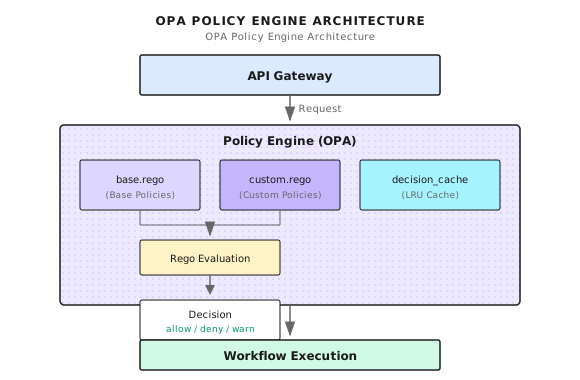
Core Components
| Component | Responsibility |
|---|---|
| OPAEngine | Main entry for policy loading, compilation, evaluation |
| PolicyInput | Context data for evaluation (user, query, budget, etc.) |
| Decision | Evaluation result (allow/deny + reason) |
| base.rego | Base security policies (default deny, deny priority) |
24.3 OPAEngine Implementation
Engine Interface
Shannon's OPA Engine design references go/orchestrator/internal/policy/ directory:
type Engine interface {
    Evaluate(ctx context.Context, input *PolicyInput) (*Decision, error)
    LoadPolicies() error
    IsEnabled() bool
    Environment() string
    Mode() Mode
}
Behind the simple interface are several key design decisions:
- Pre-compilation: Policies compiled at startup, directly executed during evaluation
- Caching: Decision results for same input are cached
- Mode switching: Supports off/dry-run/enforce three modes
Core Data Structures
// ========== PolicyInput: Evaluation Context ==========
type PolicyInput struct {
    SessionID   string    `json:"session_id"`        // Session identifier
    UserID      string    `json:"user_id"`           // User identifier
    AgentID     string    `json:"agent_id"`          // Agent identifier
    Query       string    `json:"query"`             // Request content
    Mode        string    `json:"mode"`              // simple/standard/complex
    Environment string    `json:"environment"`       // dev/staging/prod (key: differentiate environment strictness)
    TokenBudget int       `json:"token_budget"`      // Budget limit
    Timestamp   time.Time `json:"timestamp"`
}

// ========== Decision: Evaluation Result ==========
type Decision struct {
    Allow           bool              `json:"allow"`            // Whether allowed
    Reason          string            `json:"reason"`           // Decision reason
    RequireApproval bool              `json:"require_approval"` // Needs human confirmation (allow but confirm)
    PolicyVersion   string            `json:"policy_version"`   // Policy version hash (for audit)
    AuditTags       map[string]string `json:"audit_tags"`       // Audit tags
}
The Environment field lets you write policies like "loose in development, strict in production". RequireApproval supports "allowed but needs human confirmation" scenarios.
24.4 Policy Loading and Compilation
The following code shows the core policy loading flow, referencing Shannon's implementation:
func (e *OPAEngine) LoadPolicies() error {
    if !e.config.Enabled {
        return nil
    }

    policies := make(map[string]string)

    // Recursively load all .rego files
    err := filepath.Walk(e.config.Path, func(path string, info os.FileInfo, err error) error {
        if err != nil {
            return err
        }

        if !info.IsDir() && strings.HasSuffix(info.Name(), ".rego") {
            content, err := os.ReadFile(path)
            if err != nil {
                return fmt.Errorf("failed to read policy file %s: %w", path, err)
            }

            relPath, _ := filepath.Rel(e.config.Path, path)
            moduleName := strings.TrimSuffix(relPath, ".rego")
            policies[moduleName] = string(content)

            e.logger.Debug("Loaded policy file",
                zap.String("path", path),
                zap.String("module", moduleName),
            )
        }
        return nil
    })

    if err != nil {
        return fmt.Errorf("failed to walk policy directory: %w", err)
    }

    // Pre-compile policies
    regoOptions := []func(*rego.Rego){
        rego.Query("data.shannon.task.decision"),
    }

    for moduleName, content := range policies {
        regoOptions = append(regoOptions, rego.Module(moduleName, content))
    }

    regoBuilder := rego.New(regoOptions...)
    compiled, err := regoBuilder.PrepareForEval(context.Background())
    if err != nil {
        return fmt.Errorf("failed to compile policies: %w", err)
    }

    e.compiled = &compiled

    // Record policy version for audit
    versionHash := e.calculatePolicyVersion(policies)
    RecordPolicyVersion(e.config.Path, versionHash, loadTimestamp)

    return nil
}
Key design points:
- Recursive loading: Supports subdirectories under policies/, convenient for organizing policies by domain
- Pre-compilation: Uses
PrepareForEvalinstead of compiling on every evaluation, 10x+ performance improvement - Version tracking: Calculates hash of policy content, convenient for auditing "which version of policy was used for this decision"
24.5 Policy Evaluation Flow
The evaluation flow is the core of the OPA Engine, below shows the complete evaluation logic:
func (e *OPAEngine) Evaluate(ctx context.Context, input *PolicyInput) (*Decision, error) {
    startTime := time.Now()

    defaultDecision := &Decision{
        Allow:  !e.config.FailClosed,
        Reason: "policy engine disabled or no policies loaded",
    }

    if !e.enabled || e.compiled == nil {
        return defaultDecision, nil
    }

    // Check cache first
    if d, ok := e.cache.Get(input); ok {
        RecordCacheHit(string(e.config.Mode))
        return d, nil
    }

    RecordCacheMiss(string(e.config.Mode))

    // Convert input to map
    inputMap, err := e.inputToMap(input)
    if err != nil {
        if e.config.FailClosed {
            return &Decision{Allow: false, Reason: "input conversion failed"}, err
        }
        return defaultDecision, nil
    }

    // Evaluate policy
    results, err := e.compiled.Eval(ctx, rego.EvalInput(inputMap))
    if err != nil {
        RecordError("policy_evaluation", string(e.config.Mode))
        if e.config.FailClosed {
            return &Decision{Allow: false, Reason: "policy evaluation error"}, err
        }
        return defaultDecision, nil
    }

    // Parse results
    decision := e.parseResults(results, input)

    // Apply canary mode
    effectiveMode := e.determineEffectiveMode(input)
    decision = e.applyModeToDecision(decision, effectiveMode, input)

    // Record metrics and audit log
    duration := time.Since(startTime)
    e.recordComprehensiveMetrics(input, decision, effectiveMode, duration)

    // Write to cache
    e.cache.Set(input, decision)
    return decision, nil
}
There's a key concept here: FailClosed vs FailOpen.
| Mode | Behavior When OPA Errors | Use Case |
|---|---|---|
| FailClosed | Reject request | Security-sensitive systems |
| FailOpen | Allow request | Availability-priority systems |
For production I recommend FailOpen + alerting, rather than FailClosed. The reason: Policy engine being down causing entire system unavailability is worse than letting through a few requests. Of course, this depends on your business scenario.
Decision Cache
Decision results for same input should be cached. Key is designing the cache key well:
type decisionCache struct {
    cap    int
    ttl    time.Duration
    mu     sync.Mutex
    list   *list.List
    m      map[string]*list.Element
    hits   int64
    misses int64
}

func (c *decisionCache) makeKey(input *PolicyInput) string {
    h := fnv.New64a()
    h.Write([]byte(strings.ToLower(input.Query)))
    qh := h.Sum64()
    comp := fmt.Sprintf("%.2f", input.ComplexityScore)
    return fmt.Sprintf("%s|%s|%s|%s|%d|%s|%x",
        input.Environment, input.Mode, input.UserID,
        input.AgentID, input.TokenBudget, comp, qh,
    )
}
Cache key design considerations:
- Include environment: Same request in dev and prod may have different decisions
- Hash the query: Avoid key being too long
- Keep 2 decimal places for complexity: Reduce key changes due to floating point precision
24.6 Writing Rego Policies
Shannon's base policy references config/opa/policies/base.rego. Core design principle: default deny, deny takes priority.
Basic Structure and Environment Differentiation
package shannon.task
import future.keywords.in

# ========== Default Deny (Most Important) ==========
default decision := {"allow": false, "reason": "default deny - no matching rule"}

# Deny rules take priority over all allow rules
decision := {"allow": false, "reason": reason} { some reason; deny[reason] }

# ========== Environment Differentiation ==========
# Development environment: Loose (but still has budget limits)
decision := {"allow": true, "reason": "dev environment"} {
    input.environment == "dev"
    input.token_budget <= 10000
}
# Production environment: Strict (requires user whitelist + no suspicious queries)
decision := {"allow": true, "reason": "authorized user"} {
    input.environment == "prod"
    allowed_users[input.user_id]
    input.token_budget <= 5000
    not suspicious_query
}
Why default deny? Default allow means you must foresee all dangerous situations; default deny only needs to list known safe situations, unknown situations are automatically denied.
User Management and Query Pattern Matching
# ========== User Whitelist/Blacklist ==========
allowed_users := {"admin", "orchestrator", "shannon_system", "api_user"}
privileged_users := {"admin", "shannon_system", "security_admin"}
blocked_users := {"blocked_user", "suspended_account"}

# ========== Query Pattern Levels ==========
safe_patterns := {"what is", "how to", "explain", "summarize"}  # Safe
suspicious_patterns := {"delete", "hack", "bypass", "admin", "sudo"}  # Suspicious
dangerous_patterns := {"rm -rf", "drop table", "/etc/passwd", "api key"}  # Dangerous

suspicious_query { count([p | suspicious_patterns[p]; contains(lower(input.query), p)]) > 0 }
dangerous_query { count([p | dangerous_patterns[p]; contains(lower(input.query), p)]) > 0 }
Deny Rules (Highest Priority)
# Dangerous query patterns
deny[sprintf("dangerous: %s", [p])] { dangerous_patterns[p]; contains(lower(input.query), p) }
# Exceeds budget limit
deny[sprintf("budget %d exceeds max %d", [input.token_budget, 50000])] { input.token_budget > 50000 }
# Blocked user
deny[sprintf("user %s blocked", [input.user_id])] { blocked_users[input.user_id] }
# Unauthorized user in production
deny["unauthorized user in prod"] {
    input.environment == "prod"; input.user_id != ""
    not allowed_users[input.user_id]; not privileged_users[input.user_id]
}
Budget Limits
max_budgets := {"simple": 1000, "standard": 5000, "complex": 15000}
system_limits := {"max_tokens": 50000, "max_concurrent_requests": 20}

decision := {"allow": false, "reason": sprintf("budget %d exceeds max %d for %s",
    [input.token_budget, max_budgets[input.mode], input.mode])} {
    max_budgets[input.mode] < input.token_budget
}
24.7 Execution Modes and Canary Release
One of OPA's most valuable features: Safely releasing new policies.
| Mode | Policy Evaluation | Actual Blocking | Log Recording | Purpose |
|---|---|---|---|---|
| off | No | No | No | Maintenance mode |
| dry-run | Yes | No | Yes | Testing new policies |
| enforce | Yes | Yes | Yes | Official execution |
Mode and Canary Configuration
// ========== Execution Modes ==========
type Mode string
const (
    ModeOff     Mode = "off"      // Policy disabled
    ModeDryRun  Mode = "dry-run"  // Log only, don't execute
    ModeEnforce Mode = "enforce"  // Enforce
)

// ========== Canary Configuration ==========
type CanaryConfig struct {
    Enabled           bool     `yaml:"enabled"`
    EnforcePercentage int      `yaml:"enforce_percentage"` // 0-100%
    EnforceUsers      []string `yaml:"enforce_users"`      // Whitelist users
    DryRunUsers       []string `yaml:"dry_run_users"`      // Force dry-run users
}

// ========== Determine Effective Mode (Priority: Emergency Switch > Explicit User > Percentage) ==========
func (e *OPAEngine) determineEffectiveMode(input *PolicyInput) Mode {
    if e.config.EmergencyKillSwitch { return ModeDryRun }  // Emergency switch overrides everything
    if !e.config.Canary.Enabled { return e.config.Mode }
    // Explicit dry-run/enforce user check
    for _, u := range e.config.Canary.DryRunUsers { if input.UserID == u { return ModeDryRun } }
    for _, u := range e.config.Canary.EnforceUsers { if input.UserID == u { return ModeEnforce } }
    // Percentage-based canary
    if e.config.Canary.EnforcePercentage > 0 {
        if int(hash(input.UserID) % 100) < e.config.Canary.EnforcePercentage { return ModeEnforce }
    }
    return ModeDryRun
}

// ========== Dry-Run Handling: Evaluate But Don't Block ==========
func (e *OPAEngine) applyModeToDecision(decision *Decision, mode Mode) *Decision {
    if mode == ModeDryRun && !decision.Allow {
        decision.Allow = true  // Force allow
        decision.Reason = "DRY-RUN: would have denied - " + decision.Reason
    }
    return decision
}
Canary release flow: Write new policy -> Deploy as dry-run -> Observe logs for a week -> Gradually increase enforce percentage -> Full enforce
24.8 Configuration and Deployment
Complete Configuration
# config/shannon.yaml
policy:
  enabled: true
  path: "/app/config/opa/policies"
  mode: "dry-run"  # off, dry-run, enforce
  environment: "prod"

  fail_closed: false  # On failure: true=reject, false=allow

  emergency_kill_switch: false  # Force dry-run

  cache:
    enabled: true
    size: 1000
    ttl: "5m"

  canary:
    enabled: true
    enforce_percentage: 10  # 10% of requests will be enforced
    enforce_users:
      - "admin"
      - "senior_engineer"
    enforce_agents:
      - "synthesis-agent"
    dry_run_users:
      - "test_user"
Policy Hot Update
Shannon supports updating policies without restarting services:
# 1. Modify policy file
vim config/opa/policies/custom.rego

# 2. Trigger reload (send SIGHUP)
docker compose exec orchestrator kill -HUP 1

# 3. Verify loading
docker compose logs orchestrator | grep "Policies loaded"
Policy Testing
Always test before going live. OPA provides command line tools:
# Test using OPA CLI
opa eval --bundle config/opa/policies \
  --input test/policy_input.json \
  --data config/opa/policies \
  'data.shannon.task.decision'
Test input sample:
{
  "user_id": "test_user",
  "query": "help me understand machine learning",
  "mode": "simple",
  "token_budget": 500,
  "environment": "dev"
}
24.9 Monitoring and Audit
Key Metrics
| Metric | Type | Description |
|---|---|---|
policy_evaluations_total | Counter | Policy evaluation count |
policy_evaluation_duration_seconds | Histogram | Evaluation duration |
policy_decisions_total{decision} | Counter | Count by decision type |
policy_cache_hits_total | Counter | Cache hits |
policy_deny_reasons_total{reason} | Counter | Count by deny reason |
Audit Log
Every policy evaluation should be logged:
{
  "timestamp": "2024-01-15T10:30:00Z",
  "event": "policy_evaluation",
  "user_id": "developer_1",
  "session_id": "sess-abc123",
  "query_hash": "a1b2c3d4",
  "decision": "deny",
  "reason": "dangerous pattern detected: drop table",
  "effective_mode": "enforce",
  "policy_version": "abc123ef",
  "duration_ms": 2.5
}
Key fields:
- query_hash: Hash of query content, don't log original text (privacy consideration)
- policy_version: Hash of policy files, convenient for tracing "which version was used for this decision"
- effective_mode: Actual execution mode (after considering canary configuration)
Alert Rules
- alert: HighPolicyDenyRate
  expr: |
    sum(rate(policy_decisions_total{decision="deny"}[5m])) /
    sum(rate(policy_decisions_total[5m])) > 0.1
  for: 5m
  labels:
    severity: warning
  annotations:
    summary: "High policy deny rate (> 10%)"

- alert: PolicyEvaluationSlow
  expr: histogram_quantile(0.95, policy_evaluation_duration_seconds) > 0.05
  for: 5m
  labels:
    severity: warning
  annotations:
    summary: "Policy evaluation P95 latency > 50ms"
24.10 Common Pitfalls
| Pitfall | Problem | Solution |
|---|---|---|
| Forgetting Default Deny | Unmatched rules return undefined (interpreted as allow) | Explicitly define default decision |
| Deny Priority | Allow rules might bypass deny | Use deny set + count(deny)==0 check |
| Incomplete Cache Key | Field changes return wrong cached result | Include all fields affecting decision |
| Ignoring Compile Errors | Policy syntax errors cause undefined behavior | Explicitly handle errors, decide fail-open/closed |
# ========== Pitfall 1: Forgetting Default Deny ==========
decision := {"allow": true} { input.mode == "simple" }  # Wrong: no default
default decision := {"allow": false, "reason": "no match"}  # Correct

# ========== Pitfall 2: Deny Priority ==========
decision := {"allow": true} { ... }                        # Wrong: might bypass deny
decision := {"allow": false} { dangerous_query }
# Correct: deny set checked first
deny["dangerous"] { dangerous_query }
decision := {"allow": false, "reason": r} { some r; deny[r] }
decision := {"allow": true, ...} { count(deny) == 0; ... }
// ========== Pitfall 3: Incomplete Cache Key ==========
return fmt.Sprintf("%s|%s", input.UserID, input.Mode) // Wrong: missing Environment etc.
return fmt.Sprintf("%s|%s|%s|%s|%d|%s", // Correct: include all decision-affecting fields
input.Environment, input.Mode, input.UserID, input.AgentID, input.TokenBudget, queryHash)
// ========== Pitfall 4: Ignoring Compile Errors ==========
compiled, _ := regoBuilder.PrepareForEval(ctx) // Wrong: ignoring error
compiled, err := regoBuilder.PrepareForEval(ctx) // Correct: explicit handling
if err != nil {
if failClosed { return nil, err } // FailClosed: reject all
e.enabled = false // FailOpen: disable policy engine
}24.11 Framework Comparison
OPA isn't the only policy engine. How do other frameworks handle access control?
| Framework | Policy Mechanism | Hot Update | Canary Release | Audit Log |
|---|---|---|---|---|
| Shannon + OPA | Declarative Rego | Supported | Built-in Canary | Complete |
| LangChain | No built-in | N/A | Implement yourself | Implement yourself |
| LangGraph | Callback | Requires restart | Implement yourself | Implement yourself |
| CrewAI | No built-in | N/A | N/A | N/A |
| Kubernetes | OPA Gatekeeper | Supported | Supported | Complete |
OPA's advantage is that it's a general-purpose policy engine, not just designed for Agent systems. You can use the same tech stack to manage Kubernetes admission control, API gateway authorization, microservices access control.
What This Chapter Covered
- Default Deny: Always define
default decisionas deny, safety first - Deny Priority: Use
denyset to implement deny rule priority, avoid bypasses - Canary Release: First dry-run to validate, then canary rollout by percentage
- Decision Cache: LRU cache reduces evaluation overhead, note cache key design
- Complete Audit: Record every decision's reason and policy version
Shannon Lab (10-Minute Quickstart)
This section helps you map this chapter's concepts to Shannon source code in 10 minutes.
Required Reading (1 file)
config/opa/policies/base.rego: See wheredefault decisionis defined to understand "default deny", usage ofdenyset, query pattern matching design withdangerous_patternsset
Optional Deep Dive (pick 2 based on interest)
go/orchestrator/internal/policy/engine.go(if exists): Understand OPA Engine initialization and evaluation flow, seeLoadPoliciesandEvaluatefunctions- OPA Playground (https://play.openpolicyagent.org/): Test Rego policies online, copy base.rego there and test with different inputs
Exercises
Exercise 1: Design a New Policy
Scenario: Product requires "no complex tasks during off-hours (22:00-08:00)". Write the corresponding Rego rule, requirements:
- Use
input.timestampfield - Only affects tasks where
mode == "complex" - Provide clear deny reason
Exercise 2: Source Code Understanding
Read Shannon's config/opa/policies/base.rego:
- If a request matches both
allowed_usersanddangerous_query, will it ultimately be allowed or denied? Why? - What's the purpose of the
safe_query_checkrule? What happens if you delete it?
Exercise 3 (Advanced): Design Canary Release Plan
You wrote a new deny rule and need to roll it out to production. Design a canary release plan including:
- What to do first week (hint: dry-run)
- How to confirm new rule won't false-positive normal requests
- How to rollback if problems occur
Further Reading
- OPA Official Documentation: https://www.openpolicyagent.org/docs - Rego syntax and best practices
- Rego Playground: https://play.openpolicyagent.org/ - Test policies online
- OPA and Kubernetes: https://www.openpolicyagent.org/docs/latest/kubernetes-introduction/ - If you also use K8s, you can reuse the same policy skills
Next Chapter Preview
OPA solved the "who can do what" problem. But there's another question: Is tool execution safe?
An Agent called a Python script. Will this script:
- Read sensitive files?
- Make network requests to leak data?
- Consume lots of CPU/memory dragging down the system?
- Execute malicious code?
These questions, OPA can't handle. You need sandboxing.
Next chapter we'll discuss WASI Sandbox Secure Execution—using WebAssembly to isolate tool execution, preventing malicious code from escaping.
See you in Chapter 25.