AI Quantitative Trading: From Zero to One
Build production-ready quantitative trading systems with multi-agent architecture
Author: Wayland Zhang · Project Homepage: dnalyaw.com · GitHub: ai-quant-book
What's This Book About?
Not a strategy holy grail, but teaching you to build production-ready quant systems. Most quant tutorials stop at API translations, technical indicators, or "magic strategies." Real quant systems answer:
- Where does data come from? Rate limits, missing values, adjustments, timezones
- How not to fool yourself in backtests? Lookahead bias, overfitting, transaction costs
- Why isn't one model enough? Regime changes, signal conflicts, risk diversification
- How to control risk? Stop loss, position sizing, factor exposure, circuit breakers
- How to go to production? Execution slippage, monitoring, disaster recovery
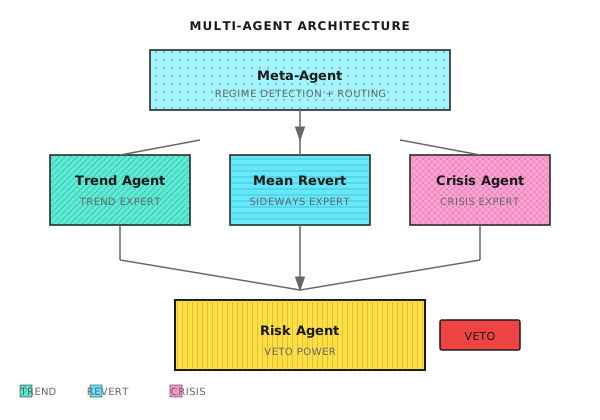
This book uses multi-agent architecture: different agents handle different responsibilities (signals, risk, execution), collaborating to make trading decisions.
Content Overview
The book has 5 parts, 22 lessons:
| Part | Topic | Lessons | Core Content |
|---|---|---|---|
| 1 | Quick Start | 1 | Quant landscape, multi-agent intuition |
| 2 | Fundamentals | 7 | Markets, statistics, strategies, data, backtesting |
| 3 | Machine Learning | 2 | Supervised learning, from models to agents |
| 4 | Multi-Agent | 7 | Architecture, regime detection, LLM, risk control |
| 5 | Production | 5 | Costs, execution, operations, projects |
Plus 30 background articles and 4 appendices
Target Readers
- Developers → Quant: Complete path to build trading systems
- Quant Researchers: Multi-agent architecture, production risk control
- Investors/PMs: Understand quant system capabilities and risks
Prerequisites: Basic programming (Python) required; statistics/finance helpful; ML/DL not needed
⚠️ Risk Disclaimer
Quantitative trading involves risk. Invest carefully.
This book is educational and does not constitute investment advice:
- Strategies are for learning only, no profit guaranteed
- Fully understand risks before live trading
- Never trade with money you can't afford to lose
- Past performance ≠ future results
Table of Contents
Part 1: Quick Start
Establish a global perspective and understand the quantitative world and multi-agent architecture
| Lesson | Title |
|---|---|
| Lesson 01 | The Complete Landscape of Quantitative Trading |
Background Knowledge: Alpha and Beta · US vs China Quant Market Differences · Top Quantitative Hedge Funds · Famous Quantitative Disasters · Recommended Reading List
Part 2: Quant Fundamentals
Build a solid foundation in markets, data, strategies, and backtesting
| Lesson | Title |
|---|---|
| Lesson 02 | Financial Markets and Trading Basics |
| Lesson 03 | Math and Statistics Fundamentals |
| Lesson 04 | The Real Role of Technical Indicators |
| Lesson 05 | Classic Strategy Paradigms |
| Lesson 06 | The Harsh Reality of Data Engineering |
| Lesson 07 | Backtesting System Pitfalls |
| Lesson 08 | Beta, Hedging, and Market Neutrality |
Background Knowledge: Exchanges and Order Book Mechanics · HF Market Microstructure · Tick-Level Backtesting Framework · Statistical Traps of Sharpe Ratio · Candlestick Patterns and Volume Analysis · Cryptocurrency Trading Characteristics · Data Sources and API Comparison
Part 3: Machine Learning
From traditional models to decision-making agents
| Lesson | Title |
|---|---|
| Lesson 09 | Supervised Learning in Quantitative Finance |
| Lesson 10 | From Models to Agents |
Background Knowledge: LLM in Quantitative Research · Triple Barrier Labeling Method · Time Series Cross-Validation (Purged CV) · Reinforcement Learning in Trading · Alternative Data (NLP and Satellite) · Meta-Labeling Method · Feature Engineering Pitfalls · Limitations of ML in Finance · Model Architecture Selection Guide · Model Drift and Retraining · MLOps Infrastructure · Cutting-Edge ML and RL Methods (2025)
Part 4: Multi-Agent Systems
Build collaborative agent architectures for specialization and risk control
| Lesson | Title |
|---|---|
| Lesson 11 | Why Multi-Agent Architecture |
| Lesson 12 | Market Regime Detection |
| Lesson 13 | Regime Misclassification and Systemic Failure Patterns |
| Lesson 14 | LLM Applications in Quantitative Trading |
| Lesson 15 | Risk Control and Capital Management |
| Lesson 16 | Portfolio Construction and Risk Exposure Management |
| Lesson 17 | Online Learning and Strategy Evolution |
Background Knowledge: Multi-Agent Framework Comparison · Quantitative Open-Source Framework Comparison · Mean-Variance Portfolio Optimization
Part 5: Production and Practice
From backtesting to live trading, deploy a running trading system
| Lesson | Title |
|---|---|
| Lesson 18 | Transaction Cost Modeling and Tradability |
| Lesson 19 | Execution Systems - From Signals to Real Fills |
| Lesson 20 | Production Operations |
| Lesson 21 | Project Practice |
| Lesson 22 | Summary and Advanced Directions |
Background Knowledge: Execution Simulator Implementation · Strategy Homogenization and Capacity Bottlenecks · Algorithmic Trading Regulations (2024-2026)
Appendices
| Appendix | Title |
|---|---|
| Appendix A | Live Trading Record Standards Guide |
| Appendix B | 12 Common Ways Quantitative Systems Die |
| Appendix C | Human Decisions and Automation Boundaries |
| Appendix D | Quantitative Trading FAQ |
References
Statistics
| Item | Count |
|---|---|
| Main Lessons | 22 |
| Background Knowledge | 30 |
| Appendices | 4 |
| Total | 56 |
Reading Recommendations
| Reader Type | Recommended Path |
|---|---|
| Complete Beginner | Part 1 → All of Part 2 → Part 3 → Part 4 (skip Lesson 13) → Part 5 |
| With Programming Background | Lesson 01 → Quick review of Part 2 → All of Parts 3-5 |
| With Quantitative Background | Lesson 01 → Lesson 08 → All of Parts 3-5 |
| Architecture Focus Only | Lesson 01 → Lessons 10-17 → Appendix B |