Lesson 01: The Complete Landscape of Quantitative Trading
Goal: Establish a global perspective first, then dive into details. Understand who the players are in the quantitative world, what strategies exist, why multi-agent architecture is needed, and where this book focuses.
A Typical Scenario (Illustrative)
Note: The following is a synthesized example to illustrate common phenomena; the numbers are illustrative and do not correspond to any specific individual/account.
In 2020, a quantitative trader developed a machine learning-based strategy for US stocks, primarily trading S&P 500 constituents. The backtest returns were impressive: 80% annualized return, Sharpe ratio of 2.5.
He confidently invested $500,000.
For the first two months, the strategy performed perfectly—going long with the market's upward trend, the account grew 30%. Then the market entered a sideways period, and the strategy started getting whipsawed repeatedly: chasing highs and selling lows, always buying at peaks and selling at troughs. Three months later, the account had drawn down 40%.
He tried adjusting parameters to make the strategy better suited for sideways markets. The result? When the next trend came, the strategy perfectly missed it.
What went wrong? It wasn't that the model wasn't good enough, but rather that a single model cannot excel in all market regimes simultaneously. Trending markets need momentum strategies, sideways markets need mean reversion, and crisis markets need risk control first. This is a structural contradiction, not something parameter tuning can solve.
But before discussing solutions, let's first establish a comprehensive understanding of quantitative trading.
1.1 Three Tiers of Quantitative Trading
When people hear "quantitative trading," different images come to mind:
- Retail traders think: Write a Python strategy, automate buying and selling stocks, make money while sleeping
- Programmers think: High-frequency trading, nanosecond latency, FPGA, colocation
- Finance professionals think: Factor models, risk parity, Smart Beta
They're all talking about "quant," but they're not talking about the same thing at all.
Classification by Capital Scale and Competitive Dimension
| Tier | Typical Capital | Core Competitive Advantage | Representative Players |
|---|---|---|---|
| Tier 1: HFT Market Making | $1B+ | Speed (microsecond-level), hardware, exchange relationships | Citadel Securities, Virtu, Jump |
| Tier 2: Institutional Quant | $100M-$10B | Research depth, factor mining, risk control systems | Two Sigma, DE Shaw, High-Flyer, Jiukun |
| Tier 3: Small/Individual | <$100M | Flexibility, niche markets, execution discipline | Small hedge funds, proprietary traders |
Tier 1: HFT Market Making (Opponents You Can't Beat)
What they do: Profit from the bid-ask spread, provide liquidity, exploit microsecond information advantages for arbitrage, execute millions of trades per day earning pennies per trade.
Why you can't beat them:
Your order latency: 50-100 milliseconds (normal network)
Their latency: 5-50 microseconds (exchange colocation)
Difference: 1,000-10,000x
When you see a "good price" and prepare to place an order, they've already completed 1,000 trades.
Conclusion: Unless you have hundreds of millions in capital and a top-tier technical team, don't touch HFT. This is an arms race where retail traders always lose.
Tier 2: Institutional Quant (This Book's Learning Objective)
What they do: Medium to low-frequency strategies (holding hours to weeks), multi-factor models, statistical arbitrage, event-driven strategies, strict risk control and portfolio management.
Why it's worth learning:
- No speed advantage needed, wins through strategy and risk control
- Methodology is replicable and suitable for systematic learning
- Main application scenario for multi-agent architecture
Tier 3: Small/Individual
Advantages: High flexibility, can pursue small-capacity strategies that big institutions ignore, low cost of experimentation
Disadvantages: Limited data and research resources, prone to emotional trading, lack of systematic risk control
This book's positioning: Help you build systems using institutional-grade methodology at individual/small team scale.
1.2 Major Strategy Types
Strategy Classification Map
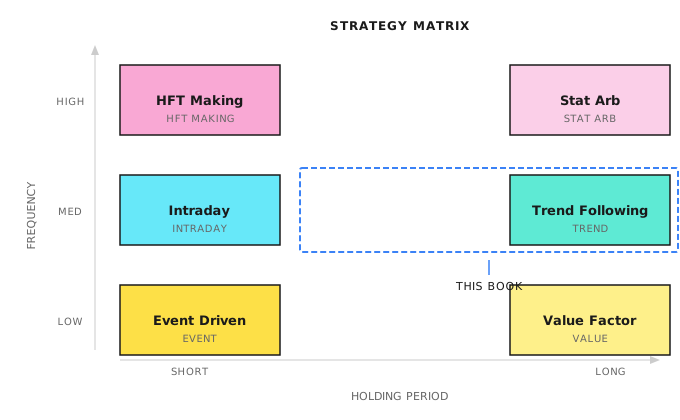
Six Major Strategy Types
| Strategy Type | Core Logic | Holding Period | Difficulty |
|---|---|---|---|
| HFT Market Making | Profit from bid-ask spread, provide liquidity | Seconds-minutes | ★★★★★ |
| Statistical Arbitrage | Related assets' price spread reversion | Minutes-days | ★★★★ |
| Trend Following | Price momentum persistence | Days-weeks | ★★★ |
| Mean Reversion | Price deviation followed by reversion | Hours-days | ★★★ |
| Event-Driven | Earnings, M&A, and other events | Days-months | ★★★★ |
| Multi-Factor | Combine multiple Alpha factors | Weeks-months | ★★★★ |
Strategy Lifecycle
Key insight: No strategy works forever.
Discovery → Validation → Deployment → Decay → RetirementYour system must be able to continuously evolve—this is why we need multi-agent architecture.
1.3 Why Multi-Agent Architecture
Let's return to the opening story: Why did the single model fail?
Fatal Flaws of Single Models
Markets switch between different regimes:
| Market Regime | Best Strategy | Single Model Problem |
|---|---|---|
| Trending | Momentum: ride the trend | Gets whipsawed in sideways markets |
| Sideways | Mean reversion: buy low, sell high | Misses big moves in trending markets |
| Crisis | Risk control first: reduce exposure | May hold full position during crashes |
Core problem: A single model cannot excel in all regimes simultaneously. This is a structural flaw, not something parameter tuning can fix.
Multi-Agent Solution Approach
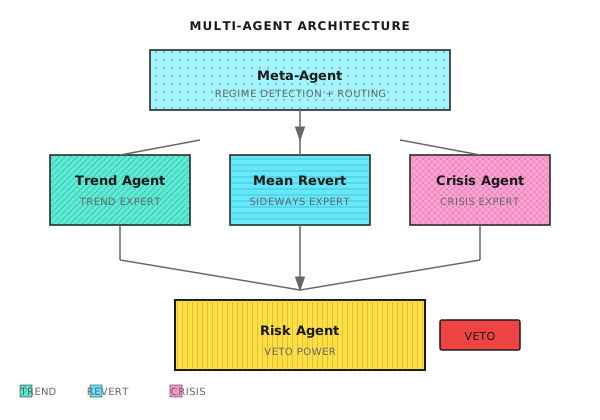
Three Core Design Principles:
- Expert Specialization: Different agents handle different market regimes, each excelling in their domain
- Dynamic Routing: Meta-Agent determines current market regime and routes tasks to corresponding experts
- Independent Risk Control: Risk Agent has veto power—any expert's recommendation must pass risk control
Note: This lesson presents the complete multi-agent target architecture. In practice, we recommend starting with a Modular Monolith — all agents running within a single process, communicating through clean interface boundaries. As scale grows, gradually extract components into independent services. See Lesson 21 for the detailed evolution path.
Common Misconceptions
| Misconception | Reality |
|---|---|
| "Multi-agent just means running multiple models" | The key is the collaboration mechanism: Who decides? How are conflicts resolved? |
| "A single model tuned to perfection can work" | Market regimes are structural changes, not noise—parameter tuning can't solve this |
| "Agents will automatically make money" | Agents are tools; Alpha comes from your strategy design and risk control discipline |
| "Quant is about predicting prices" | Quant is about managing risk-adjusted returns—prediction is just one means |
Applicability Boundaries of Multi-Agent
Every architecture has its boundaries. Multi-agent may underperform single models in these situations:
| Failure Scenario | Reason |
|---|---|
| Too rapid regime switching | Meta-Agent detection lags; by the time it switches, the optimal moment has passed |
| Blurred regime boundaries | Trending and sideways alternate; each expert is only right half the time |
| Coordination cost > benefit | Over-engineering a simple market with complex architecture |
Core principle: If your strategy only operates in a single market regime, a single model may be simpler and more effective. Multi-agent's value lies in cross-regime robustness.
1.4 Multi-Agent Collaboration Example
Let's use a market analysis task to demonstrate how multi-agent collaboration works:
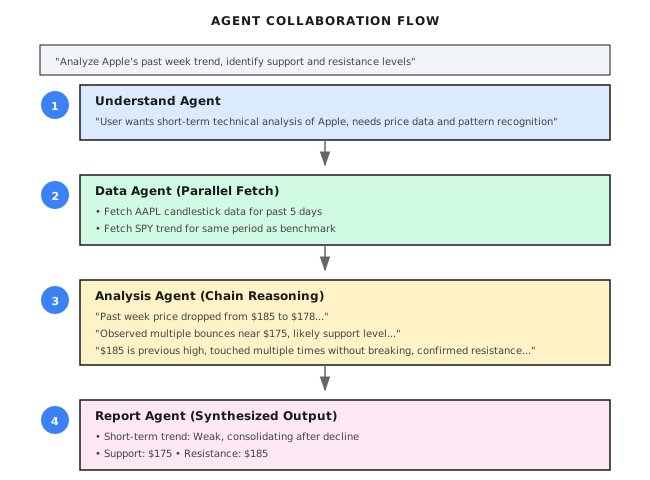
Key Collaboration Patterns
| Pattern | Description | Applicable Scenario |
|---|---|---|
| Chain | Agent A → B → C, sequential execution | Tasks with clear dependencies |
| DAG (Parallel) | Multiple agents execute simultaneously, results aggregated | Independent subtasks, like analyzing multiple stocks |
| Debate | Multiple agents provide different perspectives on the same problem | Decisions requiring multi-angle analysis |
| Reflection | Agent reviews its own or others' output | Improving output quality |
1.5 Technology Stack and Book Positioning
Four-Layer Quant System Architecture
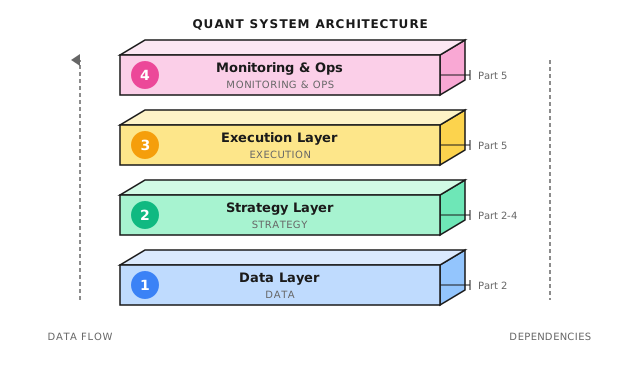
| Layer | Core Question | Book Coverage |
|---|---|---|
| Data Layer | Where does data come from? How to ensure quality? | Part 2 Lesson 06 |
| Strategy Layer | How are signals generated? How is risk controlled? | Parts 2-4 |
| Execution Layer | How to minimize transaction costs? | Part 5 Lessons 18-19 |
| Operations Layer | What if the system goes down? | Part 5 Lesson 20 |
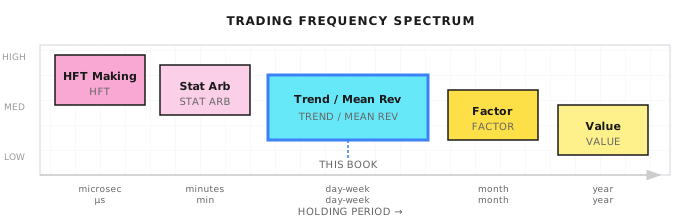
This Book's Focus: Medium-Frequency Multi-Agent Systems
| Dimension | Book's Position | Reason |
|---|---|---|
| Frequency | Intraday to weekly | No hardware arms race needed |
| Strategy | Trend + Mean Reversion + Risk Control | Classic and effective, suitable for demonstration |
| Architecture | Multi-agent collaboration | Solves single model's structural problems |
| Goal | Risk-adjusted returns | Not chasing huge profits, pursuing robustness |
1.6 Complete System Architecture Preview
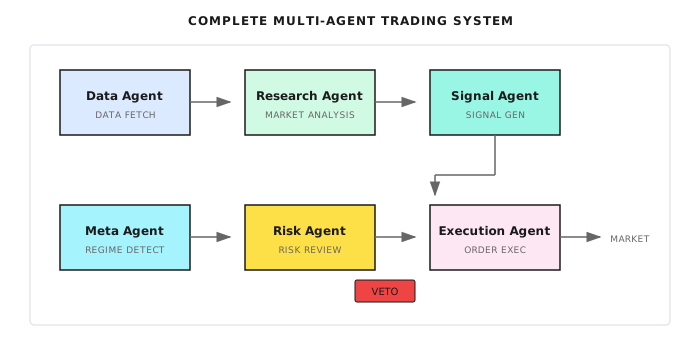
The concepts established in this lesson map to a complete multi-agent trading system:
| Agent | Responsibility | Lesson |
|---|---|---|
| Data Agent | Data acquisition, cleaning, alignment | Part 2 Lesson 06 |
| Research Agent | Market analysis, trend identification | Part 2 Lessons 04-05 |
| Signal Agent | Generate trading signals | Part 3 Lesson 10 |
| Meta Agent | Market regime detection, task routing | Part 4 Lessons 11-12 |
| Risk Agent | Risk review, veto power | Part 4 Lesson 15 |
| Execution Agent | Order splitting, execution optimization | Part 5 Lesson 19 |
1.7 Course Roadmap
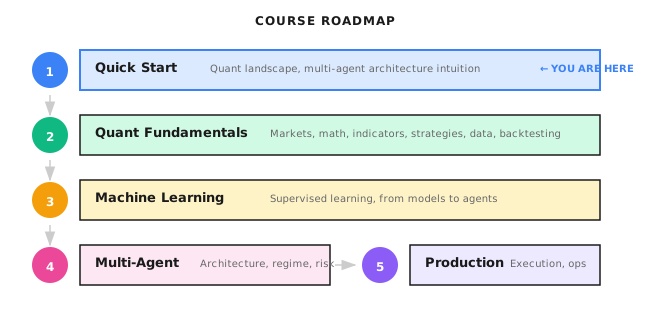
Core questions throughout the course:
- Why isn't a single model enough?
- How does multi-agent solve this?
- How to build a system that can continuously evolve?
Lesson Deliverables
After completing this lesson, you will have:
- Tiered understanding of quantitative trading - Know what HFT, institutional, and individual traders each do
- Complete map of strategy types - Understand the logic and applicable scenarios of six major strategy types
- Intuitive understanding of multi-agent architecture - Know why you need multiple experts instead of one omniscient model
- Clear learning boundaries - Know what this book focuses on and what it doesn't cover
Key Takeaways
- Quantitative trading has three tiers: HFT market making (can't beat them), institutional quant (learning target), individual/small (starting point)
- Six major strategy types: HFT market making, statistical arbitrage, trend following, mean reversion, event-driven, multi-factor
- Structural flaw of single models: Cannot excel in trending, sideways, and crisis markets simultaneously
- Three core principles of multi-agent: Expert specialization, dynamic routing, independent risk control
- This book's positioning: Medium-frequency multi-agent quantitative system, not chasing huge profits, pursuing sustainable robustness
Further Reading
- Background: Alpha and Beta - Understand the sources of returns
- Background: Top Quantitative Hedge Funds - See the strategy styles of top institutions
- Background: US vs China Market Differences - Different approaches in different markets
- Background: Famous Quantitative Disasters - Lessons from history, why risk control has veto power
Next Lesson Preview
Lesson 02: Financial Markets and Trading Basics
Now you know the complete landscape of the quantitative world and the core ideas of multi-agent architecture. Next, we return to fundamentals: How do markets work? How are orders executed? What are slippage and market impact? This foundational knowledge is a prerequisite for building any quantitative system.