Lesson 02: Financial Markets and Trading Basics
If your Agent doesn't understand order books, slippage, and market impact, it's just a machine that writes essays.
An Expensive Lesson
A quant newbie developed a strategy that looked very profitable: backtested annual return of 80%, Sharpe ratio of 2.0. He excitedly went live.
In the first week, the strategy signal said "buy 1000 shares of Tesla," and he did. The backtested expected cost was $250,000 ($250 x 1000 shares).
Actual execution price? $253,500.
He lost $3,500 before even starting to make money.
What happened?
- Slippage: His market order "ate through" multiple price levels in the order book, with an average price $2.5/share higher than expected
- Fees: Commission + SEC fees = approximately $50 loss per trade
- Market Impact: His large order attracted attention from other traders, pushing up the price
Three months later, the strategy's live performance was 40% lower than the backtest. The strategy wasn't bad - he just miscalculated the costs.
Goal of this lesson: Help your Agent understand how real markets work, and avoid the tragedy of "profitable in backtest, losing money live."
2.1 Market Types
Characteristics of Different Markets
| Market | Trading Hours | Leverage | Short Selling | Suitable Strategies |
|---|---|---|---|---|
| Stocks | Exchange hours (China A-shares: 9:30-15:00) | Limited margin trading | Restricted | Multi-factor, event-driven |
| Futures | Nearly 24 hours | High (5-20x) | Natively supported | CTA, arbitrage |
| Forex | 24 hours (except weekends) | Very high (50-100x) | Natively supported | Trend following, carry trade |
| Crypto | 24/7 | Exchange-defined (1-100x) | Natively supported | High-frequency, cross-exchange arbitrage |
Implications for Agents:
- Crypto 24/7 -> Agent must run around the clock, requiring stronger automation
- Futures high leverage -> Risk Agent's stop-loss logic must be stricter
- China A-shares T+1 (regular stocks bought today can only be sold tomorrow, some ETFs excepted) -> Execution Agent needs to consider overnight risk
Primary Market vs Secondary Market
| Primary Market | Secondary Market | |
|---|---|---|
| Definition | Initial securities issuance (IPO, secondary offerings) | Trading of issued securities between investors |
| Participants | Mainly institutions, retail IPO subscriptions | All investors |
| Quant Opportunities | IPO strategies, private placement arbitrage | Vast majority of quant strategies |
This course focuses on the secondary market - the main battlefield for quantitative trading.
Exchanges and Matching Mechanisms
Whether it's US stocks, China A-shares, or cryptocurrencies, all trades ultimately flow to the Matching Engine.
The exchange isn't your counterparty; it's just a "matchmaker," matching buyers and sellers through rules:
Matching Rules (most exchanges):
1. Price Priority: Higher bid orders get filled first
2. Time Priority: At the same price, earlier orders get filled first
Multi-Agent Perspective:
- Execution Agent: Must understand matching logic, deciding between market orders and limit orders
- Research Agent: Identifies large fund flows through transaction data
2.2 Basic Trading Units
Asset
An asset is what you trade. Different assets have different code conventions:
| Market | Asset Example | Code Format |
|---|---|---|
| China A-shares | Kweichow Moutai | 600519.SH |
| US Stocks | Apple | AAPL |
| Cryptocurrency | Bitcoin | BTC/USDT |
| Futures | CSI 300 Index Futures | IF2401 |
Time Scales: Tick -> Candlestick
Quant systems process data at different granularities:
Tick Data (finest)
    | aggregate
Minute Bars (1min, 5min, 15min)
    | aggregate
Daily / Weekly / Monthly (coarsest)
Tick Data: Every trade, every quote change. Essential for high-frequency strategies, high storage cost.
OHLCV (Candlesticks): Standard format after aggregating ticks:
- Open (opening price)
- High (highest price)
- Low (lowest price)
- Close (closing price)
- Volume (trading volume)
Order Book
The order book shows market "depth" - how many orders are queued at different price levels:
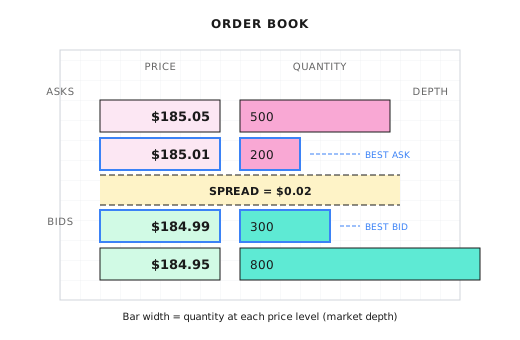
Spread (Bid-Ask Spread) = Best Ask - Best Bid = $185.01 - $184.99 = $0.02
- Smaller spread -> Better liquidity -> Lower trading costs
- Larger spread -> Worse liquidity -> Higher slippage risk
2.3 The Real Impact of Trading Costs
Backtested 50% annual return, losing money live? Trading costs are the culprit.
Slippage
Backtests assume you can buy at the best price, but in live trading:
You want to buy 1000 shares of AAPL, order book:
  $185.01 - 200 shares  <- You eat these 200 first
  $185.05 - 500 shares  <- Then eat these 500
  $185.10 - 300 shares  <- Finally eat these 300

Actual average price = (185.01x200 + 185.05x500 + 185.10x300) / 1000 = $185.057
Expected price = $185.01
Slippage = $0.047/share = Total $47
Fees: Cumulative Effect
Seemingly small fees get amplified in high-frequency trading:
# Assuming 0.1% fee per trade
fee_rate = 0.001
trades_per_day = 50
trading_days = 250

# Annualized fee cost
annual_fee = fee_rate * 2 * trades_per_day * trading_days  # buy and sell each
print(f"Annualized fee cost: {annual_fee:.1%}")  # Output: 25.0%
25% annualized fee cost - this means your strategy's annual return must exceed 25% just to break even!
Market Impact
Your large order itself changes the market. Square Root Law estimation:
Market Impact ~ Y x sigma x sqrt(Q/V)

Y = constant (typically 0.5-1.0)
sigma = daily volatility
Q = your order size
V = average daily volume
def estimate_market_impact(order_size, daily_volume, daily_volatility, Y=0.5):
"""Estimate market impact cost"""
participation = order_size / daily_volume
impact = Y * daily_volatility * (participation ** 0.5)
return impact
# Example: Order size is 1% of daily volume
impact = estimate_market_impact(
order_size=1_000_000,
daily_volume=100_000_000,
daily_volatility=0.02
)
print(f"Estimated market impact: {impact:.2%}") # Output: 0.10%Cost Summary
| Cost Type | Typical Range | Who's Most Affected |
|---|---|---|
| Slippage | 0.01% - 0.5% | Large orders, illiquid assets |
| Fees | 0.01% - 0.1% per trade | High-frequency strategies |
| Market Impact | 0.05% - 1%+ | Large capital, small-cap assets |
Multi-Agent Perspective: The Execution Agent's core responsibility is minimizing these three costs.
Paper Exercise: Is Your Strategy Really Profitable?
Scenario: You developed a US stock intraday strategy with the following backtest parameters:
| Parameter | Value |
|---|---|
| Backtested Annual Return | 35% |
| Average Daily Trades | 20 (counting buys and sells separately) |
| Average Trade Size | $50,000 |
| Broker Commission | $0 (commission-free broker) |
| SEC Fee | 0.00278% (on sells) |
| Average Slippage | 0.03% |
| Trading Days | 252 days/year |
Question: What will the live return be?
Step-by-Step Calculation:
Step 1: Calculate per-trade costs
Per-trade slippage cost = $50,000 x 0.03% = $____
Per-trade SEC fee = $50,000 x 0.00278% = $____ (sells only)
Step 2: Calculate daily costs
Daily slippage = $____ x 20 trades = $____
Daily SEC = $____ x 10 trades (sells) = $____
Daily total cost = $____
Step 3: Calculate annualized costs
Annual cost = $____ x 252 days = $____
Total trading volume = $50,000 x 20 x 252 = $252,000,000
Annual cost rate = $____ / $252,000,000 = ____%
Step 4: Calculate live return
Live annual return = 35% - ____% = ____%Answer (calculate first, then check):
Click to reveal answer
Key Concept Clarification:
- Principal: Your invested capital, e.g., $100,000
- Trade Size: Amount per trade, e.g., $50,000
- Total Trading Volume: Trade size x trades x days (includes leverage and turnover effects)
- Turnover Rate: Total trading volume / Principal, represents capital rotation
Calculation Process:
- Per-trade slippage = $50,000 x 0.03% = $15
- Per-trade SEC = $50,000 x 0.00278% = $1.39
- Daily slippage = $15 x 20 = $300
- Daily SEC = $1.39 x 10 = $13.9
- Daily total cost = $313.9
- Annual total cost = $313.9 x 252 = $79,103
Cost Rate Calculation (easy to confuse!):
| Calculation Method | Formula | Result | Meaning |
|---|---|---|---|
| Relative to trading volume | $79,103 / $252,000,000 | 0.031% | Cost per trade |
| Relative to principal | $79,103 / $100,000 | 79.1% | How much cost erodes principal |
Where: Annual trading volume = $50,000 x 20 trades x 252 days = $252,000,000 (turnover = 2520x!)
Final Answer:
- If strategy principal is $100,000:
- Annual cost relative to principal = $79,103 / $100,000 = 79.1%
- Live annual return = 35% - 79.1% = -44.1%
Conclusion: This strategy will lose big in live trading! The 0.03% slippage ignored in backtesting (small relative to trade size) accumulates to 79% (relative to principal) - a fatal wound with high turnover.
Reflection Questions:
- If slippage drops to 0.01%, can the strategy still be profitable?
- If trading frequency drops to 5 times per day, what happens?
- What insights does this give you for strategy design?
2.4 Strategy Lifecycle
A complete trade flows through the multi-agent system from inception to completion:
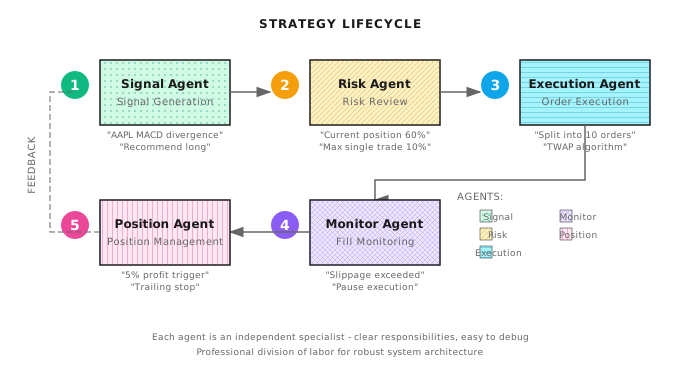
Detailed Flow:
-
Signal Generation (Signal Agent)
- "AAPL's MACD shows bullish divergence, recommend going long"
-
Risk Review (Risk Agent)
- "Current total position is 60%, max single position is 10%, this trade can only be 10%"
- May reject, reduce size, or approve
-
Order Execution (Execution Agent)
- "Order too large, split into 10 smaller orders, send one every 30 seconds using TWAP algorithm"
-
Execution Monitoring (Monitor Agent)
- "5th child order slippage exceeded threshold, pausing subsequent execution"
- Real-time execution quality feedback
-
Position Management and Exit (Position Agent)
- "Position up 5%, triggering trailing stop"
- "Position down 2%, triggering stop-loss exit"
- Loop complete
Each stage can be an independent specialized Agent - this is the advantage of multi-agent architecture: specialized division of labor, clear responsibilities, easier debugging.
Lesson Deliverables
After completing this lesson, you will have:
- Understanding of Market Structure - Know the characteristics and constraints of different markets (stocks/futures/crypto)
- Trading Cost Awareness - Can estimate the impact of slippage, fees, and market impact on strategies
- Strategy Lifecycle Perspective - Understand the complete loop from signal to exit
Verification Checklist
Use these checkpoints to confirm you truly understand this lesson:
| Checkpoint | Verification Standard | Self-Test Method |
|---|---|---|
| Cost Calculation | Can complete paper exercise independently, error < 10% | Recalculate without looking at answers |
| Order Book Understanding | Can explain why large orders create slippage | Draw order book, simulate 1000-share market order execution |
| Market Differences | Can state 3 key differences between China A-shares vs US stocks vs crypto | Explain verbally without notes |
| Lifecycle | Can draw strategy flow from signal to exit | Draw on blank paper, label each Agent's role |
If you can do these:
- Cost calculation accurate -> You have cost awareness
- Draw order book execution process -> You understand market microstructure
- Draw complete lifecycle -> You have systems thinking
If you cannot:
- Re-read relevant sections
- Walk through examples with specific numbers (e.g., AAPL $185)
- Find more detailed explanations in extended reading
Key Takeaways
- Understand characteristics of different markets (stocks/futures/forex/crypto) and their strategy implications
- Master OHLCV and order book fundamentals
- Recognize the three trading cost killers: slippage, fees, market impact
- Understand the complete strategy lifecycle loop: Signal -> Risk -> Execution -> Monitoring -> Exit
Extended Reading
- Background: Exchanges and Order Book Mechanics - Deep dive into L1/L2/L3 data differences
- Background: HF Market Microstructure - Essential reading if you want to compete with HFT
- Background: Cryptocurrency Trading Characteristics - Unique challenges of 24/7 markets
Next Lesson Preview
Lesson 03: Math and Statistics Fundamentals
Markets move, but how do we quantify these movements? Why do we use "returns" instead of "prices"? What is a "fat-tailed distribution," and why can the normal distribution assumption blow up your account? Find out next lesson.