Lesson 06: The Harsh Reality of Data Engineering
Data problems kill more strategies than model problems.
A Nightmare Weekend
Friday night at 11 PM, Xiao Wang deployed his carefully developed US stock quantitative strategy. Backtested 80% annual return, Sharpe ratio 2.5, everything looked perfect.
Monday morning at 9 AM, he was woken by an alert message: "Strategy error, unable to fetch data."
He got up to check and found Alpha Vantage API returning 429 Too Many Requests. His program was requesting 10 times per minute, exceeding the free account's API rate limit (5 times per minute).
After fixing it, the strategy finally started running.
Monday afternoon at 2 PM, another alert: "Strategy position anomaly."
This time it was a data problem: The API returned a missing minute bar, causing MACD to calculate NaN, and the program treated NaN as a sell signal, clearing all positions.
After fixing that, he decided to do a comprehensive data check. Then he discovered more problems:
- Some timestamps were UTC, others were ET (Eastern Time)
- Some bars had 0 volume (pre-market/after-hours sessions)
- Historical data and real-time data had different field names (
closevsClose)
For an entire week, he didn't write a single line of strategy code - all spent fixing data problems.
This is the harsh reality of data engineering.
6.1 Data Source Selection
Free Data Sources
| Data Source | Market Coverage | Pros | Cons |
|---|---|---|---|
| Yahoo Finance (yfinance) | US stocks, ETFs | Free, long history | Recent stability issues reported (API changes/rate limits/missing data); build robust fallbacks |
| Alpaca Markets | US stocks | Free IEX data, developer-friendly API | Free tier has limited data coverage |
| Binance API | Cryptocurrency | Real-time, free | Only Binance data |
| Alpha Vantage | Stocks, forex, crypto | Free tier available | Free-tier quotas are often very low (limits change; verify on the official site) |
| CCXT | Cryptocurrency | Unified interface | Depends on exchange APIs |
Note: Data vendors may change products, APIs, quotas, pricing, or even discontinue services. Treat data sources as having “delisting risk” and always have backups.
Paid Data Sources (2024-2025 Reference Pricing)
| Data Source | Market Coverage | Monthly Cost | Features |
|---|---|---|---|
| Bloomberg | Global | $2,500+ | Institutional standard, highest quality |
| LSEG Workspace (formerly Refinitiv) | Global | Quote-based pricing | LSEG subsidiary, former Reuters data |
| Polygon.io (now rebranded to Massive) | US stocks | $99+ | Real-time + historical, developer-friendly |
| Nasdaq Data Link (formerly Quandl) | Alternative data | Per dataset pricing | Satellite, consumer data, etc. |
How to Choose?
Personal learning/research:
    -> Free data sources + tolerate data issues

Small fund (< $1M AUM):
    -> Paid data (basic tier) + build data validation

Institutional (> $10M AUM):
    -> Bloomberg/Refinitiv + multi-source cross-validation
Core principle: Data quality determines strategy ceiling. Garbage in, garbage out.
Data Source Evolution Path
Stage Recommended Source Notes Learning/Prototyping Yahoo Finance (yfinance) Free daily bars, sufficient for exercises Small-Scale Live Polygon.io / Alpaca Real-time quotes, developer-friendly APIs Institutional Production Databento / Exchange Direct Feeds L1/L2 real-time data, low latency This lesson's exercises work perfectly with Yahoo Finance. When you're ready for live trading, you'll need to upgrade to professional-grade data sources — see Lesson 19 for details.
6.2 The Painful Reality of APIs
The Code You Think You'll Write vs Reality
You think:
data = api.get_history("AAPL", days=365)Reality:
Pseudocode Reference (replace with specific SDK like yfinance / alpaca / ccxt)
# Note: This is pseudocode showing robust data fetching design patterns
# api, log, EmptyDataError, RateLimitError need to be replaced with your specific library

import time
from typing import Optional
import pandas as pd

def get_history_robust(
    symbol: str,
    days: int,
    max_retries: int = 5,
    backoff_base: float = 2.0
) -> Optional[pd.DataFrame]:
    """
    Robust data fetching function

    Problems handled:
    - Rate Limiting (exponential backoff retry)
    - Empty data (validation + alerting)
    - Connection errors (auto-reconnect)
    - Timeouts (reasonable timeout settings)
    """
    for attempt in range(max_retries):
        try:
            # Set timeout (replace with your API call)
            data = api.get_history(
                symbol,
                days=days,
                timeout=30
            )

            # Validate data (generic logic)
            if data is None:
                raise EmptyDataError(f"No data for {symbol}")

            if len(data) == 0:
                raise EmptyDataError(f"Empty data for {symbol}")

            if len(data) < days * 0.9:  # Less than 90% of expected data
                log.warning(f"Data incomplete: got {len(data)}, expected ~{days}")

            # Check for anomalies
            if data['close'].isnull().any():
                log.warning("NaN values detected, filling...")
                data['close'] = data['close'].ffill()

            return data

        except RateLimitError:
            wait_time = backoff_base ** attempt
            log.info(f"Rate limited, waiting {wait_time}s...")
            time.sleep(wait_time)

        except ConnectionError:
            log.warning("Connection lost, reconnecting...")
            api.reconnect()
            time.sleep(1)

        except TimeoutError:
            log.warning("Request timeout, retrying...")

        except Exception as e:
            log.error(f"Unexpected error: {e}")
            if attempt == max_retries - 1:
                raise

    return None
Common API Problems
| Problem | Symptom | Solution |
|---|---|---|
| Rate Limiting | 429 errors | Exponential backoff + request queue |
| Missing Data | Empty response or partial data | Multi-source backup + missing detection |
| Data Delay | Timestamps lagging | Record delay + adjust strategy |
| Inconsistent Format | Field names change | Unified data adapter layer |
| Unstable Connection | Disconnects, timeouts | Heartbeat detection + auto-reconnect |
Production Note: Canonical Data Model Different markets and data sources use different symbol formats (
600519.SH,AAPL,0700.HK,BTC/USDT). Production systems need a unified normalization layer (Normalizer) that converts external formats to an internal standard (e.g.,SYMBOL.EXCHANGE:AAPL.NASDAQ,0700.HKEX). This is a prerequisite for multi-market trading. Watch out for common symbol resolution pitfalls: delisted tickers failing silently, corporate actions changing symbols, multi-part tickers (e.g., BRK.B), and more. See Lesson 19 for details.
The Real Cost of Rate Limiting
Suppose you need minute bars for 100 symbols:
| API Limit | Completion Time |
|---|---|
| 1 request/second | 100 seconds |
| 10 requests/second | 10 seconds |
| Unlimited | < 1 second |
High-frequency strategies need high API quotas - this is the core value of paid data sources.
6.3 Time Alignment Issues
Timezone Chaos
Different data sources use different timezones:
| Data Source | Default Timezone |
|---|---|
| Binance | UTC |
| Yahoo Finance | Exchange local time |
| China A-shares | UTC+8 |
| US stocks | ET (Eastern Time) |
If not handled:
- 9:30 A-share data + 9:30 US stock data -> Actually 12 hours apart
- Strategy uses "same moment" data, but they're actually different moments
Solution: Convert everything to UTC, store and compute in UTC.
import pandas as pd

def normalize_timezone(df, source_tz='UTC'):
    """Standardize to UTC"""
    if df.index.tz is None:
        df.index = df.index.tz_localize(source_tz)
    df.index = df.index.tz_convert('UTC')
    return df
Tick to Candlestick Aggregation
When aggregating tick data to candlesticks, note:
| Issue | Explanation |
|---|---|
| Open price | First trade price in that period |
| Close price | Last trade price in that period |
| High price | Highest trade price in that period |
| Low price | Lowest trade price in that period |
| Volume | Sum of all trades in that period |
Trap: What if there's no trade in a given minute?
Option 1: Fill OHLC with previous minute's close price
Option 2: Mark as missing, handle later
Option 3: Exclude that time point from aggregation
Different approaches lead to different indicator calculations. Must standardize handling rules.
Cross-Asset Data Alignment
Stocks, futures, forex have different trading hours:
| Asset | Trading Hours |
|---|---|
| China A-shares | 9:30-11:30, 13:00-15:00 |
| US stocks | 9:30-16:00 ET |
| Forex | Near 24/7 |
| Cryptocurrency | 24/7 |
If strategy needs cross-asset signals:
- When A-shares close, US hasn't opened yet
- Use A-share close + US open? There's a time gap
- Need careful "synchronization point" design
6.4 Data Quality Issues
Anomaly Detection and Handling
| Anomaly Type | Detection Method | Handling |
|---|---|---|
| Price jumps | Price change >20% | Check if real (stock split?) |
| Volume anomaly | 0 or extreme values | Check exchange status |
| Missing values | NaN | Forward fill or delete |
| Duplicate data | Duplicate timestamps | Keep first or last |
def detect_anomalies(df, price_col='close', volume_col='volume'):
    """Detect data anomalies"""
    issues = []

    # Price jumps
    returns = df[price_col].pct_change()
    jumps = returns.abs() >`0`.20
    if jumps.any():
        issues.append(f"Price jumps detected: {jumps.sum()} times")

    # Zero volume
    zero_volume = df[volume_col] == 0
    if zero_volume.any():
        issues.append(f"Zero volume: {zero_volume.sum()} bars")

    # Missing values
    nulls = df.isnull().sum()
    if nulls.any():
        issues.append(f"Null values: {nulls.to_dict()}")

    # Duplicate timestamps
    duplicates = df.index.duplicated()
    if duplicates.any():
        issues.append(f"Duplicate timestamps: {duplicates.sum()}")

    return issues
Stock Dividend and Split Adjustments
Stock historical prices need "adjustment":
| Event | Actual Change | Unadjusted Data | Adjusted Data |
|---|---|---|---|
| 2-for-1 split | Shares double, price halves | Price cliff before/after | Smooth and continuous |
| Dividend | Ex-dividend deduction | Gap on ex-div date | Historical prices adjusted |
Consequences of not adjusting:
- In backtests, strategy generates false signals on ex-dates
- Return calculations show extreme values
Futures Roll Handling
Futures contracts expire and need "rolling":
January 2024: Hold IF2401 (January contract)
Before January expiry: Switch to IF2402 (February contract)

Problem: IF2401 closes at 4000, IF2402 closes at 4050
Not real price movement, but different contractsSolutions:
- Calculate spread when splicing, adjust historical prices
- Or use "continuous main contract" data (pre-processed by data vendor)
6.5 Survivorship Bias
What is Survivorship Bias?
If you only backtest with "stocks that still exist today":
2010 stock pool: 1000 stocks
Still exist in 2024: 800 stocks
Delisted/bankrupt: 200 stocks

Your backtest only uses 800, ignoring those 200 failed companies
-> Backtest returns are inflated
How Serious is Survivorship Bias?
| Research | Conclusion |
|---|---|
| Academic studies | Annual returns inflated 1-3% |
| Value investing strategies | Bias more severe (cheap stocks more likely to delist) |
| Small-cap strategies | Bias is largest |
How to Avoid?
| Method | Difficulty | Effectiveness |
|---|---|---|
| Use database including delisted stocks | High | Most accurate |
| Use historical index constituents | Medium | Fairly accurate |
| Acknowledge bias in conclusions | Low | At least honest |
Paid data sources typically provide "survivorship-bias-free" datasets - another value of paying.
6.6 Alternative Data Introduction
What is Alternative Data?
Traditional data: Prices, volume, financial statements Alternative data: Everything else
| Type | Data Source | Application |
|---|---|---|
| Satellite data | Parking lot car counts, oil tank levels | Predict retail earnings, oil inventory |
| Text data | News, social media, earnings calls | Sentiment analysis, event-driven |
| Credit card data | Spending statistics | Predict company revenue |
| Web traffic | Website visits | Predict e-commerce performance |
| GPS data | Phone locations | Foot traffic analysis |
Challenges of Alternative Data
| Challenge | Explanation |
|---|---|
| High noise | Signal/noise ratio far lower than price data |
| Compliance risk | Privacy issues, data source legality |
| Fast alpha decay | Once widely used, advantage disappears |
| High cost | Data itself expensive + processing costs |
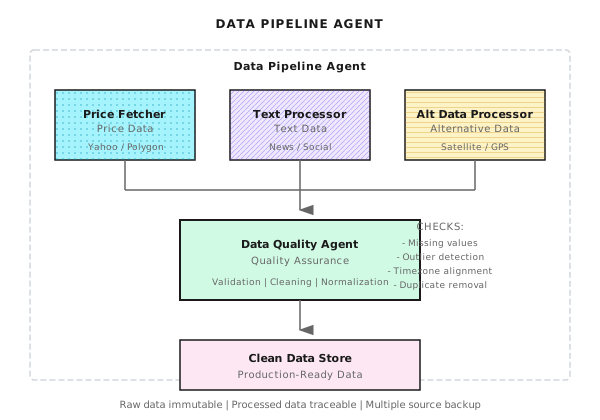
Multi-Agent Perspective
6.7 Data Pipeline Design Principles
Three Principles
| Principle | Explanation |
|---|---|
| Immutability | Never modify raw data, generate new files after processing |
| Traceability | Record source, processing time, processing version for each data point |
| Redundant backup | Cross-validate with at least two data sources |
Data Pipeline Architecture
Data Collection Layer
    |
    |-> Raw Data Storage (immutable)
    |         |
    |         v
    |-> Data Cleaning Layer
    |     - Anomaly handling
    |     - Missing value filling
    |     - Timezone standardization
    |         |
    |         v
    |-> Feature Engineering Layer
    |     - Technical indicator calculation
    |     - Label generation
    |         |
    |         v
    --> Ready Data Storage -> Strategy Use
Monitoring and Alerting
| Monitor Item | Suggested Threshold | Alert Action |
|---|---|---|
| Data delay | >1 minute | Warning |
| Missing data rate | >1% | Warning |
| Anomaly ratio | >0.1% | Investigate |
| API error rate | >5% | Pause strategy |
Code Implementation (Optional)
Data Quality Check Framework
import pandas as pd
from dataclasses import dataclass
from typing import List

@dataclass
class DataQualityReport:
    symbol: str
    start_date: str
    end_date: str
    total_rows: int
    missing_rows: int
    null_values: dict
    anomalies: List[str]
    is_valid: bool

def check_data_quality(df: pd.DataFrame, symbol: str) -> DataQualityReport:
    """Comprehensive data quality check"""

    anomalies = []

    # Check time continuity
    # Note: This example assumes *daily* bars and uses business days as a rough expectation.
    # For minute/tick data, you must generate expected_index based on exchange trading sessions,
    # holidays, lunch breaks (if any), etc.
    idx = pd.DatetimeIndex(df.index)
    expected_index = pd.bdate_range(start=idx.min().normalize(), end=idx.max().normalize())
    expected_rows = len(expected_index)
    actual_rows = len(df)
    missing_rows = expected_rows - actual_rows

    if missing_rows > expected_rows * 0.05:
        anomalies.append(f"High missing rate: {missing_rows/expected_rows:.1%}")

    # Check NULL values
    null_counts = df.isnull().sum().to_dict()

    # Check price jumps
    if 'close' in df.columns:
        returns = df['close'].pct_change()
        extreme_moves = (returns.abs() >`0`.2).sum()
        if extreme_moves >`0`:
            anomalies.append(f"Extreme price moves: {extreme_moves}")

    # Check volume
    if 'volume' in df.columns:
        zero_volume = (df['volume'] == 0).sum()
        if zero_volume >`0`:
            anomalies.append(f"Zero volume periods: {zero_volume}")

    # Check timestamp duplicates
    duplicates = df.index.duplicated().sum()
    if duplicates >`0`:
        anomalies.append(f"Duplicate timestamps: {duplicates}")

    return DataQualityReport(
        symbol=symbol,
        start_date=str(df.index[0]),
        end_date=str(df.index[-1]),
        total_rows=actual_rows,
        missing_rows=missing_rows,
        null_values=null_counts,
        anomalies=anomalies,
        is_valid=len(anomalies) == 0
    )
Lesson Deliverables
After completing this lesson, you will have:
- Deep understanding of data problems - Know that data engineering is the main battlefield of quant
- API best practices - Robust data fetching code framework
- Data quality checking ability - Can identify and handle common data issues
- Data pipeline design thinking - Understand production-grade data system architecture
Key Takeaways
- Understand the trade-offs between free and paid data sources
- Master methods for handling API rate limiting, missing data, etc.
- Recognize hidden issues like timezone chaos, survivorship bias
- Understand the value and challenges of alternative data
- Understand data pipeline design principles
Extended Reading
- Background: Exchanges and Order Book Mechanics - Source of tick data
- Background: Cryptocurrency Trading Characteristics - Challenges of 24/7 data
Next Lesson Preview
Lesson 07: Backtest System Pitfalls
Even if your data is fine, backtests can still deceive you. Look-Ahead Bias, overfitting, ignoring trading costs... These traps have caused countless seemingly perfect strategies to fail miserably in live trading. Next lesson reveals the truth about backtesting.