Lesson 08: Beta, Hedging, and Market Neutrality
You think you're generating Alpha, but you might just be betting on direction.
A Typical Scenario (Illustrative)
Note: The following is a synthetic example to illustrate common phenomena; numbers are illustrative and don't correspond to any specific institution/product.
In 2021, a quant team presented their performance to investors: 32% annual return, 1.8 Sharpe ratio, only 12% maximum drawdown. Investors happily invested.
A year later, investors discovered the truth:
That year, the Nasdaq 100 index rose 27%.
When they did a simple regression analysis, the results were embarrassing:
- Beta = 1.15 (strategy highly correlated with market)
- True Alpha = 32% - 1.15 x 27% = 1%
In other words, 80% of this "high-return strategy's" gains came from the market's own rise, not any unique trading skill.
Even worse, when the market fell 33% in 2022, this strategy lost 38%. Investors finally understood: they didn't buy an "Alpha strategy" - they bought a leveraged market bet.
The lesson from this story:
Without understanding Beta, you don't know where your returns come from; without understanding hedging, you don't know where your risks are.
8.1 Understanding Beta Again
8.1.1 The Essence of Beta
In the first lesson's background knowledge, we briefly introduced Alpha and Beta. Now let's understand them more deeply.
Beta measures the sensitivity of your portfolio relative to the market benchmark.
Beta = 1.0  -> Market up 10%, you up 10%
Beta = 1.5  -> Market up 10%, you up 15% (but you'll also lose 50% more when it falls)
Beta = 0.5  -> Market up 10%, you up 5% (half the volatility)
Beta = 0    -> Your returns are unrelated to market movement (this is "market neutral")
Beta < 0    -> Market up, you down; market down, you up (inverse)
8.1.2 Why is Beta More Important Than Alpha?
Many obsess over finding Alpha while ignoring a harsh reality:
| Dimension | Beta Returns | Alpha Returns |
|---|---|---|
| Source | Reward for bearing market risk | Reward for unique skill/information |
| Accessibility | Anyone can get it (buy index) | Very few can consistently get it |
| Cost | Extremely low (index fund fee 0.03%) | Extremely high (hedge fund 2%+20%) |
| Capacity | Nearly unlimited | Limited (Alpha decays) |
| Sustainability | Long-term stable (market risk premium) | Uncertain (strategy may fail) |
Key insight:
If your strategy has Beta = 1, how much of your "strategy return" is Alpha vs Beta?
For most retail investors and many "quant funds," over 80% of returns come from Beta.
8.1.3 Paper Exercise: Decompose Your Returns
Scenario: Your strategy performed as follows over the past year:
- Strategy return: +25%
- S&P 500 (benchmark) over same period: +18%
- Your strategy Beta (calculated via regression): 1.2
Question: What is your true Alpha?
Alpha = Strategy return - Beta x Benchmark return
Alpha = 25% - 1.2 x 18%
Alpha = 25% - 21.6%
Alpha = 3.4%
Note: Strictly speaking, Alpha/Beta are typically estimated via regression on excess returns (subtracting the risk-free rate), where Alpha is the intercept. This simplified formula is for intuition.
Interpretation:
- You thought you made 25%
- Actually, 21.6% was because you took on more risk than the market (Beta = 1.2)
- Only 3.4% is your "true skill"
- If the market drops 20% next year, you might lose 24% (1.2 x 20%)
Code Implementation (for engineers)
import numpy as np
import pandas as pd
from scipy import stats

def decompose_returns(strategy_returns: pd.Series,
                      benchmark_returns: pd.Series,
                      rf_rate: float = 0.02) -> dict:
    """
    Decompose strategy returns into Alpha and Beta components

    Parameters:
        strategy_returns: Daily strategy return series
        benchmark_returns: Daily benchmark return series
        rf_rate: Annualized risk-free rate

    Returns:
        Dictionary with alpha, beta, r_squared
    """
    # Convert to excess returns
    rf_daily = rf_rate / 252
    excess_strategy = strategy_returns - rf_daily
    excess_benchmark = benchmark_returns - rf_daily

    # Linear regression: R_strategy = alpha + beta * R_benchmark
    slope, intercept, r_value, p_value, std_err = stats.linregress(
        excess_benchmark, excess_strategy
    )

    beta = slope
    alpha_daily = intercept
    alpha_annual = alpha_daily * 252  # Annualize

    # Return decomposition
    # Use compounded returns instead of simple sums (closer to typical backtest conventions)
    total_return = (1 + strategy_returns).prod() - 1
    benchmark_total_return = (1 + benchmark_returns).prod() - 1
    beta_contribution = beta * benchmark_total_return
    alpha_contribution = total_return - beta_contribution

    return {
        'beta': beta,
        'alpha_annual': alpha_annual,
        'r_squared': r_value ** 2,
        'total_return': total_return,
        'benchmark_total_return': benchmark_total_return,
        'beta_contribution': beta_contribution,
        'alpha_contribution': alpha_contribution,
        'beta_pct': beta_contribution / total_return * 100 if total_return != 0 else 0
    }

# Example usage
# result = decompose_returns(strategy_rets, spy_rets)
# print(f"Beta: {result['beta']:.2f}")
# print(f"Alpha (annualized): {result['alpha_annual']:.2%}")
# print(f"Beta contribution to returns: {result['beta_pct']:.1f}%")
8.2 The Essence of Hedging
8.2.1 What is Hedging?
The core idea of hedging is very simple:
Hold positions in the opposite direction to offset risks you don't want to bear.
Analogy: You bought a Beijing-to-Shanghai flight ticket but worry the flight might be cancelled. You can also buy a same-time high-speed rail ticket as a "hedge" - if the flight is normal, the train ticket is wasted (hedge cost); if the flight is cancelled, the train ticket saves you.
8.2.2 Notional Hedging vs Beta Hedging
This is the first mistake many make: thinking equal dollar amounts means equal risk.
Case:
You hold $1M of tech stocks (Beta = 1.5). To hedge, you short $1M of S&P 500 ETF (Beta = 1.0).
Question: Is this a perfect hedge?
Your long Beta exposure: $1M x 1.5 = $1.5M
Your short Beta exposure: $1M x 1.0 = $1M
Net Beta exposure: $1.5M - $1M = $0.5M (long)

You still have $0.5M of Beta exposure unhedged!
Correct Beta hedging:
Short amount needed = Long amount x (Long Beta / Short instrument Beta)
                    = $1M x (1.5 / 1.0)
                    = $1.5M

Verification:
Long Beta exposure: $1M x 1.5 = $1.5M
Short Beta exposure: $1.5M x 1.0 = $1.5M
Net Beta exposure: 0
8.2.3 Paper Exercise: Calculate Hedge Ratios
| Scenario | Long Position | Long Beta | Short Instrument Beta | Short Amount Needed | Verification |
|---|---|---|---|---|---|
| A | $500K growth stocks | 1.3 | 1.0 (SPY) | ? | ? |
| B | $1M utility stocks | 0.6 | 1.0 (SPY) | ? | ? |
| C | $800K tech stocks | 1.8 | 1.2 (QQQ) | ? | ? |
Click to reveal answers
| Scenario | Calculation | Short Amount | Net Beta |
|---|---|---|---|
| A | $500K x 1.3 / 1.0 | $650K | 500Kx1.3 - 650Kx1.0 = 0 |
| B | $1M x 0.6 / 1.0 | $600K | 1Mx0.6 - 600Kx1.0 = 0 |
| C | $800K x 1.8 / 1.2 | $1.2M | 800Kx1.8 - 1.2Mx1.2 = 0 |
Key findings:
- Scenario A: Need to short more than long amount because long Beta >
1 - Scenario B: Need to short less than long amount because long Beta
< 1 - Scenario C: Using QQQ to hedge requires considering QQQ's own Beta
8.3 Hedging Instrument Comparison
8.3.1 ETF Shorting vs Index Futures Hedging
| Dimension | ETF Shorting | Index Futures |
|---|---|---|
| Capital efficiency | Low (≥150% margin, Reg T requirement) | High (only 5-15% margin) |
| Cost | Stock borrowing interest (1-10%/year) | Basis cost (< 1% in low-rate environment, 2-4% when rates are high) |
| Rolling | None | Need monthly/quarterly rolls |
| Precision | Can match exact amounts | Fixed contract size |
| Availability | Depends on broker stock loan inventory | Standardized contracts, good liquidity |
| Retail access | Partially available | Usually requires professional account |
8.3.2 Basis Risk
Basis = Futures price - Spot price
This is the biggest hidden risk when hedging with futures:
Normal situation:
  Futures premium = Spot price + Carry cost (interest - dividends)
  Basis usually positive, converges to zero at expiry

Abnormal situation (during crisis):
  Massive capital rushes into futures to short
  Futures trade at large discount (futures <spot)
  Your hedge position actually loses money
Example (approximate): March 2020
Note: The table below shows approximate values to illustrate "basis risk" mechanics, not exact historical data.
| Date | S&P 500 Spot | S&P 500 Futures | Basis | Impact |
|---|---|---|---|---|
| 3/9 | 2746 | 2730 | -16 | Small discount |
| 3/12 | 2480 | 2400 | -80 | Severe discount |
| 3/16 | 2386 | 2280 | -106 | Extreme discount |
Impact: If you shorted futures to hedge, you not only suffered from spot decline, but also lost extra money as futures discount widened.
8.3.3 Real-World Hedging Cost Considerations
| Cost Type | Source | Annual Estimate | Notes |
|---|---|---|---|
| Stock borrow interest | Borrowing stock/ETF to short | 1-10% | Popular stocks can be >30% |
| Futures basis | Futures premium cost | 0.5-2% | Normal markets |
| Transaction cost | Bid-ask spread + commission | 0.1-0.3%/trade | Futures lower |
| Roll cost | Futures contract roll | 0.1-0.5%/roll | Monthly/quarterly |
| Opportunity cost | Margin/capital tied up | 2-5% | Risk-free rate |
Key formula:
Net hedged return = Alpha - Hedging cost
If Alpha <Hedging cost, the hedged strategy loses money.
8.4 Market Neutral Strategies
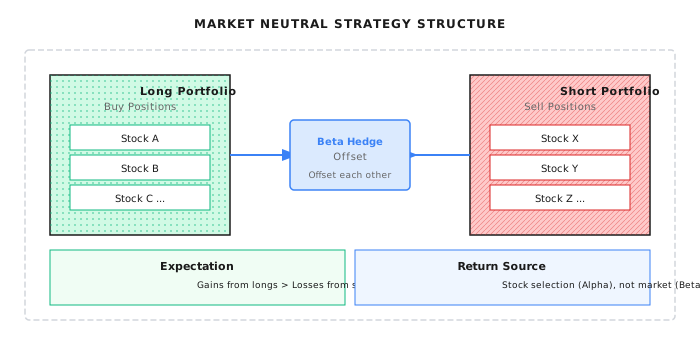
8.4.1 What is "True" Market Neutral?
Market Neutral means:
Regardless of market direction, strategy returns are unaffected (Beta ~ 0)
8.4.2 Three Levels of Market Neutrality
| Level | Definition | Difficulty | Effectiveness |
|---|---|---|---|
| Dollar Neutral | Equal long and short dollar amounts | Simple | Can't truly eliminate Beta |
| Beta Neutral | Equal long and short Beta exposure | Medium | Eliminates market risk |
| Factor Neutral | Equal long and short factor exposures | Hard | Eliminates multiple systematic risks |
The problem with Dollar Neutral:
Assume:
  Long: $1M tech stocks (Beta = 1.5)
  Short: $1M utility stocks (Beta = 0.6)

Looks "market neutral" (equal dollar amounts)

Actual Beta exposure:
  Net Beta = $1M x 1.5 - $1M x 0.6 = $0.9M

You're actually long $0.9M of market exposure!
8.4.3 Why Can't Retail Investors Do Market Neutral?
| Barrier | Institution | Retail |
|---|---|---|
| Borrow cost | 0.5-2%/year (prime client rate) | 3-10%/year (retail rate) |
| Borrow availability | Prime broker relationships | Often can't borrow desired stocks |
| Capital efficiency | 2-4x leverage | Usually no leverage |
| Transaction cost | 0.01-0.05%/trade | 0.1-0.5%/trade |
| Portfolio size | 100+ stocks | Usually 10-20 stocks |
| Risk infrastructure | Real-time factor exposure monitoring | Manual tracking |
Let's do the math:
Assume you have a "truly effective" neutral strategy:
- Gross Alpha: 8%/year (already quite good)
- Stock borrow cost: 5%/year (retail rate)
- Transaction cost: 2%/year (500% turnover, 0.2% each)
- Net return: 8% - 5% - 2% = 1%
Might as well buy Treasury bonds.
8.4.4 How Do Institutions Make It Work?
| Advantage | Specifics |
|---|---|
| Economies of scale | $1B scale, fixed costs become negligible |
| Prime broker relationships | Borrow rates < 1%, rich stock pool |
| Leverage | 2-4x leverage amplifies Alpha |
| Technology infrastructure | Millisecond execution, real-time risk control |
| Talent | 10+ person team dedicated to research |
Renaissance's Medallion Fund:
Estimated operating parameters:
- Gross returns: 60-80%/year
- Fees: 5% management + 44% performance
- Net returns: ~35-40%/year
- Beta: Near 0
- Capacity: Internal money only, ~$12B (2024 estimate)
8.5 Common Misconceptions
Misconception 1: "Long tech, short financials = market neutral"
Problem: Sector hedging != market hedging.
Tech stock Beta ~ 1.3
Financials Beta ~ 1.1

Equal allocation:
Net Beta = 0.5 x 1.3 - 0.5 x 1.1 = 0.1 (still long market)

Bigger problem:
You're simultaneously long "growth factor," short "value factor"
This isn't market neutral - it's a factor bet
Misconception 2: "Low volatility after hedging = safe"
Problem: Low volatility != low risk.
Case: LTCM
  - Strategy volatility was low (10% annual)
  - But 25x leverage
  - Actual risk exposure = 10% x 25 = 250%
  - One "impossible event" caused bankruptcy
Misconception 3: "Neutral strategy profitable in backtest = profitable live"
Problem: Backtests ignore many hidden costs.
Backtest assumes:
  x Stock borrow always available
  x Borrow cost fixed
  x No slippage
  x No market impact

Live reality:
  - Can't borrow stocks you want to short
  - Borrowed stocks get recalled
  - Insufficient liquidity causes slippage
  - Your trades get front-run
Misconception 4: "Shorting is as easy as going long"
Problem: Shorting has natural asymmetry.
| Dimension | Long | Short |
|---|---|---|
| Max loss | 100% (stock goes to zero) | Unlimited (stock can rise infinitely) |
| Cost | None (buy and hold) | Yes (borrow interest accrues) |
| Time | Can hold indefinitely | May be forced to return shares |
| Psychology | Can wait for recovery when losing | Forced to cover when losing |
8.6 Multi-Agent Perspective
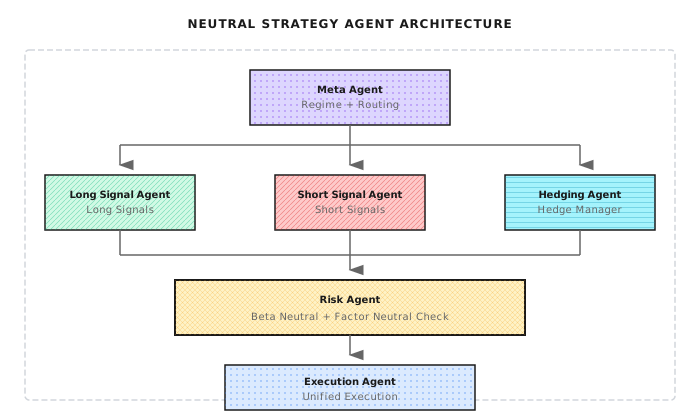
In multi-agent quant systems, Beta management and hedging need dedicated Agents.
8.6.1 Hedging Agent Responsibilities
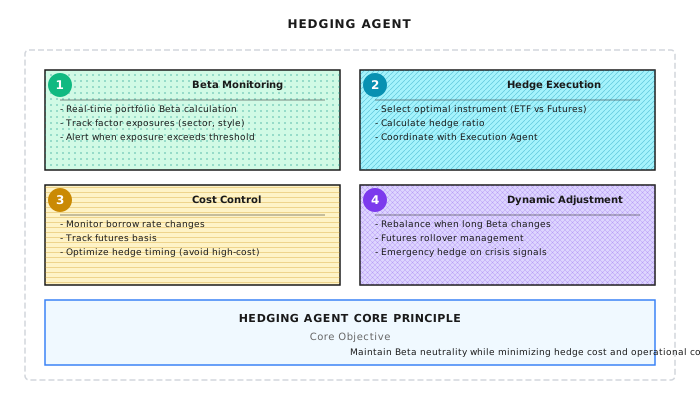
8.6.2 Collaboration with Other Agents
| Collaborator | Collaboration Method |
|---|---|
| Signal Agent | Receive position change signals, calculate new hedge requirements |
| Risk Agent | Report Beta exposure, receive risk budget constraints |
| Execution Agent | Send hedge orders, receive execution feedback |
| Cost Agent | Query borrow costs, get futures basis data |
| Regime Agent | Receive signals during crisis, increase hedge intensity |
8.6.3 Agent Architecture in Neutral Strategies
Verification Checklist
After completing this lesson, verify your learning with these standards:
| Check Item | Pass Standard | Self-Test Method |
|---|---|---|
| Understand Beta | Can explain what Beta = 1.2 means | Explain in your own words |
| Decompose returns | Can calculate Alpha and Beta contributions | Complete paper exercise |
| Calculate hedge ratios | Can correctly calculate short amount for Beta neutrality | Complete hedge exercise |
| Understand hedge costs | Can list at least 3 hedging costs | Explain why retail can't do neutral |
| Identify misconceptions | Can point out problems with "equal dollar hedge" | Explain Dollar Neutral's flaw |
Comprehensive Exercise
Design a simplified neutral strategy framework:
- Assume you have $1M capital, want to build a Beta neutral strategy
- Long: Hold 5 growth stocks, average Beta = 1.4
- Short: Use SPY to hedge
- Questions:
- How much SPY to short?
- If borrow rate is 5%/year, what's the hedge cost?
- What's the minimum gross Alpha needed to cover costs?
Click to reveal answers
-
Short amount:
- Long Beta exposure = $1M x 1.4 = $1.4M
- Need to short SPY (Beta = 1.0): $1.4M
-
Hedge cost:
- Borrow interest = $1.4M x 5% = $70,000/year
- As % of capital = $70K / $1M = 7%
-
Breakeven Alpha:
- Gross Alpha >
7% just to cover borrow cost - Add transaction costs (assume 1%), need >
8% - This means your stock-picking must be very strong
- Gross Alpha >
Conclusion: For retail investors, this strategy is likely not realistic.
Lesson Deliverables
After completing this lesson, you will have:
- Beta decomposition framework - Understand where your returns actually come from
- Hedge ratio calculation methods - Know how to correctly calculate hedge amounts
- Hedging cost checklist - Understand hidden costs' impact on strategy
- Market neutral feasibility assessment - Judge if neutral strategy suits you
Key Takeaways
- Beta measures strategy sensitivity to market, is a major source of returns
- Notional hedging (equal dollars) != Beta hedging (equal Beta exposure)
- Hedging costs (borrow, basis, transaction) can consume Alpha
- Market neutral strategies are nearly infeasible for retail (costs, tools, scale)
- "Equal long-short dollars" doesn't equal "market neutral"
Extended Reading
- Background: Alpha and Beta - Basic definitions of Alpha and Beta
- Lesson 15: Risk Control and Money Management - More on risk management
- Background: Famous Quant Disasters - LTCM and other hedging failure cases
Next Lesson Preview
Lesson 09: Supervised Learning in Quantitative Trading
After understanding the essence of Beta and hedging, we start exploring how to use machine learning to predict markets. But remember: Prediction is just the first step; converting prediction into tradeable Alpha is key - and that requires deducting all costs, including the hedging costs we discussed today.