Lesson 09: Supervised Learning in Quantitative Trading
Machine learning is not magic, but a magnifying glass for statistical patterns. If there's no pattern in the data, even the strongest model cannot extract Alpha.
From "Holy Grail" to "Tool"
In 2017, a hedge fund recruited a team of top AI researchers, promising to "revolutionize" quantitative trading with deep learning.
They built a 10-layer LSTM network, trained on 20 years of minute-level data, running on a GPU cluster for three months.
Backtest result: 150% annualized return, Sharpe ratio of 4.0.
The founder excitedly announced: "We've found the Holy Grail!"
Three months after going live:
- Month 1: +5% (as expected)
- Month 2: -8% (starting to worry)
- Month 3: -15% (panic)
Cumulative loss of 18%, while the S&P 500 gained 8% in the same period.
What happened?
- Overfitting to historical noise: The 10-layer LSTM had millions of parameters, perfectly "memorizing" historical data, but those patterns were just noise
- Prediction does not equal profit: The model's accuracy was 52%, which sounds decent, but after trading costs, it was a net loss
- Distribution drift: The market structure in 2017 was already different from the training data (1997-2016)
Lesson: The correct role of machine learning in quantitative trading is not "predicting price movements," but extracting weak but robust signals from noise. This lesson teaches you how to use supervised learning correctly.
9.1 The Quantitative Perspective on Supervised Learning
What is Supervised Learning?
Using data with known answers to "train" a model so it can predict answers for unknown data.
Training Data:
  Input X (Features)          ->  Output Y (Labels)
  [Yesterday's return, Volume, RSI]  ->  [Tomorrow up/down]
  [0.02, 1.5M, 65]            ->  [Up]
  [-0.01, 2.0M, 35]           ->  [Down]

What the model learns:
  "When RSI >`6`0 and volume increases, probability of rising tomorrow is higher"

Prediction phase:
  New input [0.01, 1.8M, 70]  ->  Model predicts [Up?]
The "Labeling" Dilemma in Quantitative Trading
Traditional machine learning: Labels are clear (cat/dog, spam/not spam)
Quantitative problem: How should labels be defined?
| Labeling Approach | Problem |
|---|---|
| "Tomorrow up = 1, down = 0" | 0.01% gain and 5% gain are both "up"? |
"5-day return >1%" | During those 5 days, it might drop 10% first then recover |
| "Return itself" | Too much noise, model struggles to find patterns |
"Positions with Sharpe >1" | Requires look-back over entire holding period, look-ahead bias risk |
The correct approach: Labels should reflect executable trading decisions, not abstract prediction targets.
Common Misconceptions
| Misconception | Reality |
|---|---|
| "Higher accuracy is better" | 52% accuracy with 3:1 win/loss ratio is far better than 70% accuracy with 1:1 ratio |
| "Complex models are stronger" | Financial data has low signal-to-noise ratio, simple models are often more robust |
| "More features are better" | Too many features lead to curse of dimensionality and overfitting |
| "Deep learning is omnipotent" | Deep learning requires massive data, which quantitative trading usually lacks |
9.2 Feature Engineering: The Core Battleground of Quantitative Trading
80% of Alpha comes from feature engineering, not model selection.
Types of Features
| Feature Type | Examples | Information Source |
|---|---|---|
| Price Features | Returns, volatility, momentum | OHLCV |
| Technical Indicators | RSI, MACD, Bollinger Bands | Price-derived |
| Statistical Features | Skewness, kurtosis, autocorrelation | Distribution characteristics |
| Cross-Asset Features | Sector momentum, market sentiment | Related assets |
| Alternative Data | Satellite imagery, social media | External data |
Feature Construction Example
Suppose we have daily data for AAPL, we construct the following features:
Base Data (5 days):
Date      Open    High    Low     Close   Volume
Day 1    $180   $182   $178   $181   10M
Day 2    $181   $185   $180   $184   12M
Day 3    $184   $186   $183   $183   11M
Day 4    $183   $184   $180   $181   15M
Day 5    $181   $183   $179   $182   13M

Feature Calculation (after Day 5 close):

1. Momentum Features
   5-day return = (182 - 181) / 181 = 0.55%
   3-day return = (182 - 184) / 184 = -1.09%

2. Volatility Features
   5-day return sequence: [1.66%, -0.54%, -1.09%, 0.55%]
   Daily volatility = std() = 1.11%
   Annualized volatility = 1.11% x sqrt(252) = 17.6%

3. Volume Features
   5-day average volume = (10+12+11+15+13)/5 = 12.2M
   Today's volume / average = 13/12.2 = 1.07 (slightly above average)

4. Price Position
   5-day high = $186, low = $178
   Current position = (182-178)/(186-178) = 50% (middle position)
Standards for Good Features
| Standard | Verification Method | Consequences if Not Met |
|---|---|---|
| Predictive Power | Univariate test IC >0.03 | Waste of computational resources |
| Stability | IC variation small across periods | Overfitting to specific periods |
| Low Correlation | Correlation with existing features < 0.7 | Information redundancy |
| Interpretable | Can explain the logic clearly | Hard to debug |
Practical Methods for Feature Selection
Method 1: Univariate Screening
Calculate the correlation between each feature and the label (IC, Information Coefficient):
IC = corr(Feature ranking, Return ranking)

Good features: IC mean >`0`.03, IC stability (IC/std(IC)) >`0`.5
Method 2: Importance Pruning
Train a simple model (like Random Forest), examine feature importance:
If top 5 features contribute >`8`0% importance:
  -> Keep only top 5-10 features
  -> Other features may be noise
Method 3: Recursive Elimination
Gradually remove the least important features, observe model performance:
Starting: 50 features, Sharpe 1.2
Reduced to 30: Sharpe 1.3 (actually improved!)
Reduced to 10: Sharpe 1.4 (continues to improve)
Reduced to 5: Sharpe 1.1 (starts declining)

-> Optimal feature count is around 10
9.3 Common Models and Their Use Cases
Model Comparison
| Model | Pros | Cons | Use Cases |
|---|---|---|---|
| Linear Regression | Simple, interpretable, resists overfitting | Only captures linear relationships | Factor investing, risk models |
| Random Forest | Non-linear, resists overfitting, feature importance | Slow, poor at extrapolation | Classification, feature selection |
| XGBoost/LightGBM | Powerful, fast, handles missing values | Easy to overfit, black box | General classification/regression |
| LSTM | Captures temporal dependencies | Needs large data, slow | Only for data-rich scenarios |
| Transformer | Powerful attention mechanism | Even larger data needs, hard to train | Research frontier, rare in production |
Model Failure Conditions
Linear Model Failures:
- Feature-return relationship is non-linear
- Strong interaction effects exist (e.g., "low valuation + high momentum")
Tree Model Failures:
- Need to extrapolate (predict values outside training range)
- Features change continuously (tree models make step-wise predictions)
Deep Learning Failures:
- Data size < 100,000 samples (usually overfits)
- Poor feature quality (garbage in, garbage out)
- Severe distribution drift (history does not represent future)
Practical Choices in Quantitative Trading
Ask yourself: How much data do I have?

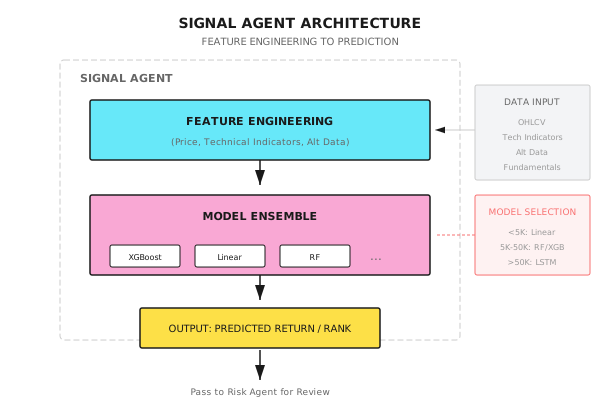
Data < 5,000 samples (e.g., 20 years of daily data)
  -> Linear model, Ridge regression
  -> Features < 20

Data 5,000-50,000 samples (e.g., 1 year of minute data)
  -> Random Forest, XGBoost
  -> Features 20-50

Data >`5`0,000 samples (e.g., tick data)
  -> Can try LSTM/Transformer
  -> But still need to verify if they outperform simple models
9.4 Special Challenges of Financial Data
Low Signal-to-Noise Ratio
Financial signals are extremely weak:
| Data Type | Signal-to-Noise Ratio | Achievable Predictive Power |
|---|---|---|
| Image Recognition | High | Accuracy 95%+ |
| Natural Language | Medium | Accuracy 80%+ |
| Financial Prediction | Extremely Low | 52-55% accuracy is already top-tier |
Why is financial signal-to-noise so low?
- Markets are nearly efficient: Obvious patterns are quickly arbitraged away
- Many participants: Patterns you find, others are using too
- Noise dominates: 90% of short-term price movement is random fluctuation
Non-Stationary Distribution
Training data and prediction data have different distributions:
Training Set (2015-2019):
  Average volatility 15%
  Trend-dominated

Test Set (2020):
  Volatility spikes to 80%
  Extreme rallies and crashes

-> Model fails in 2020
Coping Methods:
- Use rolling windows, retrain constantly
- Feature normalization using rolling statistics
- Model different regimes separately
Class Imbalance
If using "Big gain (>3%) = 1, otherwise = 0":
Big gain days: ~5%
Normal days: ~95%

Model learns to "always predict 0", 95% accuracy, but completely useless
Coping Methods:
- Adjust class weights
- Use AUC instead of accuracy for evaluation
- Stratified sampling to ensure training set class balance
9.5 Model Evaluation: Not About Accuracy
Quantitative-Specific Evaluation Metrics
| Metric | Calculation | Good Standard |
|---|---|---|
| IC (Information Coefficient) | corr(Prediction ranking, Actual return ranking) | >0.03 |
| IR (Information Ratio) | IC mean / IC standard deviation | >0.5 |
| Long-Short Return | Top quintile - Bottom quintile return difference | Significantly positive |
| Turnover-Adjusted Return | Return - Trading costs | Still positive |
Model Evaluation Example
Suppose the model predicts tomorrow's return ranking for 100 stocks:
Model Predicted Ranking (high->low):
  Stock A: 1 (predicted to rise most)
  Stock B: 2
  ...
  Stock Z: 100 (predicted to fall most)

Actual Return Ranking (high->low):
  Stock A: 5
  Stock B: 10
  ...
  Stock Z: 95

IC = corr([1,2,...,100], [5,10,...,95])
   = 0.85 (predicted ranking highly correlated with actual ranking)
Interpretation:
- IC = 0.85 means predicted ranking is highly consistent with actual ranking
- If you go long Top 10 and short Bottom 10, expect significant excess returns
- But in real markets, IC is usually only 0.02-0.05
Real-World Expectations
Top quantitative funds' IC: 0.03-0.05
Average quantitative strategy IC: 0.01-0.03
Random guessing IC: 0

Don't aim for IC >`0`.1, that's almost certainly overfitting
Production-Grade IC Calculation
The simple IC calculation shown earlier is fine for quick analysis, but production systems need robust handling of edge cases. Here is a production-ready implementation:
import numpy as np
from scipy.stats import spearmanr

def calculate_ic(
    signals: np.ndarray,
    returns: np.ndarray,
    method: str = "spearman"
) -> float:
    """Calculate Information Coefficient (IC) - correlation between signals and returns

    Args:
        signals: Prediction signal array
        returns: Actual returns array
        method: "spearman" (recommended) or "pearson"

    Returns:
        IC value, range [-1, 1]
    """
    if len(signals) != len(returns):
        raise ValueError("signals and returns must have same length")
    if len(signals) < 2:
        return 0.0

    # Handle missing values - essential for production
    mask = ~(np.isnan(signals) | np.isnan(returns))
    signals, returns = signals[mask], returns[mask]

    if len(signals) < 2:
        return 0.0

    if method == "spearman":
        ic, _ = spearmanr(signals, returns)
    else:
        ic = np.corrcoef(signals, returns)[0, 1]

    return float(ic) if not np.isnan(ic) else 0.0
Why Spearman is Preferred Over Pearson
| Aspect | Spearman | Pearson |
|---|---|---|
| Outlier Sensitivity | Robust - uses ranks | Highly sensitive - single outlier can distort |
| Relationship Type | Captures monotonic (non-linear) | Only captures linear |
| Distribution Assumption | None required | Assumes normality |
| Financial Data Fit | Better - returns have fat tails | Poor - violates normality assumption |
Key insight: Financial returns are notorious for fat tails and outliers. A single extreme day (like a market crash) can completely distort Pearson correlation. Spearman converts values to ranks first, making it immune to outlier magnitude.
Usage Examples
Basic IC Calculation:
# Daily signals and next-day returns
signals = np.array([0.02, -0.01, 0.03, 0.01, -0.02])
returns = np.array([0.015, -0.005, 0.02, 0.008, -0.01])

ic = calculate_ic(signals, returns)
print(f"IC: {ic:.4f}")  # IC: 0.9000 (strong correlation)
Rolling IC (Time Series):
def rolling_ic(
    signals: pd.Series,
    returns: pd.Series,
    window: int = 20
) -> pd.Series:
    """Calculate rolling IC over a sliding window"""
    ic_series = pd.Series(index=signals.index, dtype=float)

    for i in range(window, len(signals)):
        sig_window = signals.iloc[i-window:i].values
        ret_window = returns.iloc[i-window:i].values
        ic_series.iloc[i] = calculate_ic(sig_window, ret_window)

    return ic_series

# Example: 20-day rolling IC
rolling_ic_values = rolling_ic(signal_series, return_series, window=20)
Information Ratio (IR) Calculation:
def calculate_ir(ic_series: pd.Series) -> float:
    """Calculate Information Ratio = mean(IC) / std(IC)

    IR >`0`.5 indicates a robust signal
    """
    ic_clean = ic_series.dropna()
    if len(ic_clean) < 2 or ic_clean.std() == 0:
        return 0.0
    return ic_clean.mean() / ic_clean.std()

# Example
ir = calculate_ir(rolling_ic_values)
print(f"IR: {ir:.2f}")  # IR >`0`.5 is good
Production Notes
-
Data Alignment: Ensure signals and returns are properly aligned. Signals at time T should correspond to returns from T to T+1 (or your prediction horizon). Off-by-one errors are the most common IC calculation bug.
-
Minimum Sample Size: Use at least 30 observations for meaningful IC. With fewer samples, the correlation estimate has high variance and is unreliable.
-
IC Decay Monitoring: Track IC over time. A declining IC trend indicates:
- Alpha decay (your signal is becoming crowded)
- Regime change (market structure shifted)
- Model drift (features no longer predictive)
# IC decay detection
recent_ic = rolling_ic_values.tail(20).mean()
historical_ic = rolling_ic_values.tail(60).head(40).mean()

if recent_ic < historical_ic * 0.5:
print("WARNING: IC has decayed by 50%+")-
Cross-Sectional vs Time-Series IC:
- Cross-sectional IC: Correlation across stocks at one point in time (typical for stock selection)
- Time-series IC: Correlation over time for one asset (typical for timing signals)
The implementation above works for both; just ensure your data is structured correctly.
9.6 Multi-Agent Perspective
Model Selection for Signal Agent
In multi-agent systems, supervised learning models are the core of the Signal Agent:
What to Do When Models Fail?
Signal Agent needs to detect whether its own model is failing:
| Detection Metric | Threshold | Triggered Action |
|---|---|---|
| Rolling IC < 0 for 20 consecutive days | - | Reduce signal weight by 50% |
| Prediction distribution anomaly | Skewness >2 | Pause signal output |
| Model confidence declining | Prediction variance increasing | Notify Meta Agent |
Key Design: Signal Agent is not always correct; it needs a "self-doubt" mechanism.
Code Implementation (Optional)
Expand code example
import pandas as pd
import numpy as np
from sklearn.ensemble import RandomForestClassifier
from sklearn.model_selection import TimeSeriesSplit

def create_features(df: pd.DataFrame, lookback: int = 20) -> pd.DataFrame:
    """Build quantitative features"""
    features = pd.DataFrame(index=df.index)

    # Momentum features
    features['ret_1d'] = df['close'].pct_change(1)
    features['ret_5d'] = df['close'].pct_change(5)
    features['ret_20d'] = df['close'].pct_change(20)

    # Volatility features
    features['vol_20d'] = df['close'].pct_change().rolling(20).std()

    # Volume features
    features['vol_ratio'] = df['volume'] / df['volume'].rolling(20).mean()

    # Price position
    features['price_pos'] = (
        (df['close'] - df['low'].rolling(20).min()) /
        (df['high'].rolling(20).max() - df['low'].rolling(20).min())
    )

    return features.shift(1)  # Avoid look-ahead bias

def create_label(df: pd.DataFrame, horizon: int = 5, threshold: float = 0.02):
    """Create label: whether future n-day return exceeds threshold"""
    future_ret = df['close'].pct_change(horizon).shift(-horizon)
    label = (future_ret > threshold).astype(int)
    return label

def calculate_ic(predictions: pd.Series, returns: pd.Series) -> float:
    """Calculate Information Coefficient"""
    return predictions.corr(returns, method='spearman')

def walk_forward_train(df: pd.DataFrame, n_splits: int = 5):
    """Walk-Forward training and evaluation"""
    features = create_features(df)
    labels = create_label(df)

    # Align data
    valid_idx = features.dropna().index.intersection(labels.dropna().index)
    X = features.loc[valid_idx]
    y = labels.loc[valid_idx]

    tscv = TimeSeriesSplit(n_splits=n_splits)
    results = []

    for train_idx, test_idx in tscv.split(X):
        X_train, X_test = X.iloc[train_idx], X.iloc[test_idx]
        y_train, y_test = y.iloc[train_idx], y.iloc[test_idx]

        model = RandomForestClassifier(n_estimators=100, max_depth=5, random_state=42)
        model.fit(X_train, y_train)

        predictions = model.predict_proba(X_test)[:, 1]
        # Calculate forward returns (next 5 days), aligned with prediction horizon
        forward_returns = df.loc[X_test.index, 'close'].pct_change(5).shift(-5)
        ic = calculate_ic(pd.Series(predictions, index=X_test.index),
                         forward_returns)

        results.append({
            'test_start': X_test.index[0],
            'test_end': X_test.index[-1],
            'ic': ic,
            'accuracy': (model.predict(X_test) == y_test).mean()
        })

    return pd.DataFrame(results)
Lesson Deliverables
After completing this lesson, you will have:
- Understanding of supervised learning's role in quantitative trading - Know what it can and cannot do
- Practical feature engineering skills - Able to construct and screen effective quantitative features
- Model selection framework - Choose appropriate models based on data size
- Correct evaluation methods - Use IC/IR instead of accuracy to evaluate models
Acceptance Criteria
| Check Item | Acceptance Standard | Self-Test Method |
|---|---|---|
| Feature Construction | Can build 5 features from OHLCV data | Given price data, manually calculate feature values |
| Model Selection | Can recommend a model based on data size | Given "3 years daily" scenario, state recommendation |
| IC Calculation | Can explain what IC=0.03 means | Without notes, explain IC's business meaning |
| Failure Detection | Can list 3 model failure signals | Design Signal Agent's self-check logic |
Lesson Summary
- Understand supervised learning's correct role in quantitative trading: extracting weak signals, not predicting price movements
- Master core feature engineering methods: construction, screening, evaluation
- Recognize special challenges of financial data: low signal-to-noise, non-stationarity, class imbalance
- Learn to use IC/IR instead of accuracy to evaluate models
- Understand how Signal Agent integrates supervised learning models
Further Reading
- Advances in Financial Machine Learning by Marcos Lopez de Prado
- Background: LLM Research in Quantitative Trading - Latest research directions
Next Lesson Preview
Lesson 10: From Models to Agents
Models only output predictions, but trading requires decisions. How do you package a "prediction model" into an "Agent capable of making decisions"? In the next lesson, we bridge the gap from models to Agents.