Lesson 10: From Models to Agents
The model says "tomorrow will rise," but by how much? How much should you buy? When should you sell? The model doesn't answer these questions, but the Agent must.
The Limitations of Models
A quantitative team trained a high-quality prediction model:
- IC = 0.05 (top-tier level)
- Daily predictions for 500 stocks' return rankings
- Backtest validated stable and effective
They connected the model to their trading system with simple rules:
- Buy top 10 predicted stocks each day
- Allocate funds equally across each stock
- Sell after holding for 5 days
First month: +3% return, as expected
Second month: -5% return
What happened?
- Didn't consider correlations: All 10 stocks bought were tech stocks; when the tech sector declined, all lost together
- Didn't consider volatility: Some stocks had 5% daily volatility, others only 1%, but funds were equally distributed
- No stop-loss mechanism: One stock kept falling 15%, still held until day 5
- Didn't handle unexpected events: One stock was halted, capital was locked up
Models are only responsible for "prediction," while Agents must be responsible for "decisions." Decision-making involves:
- What to buy? (Asset selection)
- How much to buy? (Position sizing)
- When to buy/sell? (Timing)
- What if something goes wrong? (Exception handling)
This lesson teaches you how to upgrade a "prediction model" into an "Agent capable of decisions."
10.1 Prediction vs Decision
Core Differences
| Prediction Model | Trading Agent | |
|---|---|---|
| Input | Feature vector | Features + State + Constraints |
| Output | Predicted value/probability | Specific action |
| Evaluation | Prediction error (IC, MSE) | Return/Risk/Cost |
| Time | Point prediction | Continuous decision-making |
| Error Handling | None | Required |
Intuitive Example
Model output:
  "AAPL expected return tomorrow +0.5%, confidence 60%"

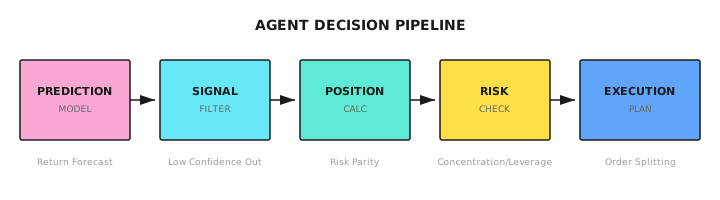
Agent must answer:
  1. Should I buy? -> Need to compare with other stocks, consider current positions
  2. How much to buy? -> Need to consider capital, risk limits, correlations
  3. At what price? -> Market order or limit order? At what level?
  4. Where's the stop-loss? -> If prediction is wrong, how much loss before exit?
  5. When to sell? -> Target price, holding period, or dynamic take-profit?
Agent's Decision Pipeline
10.2 Core Components of an Agent
State
The Agent needs to know "what situation am I in":
| State Type | Example Content |
|---|---|
| Market State | Current price, volatility, volume, trend/range |
| Position State | Current holdings, cost basis, P&L, holding duration |
| Account State | Available cash, margin, leverage used |
| System State | Is API working? What's the latency? Any alerts? |
Action Space
Actions the Agent can take:
Basic Actions:
  - BUY(symbol, quantity, order_type, price)
  - SELL(symbol, quantity, order_type, price)
  - HOLD()

Composite Actions:
  - REBALANCE(target_weights)
  - REDUCE_RISK(target_exposure)
  - CLOSE_ALL()

Constraints:
  - Single trade no more than 10% of available capital
  - Total leverage no more than 2x
  - Single stock no more than 20% of total position
Decision Function
Maps state to action:
action = decide(state, prediction, constraints)

Example:
  state = {
    cash: $100,000,
    positions: {AAPL: 100 shares, $180 cost},
    market_regime: "trend"
  }

  prediction = {
    AAPL: +0.5%,
    MSFT: +0.8%,
    GOOGL: +0.3%
  }

  constraints = {
    max_position: 20%,
    max_drawdown: 10%,
    stop_loss: 5%
  }

  action = decide(state, prediction, constraints)
  -> BUY(MSFT, 50 shares, LIMIT, $380)
10.3 Position Sizing: From Prediction to Position
Equal Weight (Simplest)
Rule: Buy Top N, allocate 1/N of funds to each

Example:
  Top 5 stocks, capital $100,000
Each gets $20,000Problem: Doesn't consider prediction strength, volatility differences, correlations
Allocation by Prediction Strength
Rule: Stronger prediction, larger allocation

Predicted returns:
  AAPL: +1.0%
  MSFT: +0.5%
  GOOGL: +0.3%

Weight calculation:
  AAPL: 1.0 / 1.8 = 56%
  MSFT: 0.5 / 1.8 = 28%
GOOGL: 0.3 / 1.8 = 16%Problem: High volatility stocks may get too much weight
Volatility Adjustment (Risk Parity)
Rule: Let each stock contribute equal risk

Volatility:
  AAPL: 25%
  MSFT: 20%
  GOOGL: 15%

Inverse volatility weights:
  AAPL: 1/0.25 = 4
  MSFT: 1/0.20 = 5
  GOOGL: 1/0.15 = 6.67

Normalized:
  AAPL: 4/15.67 = 26%
  MSFT: 5/15.67 = 32%
  GOOGL: 6.67/15.67 = 42%
Kelly Formula (Optimal)
Theoretically optimal position size:
Kelly fraction = p/a - q/b

p = win rate
q = 1 - p
a = average loss rate
b = average win rate

Example:
  Win rate 55%, win/loss ratio 1.5:1
  Kelly = 0.55/1 - 0.45/1.5 = 0.55 - 0.30 = 25%

In practice: Use half-Kelly (12.5%) for more conservative approach
Half-Kelly + Van Tharp Hybrid Model (Recommended)
Why use a hybrid model?
Using Kelly formula alone has two problems:
- Assumes infinite divisibility: In reality, stocks have minimum trading units
- Ignores fat-tail risk: During market crashes, losses can far exceed historical averages
Van Tharp's R-Multiple method addresses this gap - it forces stop-loss into position calculation, ensuring single-trade losses never exceed a fixed percentage of the account.
The two methods' roles:
| Method | Role | Purpose |
|---|---|---|
| Half-Kelly | Offense - sets upper bound | Maximize long-term compound growth |
| Van Tharp R-Multiple | Defense - sets lower bound | Survival - single loss never fatal |
Formulas:
Half-Kelly (Offensive Ceiling):
  f = (p × (b + 1) - 1) / b, then divide by 2

  p = win rate
  b = reward/risk ratio (average win / average loss)

Van Tharp R-Multiple (Defensive Floor):
  position_size = (equity × risk_pct) / stop_loss_distance

  equity = account equity
  risk_pct = risk per trade (typically 1%)
  stop_loss_distance = entry price - stop loss price
Implementation Pattern:
def half_kelly(win_rate: float, reward_risk_ratio: float) -> float:
    """Calculate Half-Kelly position ceiling"""
    full_kelly = (win_rate * (reward_risk_ratio + 1) - 1) / reward_risk_ratio
    return max(0, full_kelly / 2)

def van_tharp_limit(equity: float, risk_pct: float, stop_loss_dist: float, price: float) -> float:
    """Calculate Van Tharp position ceiling (returns position ratio)"""
    max_loss = equity * risk_pct
    shares = max_loss / stop_loss_dist
    position_value = shares * price
    return position_value / equity

# Final position = minimum of all three
strategy_cap = half_kelly(win_rate=0.55, reward_risk_ratio=1.5)  # e.g., 0.10 (10%)
risk_cap = van_tharp_limit(equity=100000, risk_pct=0.01, stop_loss_dist=5, price=100)  # e.g., 0.08 (8%)
max_notional_per_pair = 0.05  # Hard limit: no more than 5% per trade

final_position = min(strategy_cap, risk_cap, max_notional_per_pair)
Worked Example:
Account: $100,000
Strategy history: 55% win rate, 1.5:1 reward/risk ratio
Target: AAPL at $200, stop-loss at $190 (distance $10)

Step 1: Half-Kelly Ceiling
  f = (0.55 × 2.5 - 1) / 1.5 / 2 = 0.375 / 2 = 18.75%
  -> Maximum investment $18,750

Step 2: Van Tharp Floor
  Max loss per trade = $100,000 × 1% = $1,000
  Shares allowed = $1,000 / $10 = 100 shares
  Position value = 100 × $200 = $20,000
  -> By risk control, max investment $20,000

Step 3: Hard Limit
  Per-trade cap = $100,000 × 5% = $5,000

Final position = min($18,750, $20,000, $5,000) = $5,000
-> Buy 25 shares of AAPL
Core Principle:
Half-Kelly defines the offensive ceiling; Van Tharp R-Multiple defines the survival floor.
Combining both ensures:
- Not too conservative when opportunities arise (Kelly's mathematical optimization)
- Not fatal when judgment is wrong (Van Tharp's risk control floor)
- Hard limits prevent over-concentration (regardless of model confidence)
Position Calculation Example
Assumptions:
- Capital $100,000
- Max single position 20% ($20,000)
- Max total position 80% ($80,000)
Model predicts Top 3:
| Stock | Predicted Return | Volatility | Raw Weight | Risk-Adjusted Weight | Final Position |
|---|---|---|---|---|---|
| AAPL | +1.0% | 25% | 40% | 30% | $24,000 -> $20,000 (capped) |
| MSFT | +0.8% | 20% | 32% | 35% | $28,000 -> $20,000 (capped) |
| GOOGL | +0.7% | 15% | 28% | 35% | $28,000 -> $20,000 (capped) |
Final: AAPL/MSFT/GOOGL each $20,000, total position 60%
10.4 Risk Control Integration
Agent's Built-in Risk Rules
| Rule Type | Example | Triggered Action |
|---|---|---|
| Stop-Loss | Single position loss >5% | Close position |
| Take-Profit | Single position gain >10% | Reduce position by 50% |
| Total Drawdown | Account drawdown >15% | Stop opening new positions |
| Concentration | Single stock >25% | Prohibit adding more |
| Time | Holding >20 days | Force close position |
Collaboration with Risk Agent
Signal Agent proposes:
  "Buy AAPL $30,000"

Agent internal check:
  OK - Single trade < max position
  OK - Enough cash available
  X  - If bought, tech sector will exceed 60%

Internal processing options:
  A) Reduce order to $15,000
  B) Simultaneously sell some other tech stocks
  C) Abandon this trade

-> Choose A, submit $15,000 order to Risk Agent for review

Risk Agent review:
  OK - Meets account-level risk controls
  OK - No anomalies
  -> Approve for execution
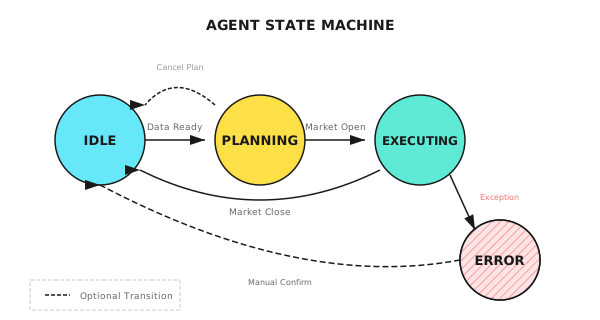
10.5 Exception Handling
Required Exception Handling
| Exception Type | Scenario | Handling Method |
|---|---|---|
| Order Rejection | Insufficient funds, stock halted | Log, adjust plan |
| Partial Fill | Insufficient liquidity | Decide whether to chase |
| Price Gap | Overnight big move | Re-evaluate stop-loss price |
| API Timeout | Network issues | Retry mechanism + circuit breaker |
| Missing Data | Data source failure | Use backup data source or pause |
Exception Handling Design Principles
- Fail Fast: When uncertain, stop rather than continue executing
- Graceful Degradation: Have backup plans when main functionality fails
- Human Intervention: Severe exceptions trigger alerts, wait for human decision
- Post-Mortem Audit: All exceptions are logged for review
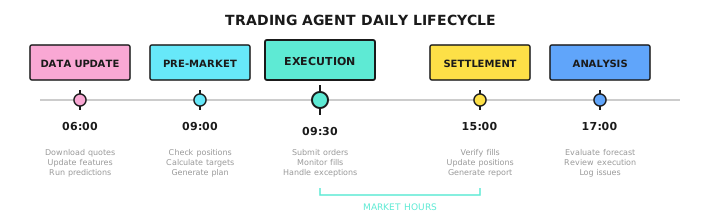
10.6 Agent Lifecycle
Daily Process
State Machine Perspective
10.7 Multi-Agent Perspective
Signal Agent's Position
Signal Agent Responsibilities:
  - Run prediction models
  - Generate raw signals (prediction rankings/returns)
  - Initial position calculation
  - Signal confidence assessment

Signal Agent Does Not:
  - Final order decision (Risk Agent)
  - Order execution (Execution Agent)
  - Position monitoring (Position Agent)
From Single Agent to Multi-Agent
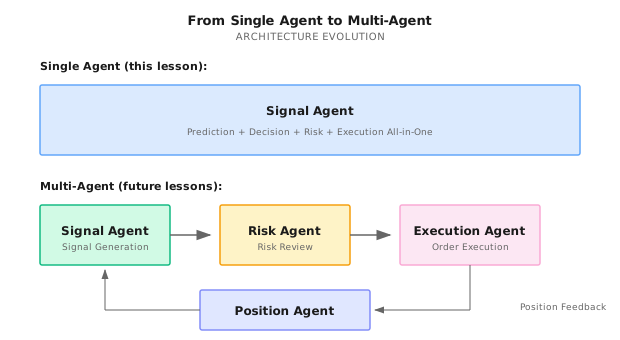
This lesson covers the simplified version of "single Agent does everything." Starting from Lesson 11, we'll split different responsibilities into specialized Agents.
Code Implementation (Optional)
Expand code example
from dataclasses import dataclass
from typing import Dict, List, Optional
from enum import Enum

class OrderType(Enum):
    MARKET = "market"
    LIMIT = "limit"

@dataclass
class Order:
    symbol: str
    quantity: int
    side: str  # "buy" or "sell"
    order_type: OrderType
    price: Optional[float] = None

@dataclass
class Position:
    symbol: str
    quantity: int
    avg_cost: float
    current_price: float

    @property
    def pnl_pct(self) -> float:
        return (self.current_price - self.avg_cost) / self.avg_cost

class TradingAgent:
    def __init__(
        self,
        capital: float,
        max_position_pct: float = 0.2,
        max_total_exposure: float = 0.8,
        stop_loss_pct: float = 0.05
    ):
        self.capital = capital
        self.max_position_pct = max_position_pct
        self.max_total_exposure = max_total_exposure
        self.stop_loss_pct = stop_loss_pct
        self.positions: Dict[str, Position] = {}

    def get_current_exposure(self) -> float:
        """Calculate current total exposure as fraction of capital"""
        total_value = sum(
            pos.quantity * pos.current_price
            for pos in self.positions.values()
        )
        return total_value / self.capital

    def calculate_position_size(
        self,
        symbol: str,
        prediction: float,
        volatility: float,
        current_price: float
    ) -> int:
        """Calculate position size"""
        # Check total exposure limit
        current_exposure = self.get_current_exposure()
        remaining_exposure = self.max_total_exposure - current_exposure
        if remaining_exposure <= 0:
            return 0  # Already at max total exposure

        # Raw weight based on prediction strength
        raw_weight = abs(prediction)

        # Volatility adjustment
        vol_adjusted_weight = raw_weight / volatility

        # Cap single position, also respect remaining exposure headroom
        capped_weight = min(vol_adjusted_weight, self.max_position_pct, remaining_exposure)

        # Calculate shares
        position_value = self.capital * capped_weight
        shares = int(position_value / current_price)

        return shares

    def check_stop_loss(self) -> List[Order]:
        """Check stop-loss triggers"""
        orders = []
        for symbol, pos in self.positions.items():
            if pos.pnl_pct < -self.stop_loss_pct:
                orders.append(Order(
                    symbol=symbol,
                    quantity=pos.quantity,
                    side="sell",
                    order_type=OrderType.MARKET
                ))
        return orders

    def generate_orders(
        self,
        predictions: Dict[str, float],
        volatilities: Dict[str, float],
        prices: Dict[str, float]
    ) -> List[Order]:
        """Generate orders"""
        orders = []

        # 1. Check stop-loss first
        stop_loss_orders = self.check_stop_loss()
        orders.extend(stop_loss_orders)

        # 2. Calculate target positions
        for symbol, pred in predictions.items():
            if pred >`0`.001:  # Only process positive predictions
                target_shares = self.calculate_position_size(
                    symbol, pred,
                    volatilities.get(symbol, 0.2),
                    prices[symbol]
                )

                current_shares = self.positions.get(symbol, Position(symbol, 0, 0, 0)).quantity
                diff = target_shares - current_shares

                if diff >`0`:
                    orders.append(Order(
                        symbol=symbol,
                        quantity=diff,
                        side="buy",
                        order_type=OrderType.LIMIT,
                        price=prices[symbol] * 0.999  # Slightly below current price
                    ))
                elif diff < 0:
                    orders.append(Order(
                        symbol=symbol,
                        quantity=-diff,
                        side="sell",
                        order_type=OrderType.LIMIT,
                        price=prices[symbol] * 1.001  # Slightly above current price
                    ))

        return orders
Lesson Deliverables
After completing this lesson, you will have:
- Prediction-to-decision transformation mindset - Understand how model outputs become concrete trading actions
- Agent architecture design - Design methods for state, action space, and decision function
- Position sizing skills - Calculation methods for equal weight, prediction-weighted, risk parity
- Exception handling awareness - Know which exceptions must be handled
Acceptance Criteria
| Check Item | Acceptance Standard | Self-Test Method |
|---|---|---|
| Prediction vs Decision | Can state 3 core differences | Without notes, list differences |
| Position Calculation | Can manually calculate risk parity weights | Given 3 stocks' volatilities, calculate weights |
| Decision Pipeline | Can draw complete flow from prediction to order | Draw on blank paper |
| Exception Handling | Can list 5 types of exceptions that must be handled | Design exception handling table |
Scenario Exercise:
Model predicts: AAPL +1.2%, TSLA +0.8%, MSFT +0.5% Volatility: AAPL 25%, TSLA 50%, MSFT 20% Capital: $100,000, max single position 20%
Question: Using risk parity calculation, how much capital should be allocated to each stock?
Click to see answer
Inverse volatility:
- AAPL: 1/0.25 = 4
- TSLA: 1/0.50 = 2
- MSFT: 1/0.20 = 5
- Total: 11
Normalized weights:
- AAPL: 4/11 = 36.4%
- TSLA: 2/11 = 18.2%
- MSFT: 5/11 = 45.4%
Capital allocation (considering 20% single position cap):
- AAPL: $36,400 -> $20,000 (capped)
- TSLA: $18,200 -> $18,200
- MSFT: $45,400 -> $20,000 (capped)
Final: AAPL $20k, TSLA $18.2k, MSFT $20k, total position 58.2%
Lesson Summary
- Understand the core differences between prediction models and trading Agents
- Master Agent's core components: state, action space, decision function
- Learn multiple position sizing methods: equal weight, prediction-weighted, risk parity, Kelly
- Recognize required exception types and handling principles
- Understand Signal Agent's position in multi-agent systems
Further Reading
- Active Portfolio Management by Grinold & Kahn - Classic work on position management
- Lesson 15: Risk Control and Money Management - More detailed risk control content
Part 3 Summary
Congratulations on completing the Machine Learning stage!
| Lesson | Key Takeaways |
|---|---|
| Lesson 09 | Supervised learning's role in quantitative trading, feature engineering, model selection, IC evaluation |
| Lesson 10 | Transformation from prediction to decision, Agent architecture, position sizing |
Next Stage Preview:
Part 4 will dive into Multi-Agent Systems:
- Lesson 11: Why Multi-Agent is Needed
- Lesson 12: Market Regime Detection
- Lesson 13: Regime Misjudgment and Systemic Collapse Patterns
- Lesson 14: LLM Applications in Quantitative Trading
- Lesson 15: Risk Control and Capital Management
- Lesson 16: Portfolio Construction and Risk Exposure Management
- Lesson 17: Online Learning and Strategy Evolution
You will learn how to build a complete multi-agent trading system, letting different expert Agents collaborate to complete the full workflow from analysis to execution.