Lesson 11: Why Multi-Agent
A person cannot simultaneously be a surgeon, lawyer, and pilot. Trading systems are the same - specialization enables excellence.
The All-in-One Dilemma
In 2018, a quant team developed an "all-in-one Agent":
- Could identify market regimes
- Could generate trading signals
- Could manage risk
- Could execute orders
- Could monitor anomalies
Backtest results were stunning: 45% annualized return, 2.3 Sharpe ratio, 12% max drawdown.
They confidently deployed it live.
Three months later, the postmortem:
| Issue | What Happened | Root Cause |
|---|---|---|
| Signal delay | When market moved, Agent was still calculating risk | Serial processing, cannot parallelize |
| Risk control failure | Stop-loss skipped during extreme markets | One module failure blocks everything |
| Hard to debug | Lost money, don't know where the problem is | Responsibilities mixed, cannot isolate |
| Hard to improve | Want to optimize execution, worried about affecting signals | Tight coupling, everything interconnected |
Core problem: Their Agent was a "super brain" doing everything, resulting in nothing done well.
It's like having one surgeon act as anesthesiologist, nurse, and hospital director simultaneously - theoretically possible, but practically guaranteed to fail.
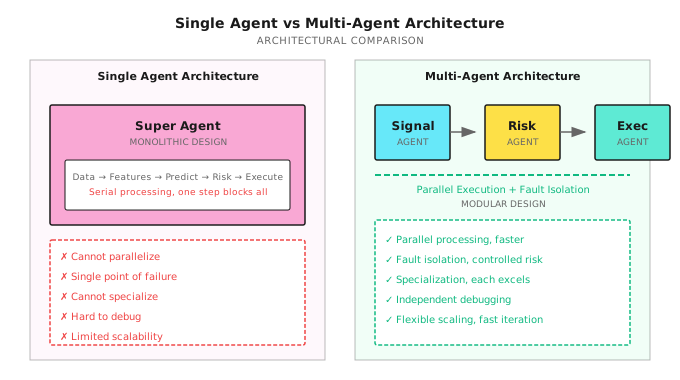
11.1 Structural Defects of Single Agent
Why Isn't One Agent Enough?
| Defect | Explanation | Impact |
|---|---|---|
| Cannot parallelize | One Agent can only process tasks sequentially | Miss time-sensitive opportunities |
| Single point of failure | One module crashes, entire system stops | Risk out of control |
| Cannot specialize | Does everything, excels at nothing | Mediocre overall performance |
| Hard to debug | Where's the problem? Signal? Risk? Execution? | Inefficient postmortem |
| Limited scalability | Adding features requires changing entire system | Slow iteration |
Visual Comparison
11.2 Core Advantages of Multi-Agent
Advantage 1: Specialization
Each Agent does one thing, but does it excellently:
| Agent | Specialization | Evaluation Metrics |
|---|---|---|
| Signal Agent | Predict future returns | IC, IR, Directional accuracy |
| Risk Agent | Protect capital | Max drawdown, VaR |
| Execution Agent | Optimal execution price | Slippage, Fill rate |
| Regime Agent | Identify market state | Switching accuracy, Latency |
Analogy: A trading system is like a hospital - needs specialists, not one all-purpose doctor.
Advantage 2: Parallel Processing
Scenario: Market suddenly moves, need to do multiple things simultaneously

Single Agent:
  09:30:00 Receive quote
  09:30:01 Calculate signal
  09:30:02 Calculate risk
  09:30:03 Prepare order
  09:30:04 Submit order  <- 4 second delay, may miss opportunity

Multi-Agent:
  09:30:00 Quote broadcast
           |-- Signal Agent: Calculate signal
           |-- Risk Agent: Assess risk
           +-- Execution Agent: Prepare execution environment
  09:30:01 Signal ready -> Risk Agent instant approval
  09:30:01.5 Order submitted  <- 1.5 seconds, 2.5x faster
Advantage 3: Fault Isolation
Scenario: Execution Agent has a bug

Single Agent:
  Entire system crashes
  -> Cannot stop-loss
  -> Cannot monitor
  -> Catastrophic outcome

Multi-Agent:
  Execution Agent fails
  -> Risk Agent detects execution anomaly
  -> Triggers emergency circuit breaker
  -> Notifies human intervention
  -> Other Agents continue running
  -> Loss controlled
Advantage 4: Independent Iteration
Scenario: Want to optimize execution algorithm

Single Agent:
  Modify execution code
  -> Worried about affecting signal logic
  -> Need full regression testing
  ->`2` week iteration cycle

Multi-Agent:
  Only modify Execution Agent
  -> Interface unchanged, other Agents unaffected
  -> Test execution logic independently
  ->`2` day iteration cycle
11.3 Multi-Agent Collaboration Mechanisms
Communication Patterns
| Pattern | Use Case | Example |
|---|---|---|
| Request-Response | Operations requiring confirmation | Signal -> Risk: "Can I buy AAPL?" |
| Publish-Subscribe | Broadcast notifications | Data Agent publishes new quotes, all subscribers receive |
| Queue | Asynchronous processing | Order queue, Execution Agent processes one by one |
| Shared State | Need consistent view | All Agents share position state |
Decision Arbitration
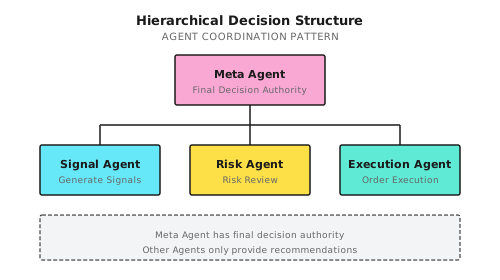
When multiple Agents have conflicting opinions, how to decide?
Approach 1: Hierarchical Structure
Approach 2: Voting Mechanism
Signal Agent: Buy AAPL (+1 vote)
Risk Agent: Don't buy, concentration limit exceeded (-1 vote)
Regime Agent: Currently trending market, inclined to follow signal (+1 vote)

Vote result: +1, execute buy (possibly reduce position to satisfy risk)
Approach 3: Veto Power
Risk Agent has veto power:
  Any trade must be approved by Risk Agent
  If Risk Agent says "no", trade doesn't execute
  This is the last line of defense for protecting capital
Responsibility Boundaries
| Agent | Responsible For | Not Responsible For |
|---|---|---|
| Signal Agent | Generate signals, predict returns | Risk, Execution |
| Risk Agent | Review orders, force stop-loss | Signal quality |
| Execution Agent | Optimal execution, order management | Signals, Risk |
| Regime Agent | Identify market state | Trading decisions |
| Meta Agent | Coordinate, arbitrate, global decisions | Specific execution |
Golden Rule: Each Agent only cares about its own responsibilities, trusting other Agents to do their jobs.
11.4 Multi-Agent Architecture Design
Standard Architecture
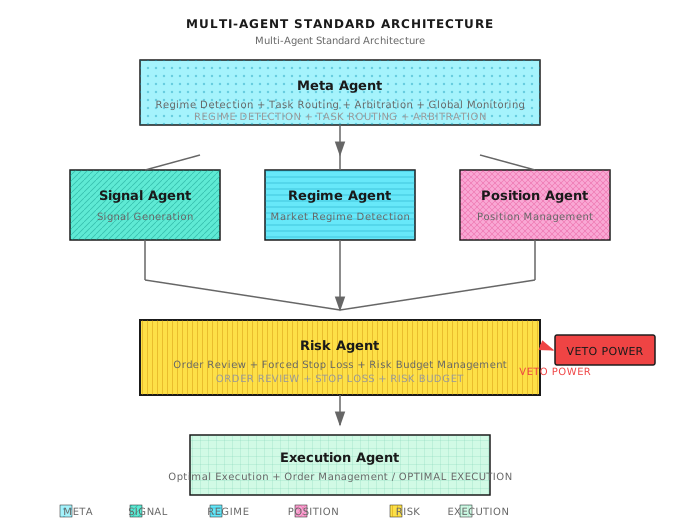
Detailed Agent Responsibilities
| Agent | Input | Output | Key Metrics |
|---|---|---|---|
| Data Agent | External data sources | Cleaned data | Latency, Completeness |
| Signal Agent | Features | Predicted returns/rankings | IC, IR |
| Regime Agent | Price, Volatility | Current market state | Accuracy, Switching latency |
| Position Agent | Current positions | Target positions | Turnover, Cost |
| Risk Agent | Pending orders | Approve/Reject/Adjust | Prevented losses |
| Execution Agent | Approved orders | Execution report | Slippage, Fill rate |
| Meta Agent | Global state | Scheduling commands | System health |
11.5 When Multi-Agent Fails
When Is Multi-Agent Actually Worse?
| Scenario | Reason | Better Choice |
|---|---|---|
| Ultra-simple strategy | Just a few rules, no need for division | Single script |
| Low latency requirements | Agent communication has overhead, may add 1-10ms | Single process optimization |
| Team too small | 1 person cannot maintain multiple Agents | Validate with single Agent first |
| Coordination cost > benefit | Too many Agents, communication complexity explodes | Reduce Agent count |
Common Multi-Agent Problems
| Problem | Symptom | Solution |
|---|---|---|
| Deadlock | Agents waiting for each other | Timeout mechanism + Priority |
| Message loss | Critical signals not delivered | Acknowledgment + Retry |
| State inconsistency | Different Agents see different positions | Shared state + Sync mechanism |
| Cascade failure | One failure triggers chain reaction | Circuit breaker + Graceful degradation |
11.6 Progressive Evolution Path
From Single Agent to Multi-Agent
Practical Principle: Get it right in one process first. Multi-agent systems are conceptually multiple independent entities collaborating, but deployment doesn't need to start as microservices from day one. Recommended path: Modular Monolith → Selective Extraction (e.g., risk engine as independent service) → Fully Distributed. Module boundaries should be clear from day one; deployment boundaries can be deferred. See Lesson 21's architecture evolution section.
Don't build complex systems from the start. Recommended path:
Stage 1: Single Agent
  |-- Validate strategy viability
  |-- Fast iteration
  +-- Accumulate experience

Stage 2: Signal + Risk Separation
  |-- Signal Agent
  +-- Risk Agent (veto power)

Stage 3: Add Execution
  |-- Signal Agent
  |-- Risk Agent
  +-- Execution Agent

Stage 4: Add Regime
  |-- Regime Agent
  |-- Signal Agent (adjust based on Regime)
  |-- Risk Agent
  +-- Execution Agent

Stage 5: Complete Architecture
  |-- Meta Agent
  |-- Data Agent
  |-- Regime Agent
  |-- Signal Agent
  |-- Position Agent
  |-- Risk Agent
  +-- Execution Agent
Acceptance Criteria for Each Stage
| Stage | Acceptance Criteria |
|---|---|
1 ->2 | Strategy Sharpe >1, need stricter risk control |
2 ->3 | Slippage cost >10% of returns, need execution optimization |
3 ->4 | Large performance difference across market states, need Regime detection |
4 ->5 | System complexity requires unified orchestration |
11.7 Multi-Agent Perspective
This Lesson's Position
Parts 1-3: Building individual Agent capabilities
  |-- Understanding markets
  |-- Mastering math and statistics
  |-- Learning machine learning
  +-- From models to Agents

Part 4 (starting from this lesson): Building multi-Agent systems
  |-- Lesson 11: Why Multi-Agent <- You are here
  |-- Lesson 12: Regime Detection (Regime Agent)
  |-- Lesson 13: Regime Misjudgment and Systemic Collapse
  |-- Lesson 14: LLM Applications in Quant
  |-- Lesson 15: Risk Control and Money Management (Risk Agent)
  |-- Lesson 16: Portfolio Construction and Exposure Management
  +-- Lesson 17: Online Learning and Strategy Evolution
Upcoming Lessons Preview
| Lesson | Focus Agent | Core Capability |
|---|---|---|
| Lesson 12 | Regime Agent | Identify bull/bear/ranging markets |
| Lesson 13 | Resilience Layer | Misjudgment diagnosis, degradation strategy |
| Lesson 14 | Research Agent (LLM) | Information extraction, analytical assistance |
| Lesson 15 | Risk Agent | Veto power, money management |
| Lesson 16 | Portfolio Agent | Position allocation, exposure monitoring |
| Lesson 17 | Evolution Agent | Online learning, strategy evolution |
Lesson Deliverables
After completing this lesson, you will have:
- Deep understanding of multi-agent architecture - Know why division of labor and collaboration is needed
- Architecture design capability - Can draw standard multi-Agent system architecture
- Collaboration mechanism design - Understand communication, arbitration, responsibility boundaries
- Progressive evolution strategy - Know when to upgrade from single Agent to multi-Agent
Acceptance Criteria
| Checkpoint | Acceptance Standard | Self-Test Method |
|---|---|---|
| Single Agent defects | Can list 5 structural problems | List without notes |
| Architecture diagram | Can draw standard multi-Agent architecture | Draw on blank paper, annotate Agent responsibilities |
| Collaboration mechanisms | Can explain 3 decision arbitration methods | Given conflict scenario, state solution |
| Evolution path | Can describe 5 stages from single to multi | Describe without notes |
Design Exercise:
You have a running single Agent strategy with the following performance:
- 25% annualized return
- 18% max drawdown
- Significant losses in ranging markets
- Execution slippage about 15% of returns
Question: How should you evolve the architecture? Which Agent to split first?
Click to see answer
Analysis:
- Ranging market losses -> Need Regime Agent to identify market state
- 15% slippage -> Need Execution Agent to optimize execution
- 18% drawdown is high -> Risk Agent needs stronger controls
Recommended evolution order:
- First: Split Risk Agent (18% drawdown too high, risk control priority)
- Second: Add Regime Agent (solve ranging market loss problem)
- Finally: Split Execution Agent (optimize 15% slippage)
Rationale: Protect capital first, then improve returns.
Lesson Summary
- Understand 5 structural defects of single Agent
- Master 4 core advantages of multi-Agent: specialization, parallel processing, fault isolation, independent iteration
- Learn 3 decision arbitration mechanisms: hierarchical structure, voting, veto power
- Recognize multi-Agent failure scenarios: ultra-simple strategy, low latency, small team
- Master progressive evolution path from single Agent to multi-Agent
Further Reading
- Background: Multi-Agent Framework Comparison - Technical selection of mainstream frameworks
- Background: Quant Open Source Framework Comparison - Tech stack for quant systems
Next Lesson Preview
Lesson 12: Regime Detection
Use trend-following in trending markets, mean reversion in ranging markets - everyone knows this principle. But the question is: How do you identify what market you're in? Next lesson we dive deep into the Regime Agent's core capability.