Lesson 12: Regime Detection
Goal: Enable the system to know "what market we're in now" so it can choose the right strategy.
A Typical Scenario (Illustrative)
Note: The following is a synthetic example to illustrate common phenomena; numbers are illustrative and don't correspond to any specific institution/product.
In early 2021, a quant fund simultaneously ran two strategies: trend following and mean reversion. Both strategies performed excellently in their respective favorable markets.
The problem was they used fixed weights - 50% each.
Result:
- In trending markets, trend strategy gained 20%, mean reversion lost 15%, net gain 2.5%
- In ranging markets, mean reversion gained 15%, trend strategy lost 20%, net loss 2.5%
- For the whole year, the two canceled each other out, returns close to zero
Their competitor? Same two strategies, but added a Regime Detection module:
- In trending markets, trend strategy weight 80%, mean reversion 20%
- In ranging markets, reversed
Result: 18% annual return, Sharpe ratio 1.6.
What's the difference? Not the strategies themselves, but knowing when to use which strategy. This is the value of regime detection - it's the "router" of the multi-agent system.
12.1 What Is Market Regime
Three Basic States
The market is always in some "state" at any moment. While boundaries between states aren't clear, they can be roughly categorized:
| State | Characteristics | Best Strategy | Typical Duration |
|---|---|---|---|
| Trending | Price moves persistently in one direction, volatility rises | Momentum/Trend following | Weeks to months |
| Mean-Reverting | Price oscillates within a range, mean reversion works | Mean reversion/Grid | Weeks to months |
| Crisis | Violent swings, correlations spike, liquidity dries up | Risk control priority/Cash is king | Days to weeks |
Why Is Regime Detection So Hard?
| Challenge | Explanation |
|---|---|
| Rearview mirror problem | States are clear in hindsight, fuzzy in real-time |
| Fuzzy boundaries | No clear dividing line between trend and ranging |
| Nested states | Daily ranging, weekly trending, monthly ranging can coexist |
| Detection lag | By the time you confirm the state, it may be nearly over |
| Switching costs | Frequent strategy switching is itself a cost |
Paper Exercise: Identify Historical States
Look at this data and judge each period's market state:
| Period | 20-Day Return | 20-Day Volatility | ADX | Your Judgment |
|---|---|---|---|---|
| A | +12% | 18% | 35 | ? |
| B | -2% | 8% | 15 | ? |
| C | -25% | 45% | 28 | ? |
| D | +3% | 12% | 22 | ? |
Click to expand answer
| Period | Judgment | Reasoning |
|---|---|---|
| A | Trending (up) | High return + moderate volatility + high ADX (>25 indicates strong trend) |
| B | Ranging | Low return + low volatility + low ADX (< 20 indicates no trend) |
| C | Crisis | Large decline + extremely high volatility (>30% annualized is warning level) |
| D | Weak trend/Transition | Return and ADX both in middle zone, hard to judge |
Key finding: Period D is hardest to judge - this is the most common real-world situation - most of the time the market is in "gray zones."
12.2 Four Methods for Regime Detection
Method Comparison
| Method | Principle | Pros | Cons | Use Case |
|---|---|---|---|---|
| Rules-based | Use indicator thresholds | Simple, interpretable, no lag | Hard to choose thresholds, hard boundaries | Quick prototype, baseline |
| Statistical | Use statistical tests to identify structural changes | Mathematically rigorous | Needs historical data, has lag | Offline analysis |
| Machine Learning | Use ML models to classify | Can capture complex patterns | Needs labels, overfitting risk | When sufficient labeled data exists |
| Hidden Markov | Assume states follow Markov chain | Can estimate state probabilities | Assumptions may not hold | When number of states is known |
Method 1: Rules-Based (Most Practical)
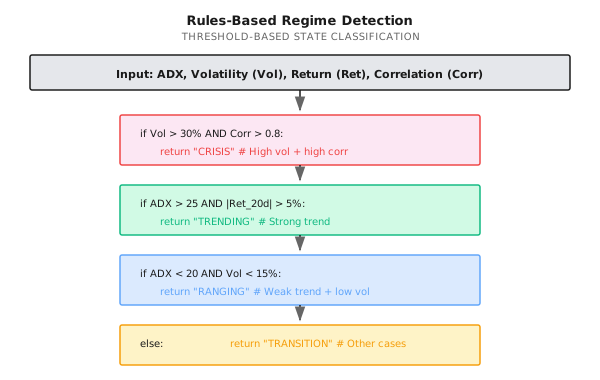
Use combinations of technical indicator thresholds to judge state:
Paper Exercise: Design Your Rules
Given the following market data, use the rules above to judge state:
| Scenario | ADX | 20-Day Volatility | 20-Day Return | Asset Correlation | State |
|---|---|---|---|---|---|
| 1 | 32 | 22% | +8% | 0.4 | ? |
| 2 | 18 | 12% | -1% | 0.3 | ? |
| 3 | 25 | 38% | -15% | 0.85 | ? |
| 4 | 23 | 18% | +3% | 0.5 | ? |
Click to expand answer
| Scenario | State | Decision Path |
|---|---|---|
| 1 | Trending | Vol=22% < 30% (not crisis) -> ADX=32 >25 and Ret=8% >5% (trending) |
| 2 | Ranging | Vol=12% < 30% (not crisis) -> ADX=18 < 20 and Vol=12% < 15% (ranging) |
| 3 | Crisis | Vol=38% >30% and Corr=0.85 >0.8 (crisis takes priority) |
| 4 | Transition | Doesn't satisfy any clear condition (ADX=23 is between 20-25) |
Method 2: Hidden Markov Model (HMM)
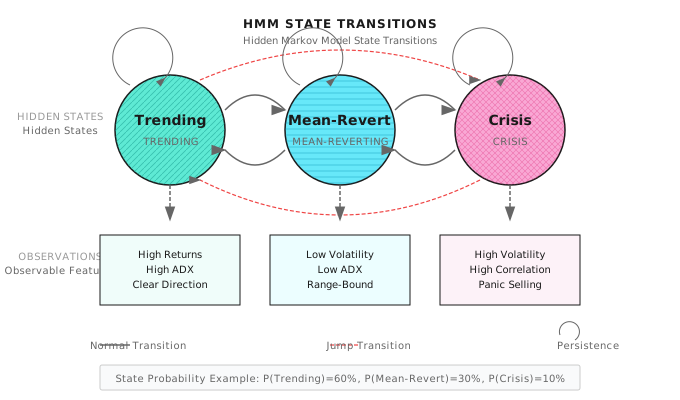
HMM assumes the market switches between several hidden states - we can only observe prices, not the true state.
HMM Core Outputs:
- State probabilities: Probability of being in each state now (e.g., Trending 60%, Ranging 30%, Crisis 10%)
- Transition probabilities: Probability of switching from one state to another
Paper Exercise: Understanding State Probabilities
HMM outputs current state probabilities as: Trending 55%, Ranging 35%, Crisis 10%
| Strategy Weight Approach | Trend Strategy | Mean Reversion | Defense Strategy | Issue |
|---|---|---|---|---|
| Hard switch | 100% | 0% | 0% | Ignores 35% ranging probability |
| Probability weighted | 55% | 35% | 10% | More robust, but slow crisis response |
| Adjusted weighting | 50% | 30% | 20% | Amplify crisis weight as insurance |
Key insight: State probabilities shouldn't be used directly as strategy weights - they need adjustment based on risk preference.
Code Implementation (For Engineers)
# Note: This is illustrative code showing basic HMM usage
# Requires hmmlearn: pip install hmmlearn

import numpy as np
from hmmlearn import hmm

class RegimeDetector:
    """HMM-based market regime detector"""

    def __init__(self, n_states: int = 3):
        self.n_states = n_states
        self.model = hmm.GaussianHMM(
            n_components=n_states,
            covariance_type="full",
            n_iter=100
        )

    def fit(self, features: np.ndarray):
        """
        Train HMM model

        features: shape (n_samples, n_features)
                  typically includes: returns, volatility, ADX, etc.
        """
        self.model.fit(features)
        return self

    def predict_proba(self, features: np.ndarray) -> np.ndarray:
        """
        Predict current state probability

        Returns: shape (n_states,) probability distribution
        """
        # Get posterior probabilities
        posteriors = self.model.predict_proba(features)
        return posteriors[-1]  # Latest time point probability

    def get_regime(self, features: np.ndarray, threshold: float = 0.5) -> str:
        """
        Get current state (with confidence threshold)
        """
        probs = self.predict_proba(features)
        max_prob = np.max(probs)
        max_state = np.argmax(probs)

        if max_prob < threshold:
            return "uncertain"

        state_names = ["trending", "mean_reverting", "crisis"]
        return state_names[max_state]
Method 3: Volatility Clustering (Practical Variant)
A simplified but practical approach is to only look at volatility state:
| Volatility Range | State | Strategy Recommendation |
|---|---|---|
| < 15% | Low volatility (Ranging) | Mean reversion, Sell options |
| 15% - 25% | Normal volatility | Normal operation |
| 25% - 35% | High volatility (Trending) | Trend following, Reduce positions |
>35% | Extreme volatility (Crisis) | Risk control priority, Major position reduction |
Why Is Volatility So Important?
- Volatility is the market's "temperature," quickly reflects market health
- Volatility has clustering effect (high volatility tends to follow high volatility)
- Volatility is more predictable than returns
12.3 Evaluating Regime Detection
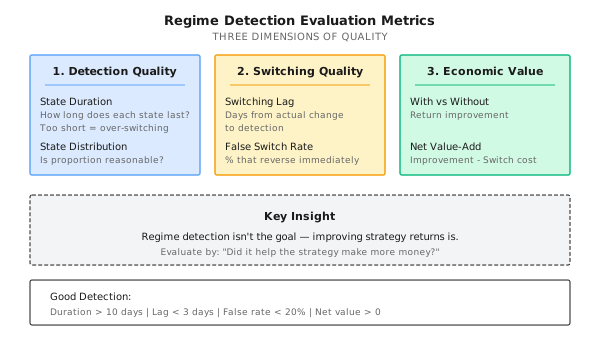
Regime detection isn't the goal - the goal is improving strategy returns. So the evaluation standard isn't "accuracy" but "did it help the strategy make more money."
Evaluation Framework
Paper Exercise: Calculate Regime Detection Value
Scenario: Your Regime Detection module's past year performance:
| Metric | Value |
|---|---|
| State switch count | 24 times |
| Average state duration | 15 days |
| Switching lag | 3 days |
| False switch rate | 20% (switched back within 5 days) |
Strategy Performance Comparison:
| Approach | Annual Return | Max Drawdown | Sharpe Ratio |
|---|---|---|---|
| No Regime (fixed 50/50) | 8% | 18% | 0.6 |
| With Regime (dynamic switching) | 15% | 12% | 1.2 |
| Switching cost (24 times x 0.5%) | -12% | - | - |
Questions:
- What is the net value-add of Regime Detection?
- If false switch rate drops to 10%, how would expected return change?
- What to do if switching cost is too high?
Click to expand answer
-
Net value-add calculation:
- Gross return improvement = 15% - 8% = 7%
- Switching cost = 24 x 0.5% = 12% (assuming each switch involves full position adjustment)
- Net value-add = 7% - 12% = -5% (Actually lost money!)
Problem: Switching too frequently, costs ate up the gains!
-
If false switch rate drops to 10%:
- False switches drop from 4.8 to 2.4
- 2.4 fewer useless switches saves 2.4 x 0.5% = 1.2%
- Net value-add = -5% + 1.2% = -3.8% (still negative)
-
Solutions for high switching costs:
- Gradual switching: Not 0->100%, but 50%->70%->90%
- Confirmation delay: State must persist N days before switching
- Soft switching: Use probability weighting instead of hard switches
- Reduce frequency: Only switch when state is very certain
Key lesson: Regime Detection value = Detection accuracy x Strategy difference - Switching cost
The Cost of Switching Lag
| Lag Days | Impact in Trending Market | Impact in Crisis Market |
|---|---|---|
| 1 day | Miss about 5% of the move | Suffer about 3% more loss |
| 3 days | Miss about 15% of the move | Suffer about 10% more loss |
| 5 days | Miss about 25% of the move | May miss stop-loss timing |
| 10 days | Trend may be half over | Crisis may have ended |
Conclusion: Better to have some false positives than too much lag. Especially crisis detection must be fast.
12.4 Common Misconceptions
Misconception 1: Higher Regime Detection accuracy is always better
Not entirely true. The evaluation standard isn't "accuracy" but "did it help the strategy make more money." 80% accuracy but switching costs eating returns is worse than 60% accuracy with fewer switches.
Misconception 2: Trend/Ranging is a binary judgment
In reality, most of the time the market is in "gray zones." Forcing binary judgment leads to frequent false switches. Correct approach: use probability weighting (Trend 60%/Ranging 40%) or acknowledge "Transition period."
Misconception 3: Switch strategy immediately when state change is detected
Dangerous approach. Switching itself has costs (trading costs, slippage), frequent switching can lose all gains. Correct approach: confirmation delay (state persists N days) + gradual switching (50%->70%->90%).
Misconception 4: Crisis detection can "wait for confirmation"
Crisis detection must be fast. By the time you confirm, you may have lost 20%. Better to false positive on crisis (earn less) than miss it (lose big).
12.5 Handling Transition Periods
The hardest thing to handle in reality isn't clear trends or ranging, but transition periods - state is changing, but not yet certain.
Characteristics of Transition Periods
| Characteristic | Manifestation |
|---|---|
| Indicator contradiction | ADX says trending, volatility says ranging |
| Fuzzy probabilities | HMM outputs 40%/35%/25%, no clear dominant state |
| Signal conflict | Trend and mean reversion strategies give opposite signals |
Transition Period Strategies
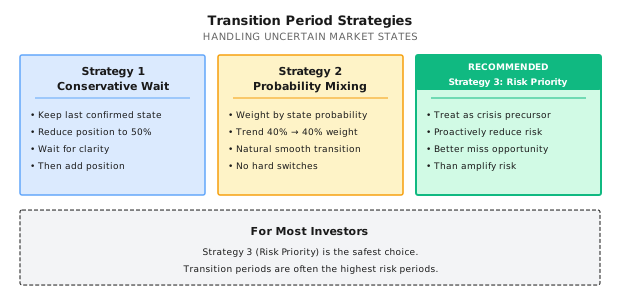
Recommendation: For most investors, Strategy 3 (Risk Priority) is the safest choice. Transition periods are often the highest risk periods.
12.5 Multi-Agent Perspective
In multi-agent architecture, Regime Detection is Meta Agent's core capability.
Architecture Design
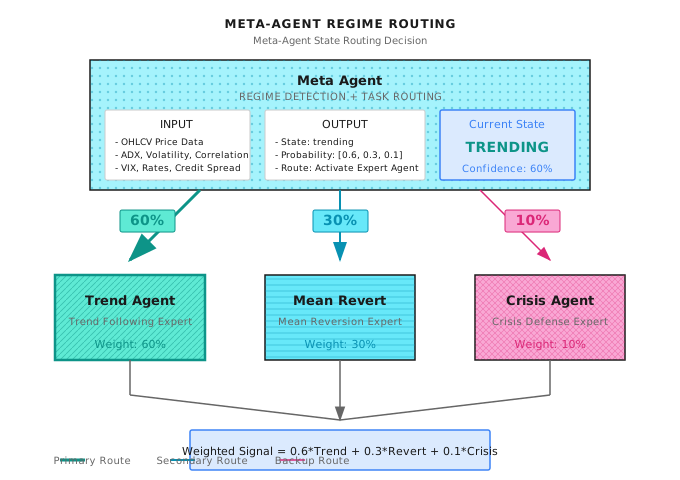
Regime Agent Responsibilities
| Responsibility | Specific Content | Trigger Condition |
|---|---|---|
| State detection | Judge current market state | Daily/Hourly |
| Signal routing | Decide which expert Agent to dispatch tasks to | When state changes |
| Weight allocation | Allocate expert weights based on state probability | Continuous |
| Switching control | Prevent over-switching, manage transitions | When state is fuzzy |
| Retrospective attribution | Record state judgments for post-analysis | Continuous |
Collaboration with Other Agents
| Collaborator | Collaboration Method |
|---|---|
| Signal Agent | Receives Regime signals, adjusts strategy parameters |
| Risk Agent | In crisis state, Risk Agent gets greater veto power |
| Execution Agent | During state switches, Execution Agent handles smooth rebalancing |
| Evolution Agent | Provides historical accuracy of regime detection for model evolution |
Acceptance Criteria
After completing this lesson, use these standards to verify learning:
| Checkpoint | Standard | Self-Test Method |
|---|---|---|
| Understand three states | Can describe characteristics and best strategies for trend/ranging/crisis | Explain in your own words |
| Master rules-based method | Can design judgment rules using ADX/volatility/correlation | Complete paper exercises |
| Understand HMM principle | Can explain the meaning and use of state probabilities | Explain why not to directly use probabilities as weights |
| Evaluate detection value | Can calculate net value-add = Return improvement - Switching cost | Complete evaluation exercise |
| Handle transition periods | Can name three transition strategies and their use cases | Give your choice and reasoning |
Comprehensive Exercise
Design Your Regime Detection System:
- Choose detection method (Rules-based/HMM/Other) and explain why
- Define input features and thresholds
- Design transition period handling strategy
- Set switching confirmation conditions (prevent over-switching)
- Define evaluation metrics
Lesson Deliverables
After completing this lesson, you will have:
- Regime Detection design framework - Complete thinking from method selection to evaluation metrics
- Practical rules-based template - Directly usable ADX/volatility/correlation judgment rules
- Method to evaluate Regime Detection value - Net value-add = Return improvement - Switching cost
- Transition period handling strategies - Three approaches and their use cases
Lesson Summary
- Understand the concept of market regime and its impact on strategy selection
- Master four Regime Detection methods: rules-based, statistical, ML, HMM
- Understand Regime Detection evaluation isn't "accuracy" but "economic value"
- Master transition period handling strategies
Further Reading
- Lesson 05: Classic Strategy Paradigms - Strategies for different states
- Lesson 11: Why Multi-Agent - Role of Regime Detection in multi-agent
- Background: Famous Quant Disasters - Consequences of failing to detect crisis states
Next Lesson Preview
Lesson 13: Regime Misjudgment and Systemic Collapse
Regime Detection is the core of multi-agent systems, but it makes mistakes - misjudgment, lag, boundary oscillation. Next lesson we dive deep into five failure modes of Regime Detection, and how to design degradation strategies to prevent systemic collapse.