Lesson 13: Regime Misjudgment and Systemic Collapse
Maximum drawdown often comes from: wrong state judgment + wrong strategy activated.
A Typical Scenario (Illustrative)
Note: The following is a synthetic example to illustrate common phenomena; numbers are illustrative and don't correspond to any specific institution/product.
In February 2020, a quant fund's Regime Detection system showed: "Ranging market".
This was a reasonable judgment - market volatility had been low for months, ADX was below 20, no clear trend.
Based on this judgment, the system activated the mean reversion strategy, adding positions on every dip.
Then March arrived.
| Date | S&P 500 | System State Judgment | Strategy Action | Result |
|---|---|---|---|---|
| 2/20 | 3,373 | Ranging | Normal holdings | - |
| 2/24 | 3,225 (-4.4%) | Ranging | Add position (buy the dip) | Loss |
| 2/27 | 2,954 (-8.4%) | Transition | Continue holding | Loss deepens |
| 3/9 | 2,746 (-7.6%) | Trending? | Confused | Deeply trapped |
| 3/12 | 2,480 (-9.5%) | Crisis! | Trigger stop-loss | 25% loss |
| 3/16 | 2,386 (-3.8%) | Crisis | Already liquidated | Miss rebound |
| 3/23 | 2,237 (bottom) | Crisis | Empty | - |
| 4/9 | 2,789 (+24.7%) | Transition | Wait and see | Miss rebound |
Final result:
- 32% drawdown from peak
- Lost 7% more than simply holding the index
- The Regime system not only didn't help, it amplified losses
Why did this happen?
- Detection lag: Took 3 weeks to switch from "Ranging" to "Crisis"
- Wrong strategy activated: Ranging strategy kept adding positions in a trending market
- Stop-loss too late: Already missed the best escape timing when crisis was confirmed
- Recovery too slow: Too conservative after crisis confirmation, missed the rebound
This is the cost of Regime misjudgment - it often happens exactly when you most need correct judgment.
13.1 Why Regime Detection Will Always Be Wrong
13.1.1 Inevitable Lag
Any Regime Detection method needs to observe a period of historical data before making a judgment. This means:
Actual state change point ----------------------+
                                    |
                                    v
         +-------------------------+-------+-------------------+
Timeline:|     Old State          |Window | New State         |
         +-------------------------+-------+-------------------+
                                    |       |
                                    v       v
                            System confirms new state

Lag = Detection window + Confirmation delay
Typical value: 3-10 trading days
Paper Exercise: The Cost of Lag
Assume the market switches from "Ranging" to "Crisis," S&P 500 drops 15% in 5 days.
| Lag Days | When You Confirm Crisis | How Much Lost | What Can You Do |
|---|---|---|---|
| 1 day | Day 2 | -3% | Stop-loss, save 12% |
| 3 days | Day 4 | -9% | Stop-loss, save 6% |
| 5 days | Day 6 | -15% | Already dropped fully |
| 10 days | Day 11 | -15% | Market may have rebounded |
Conclusion: In a fast crash, 3 days of lag can mean missing 60% of stop-loss opportunity.
13.1.2 The Rearview Mirror Problem
+-------------------------------------------------------------+
|                                                             |
|   Hindsight:  ------------------+------------------         |
|                               |                             |
|              Clearly ranging   |      Clearly trending      |
|                               |                             |
|   Real-time:  ------------------+------------------         |
|                               |                             |
|              Is ranging ending?|   Is this a false breakout?|
|              Or trend starting?|   Or a real trend?         |
|                               |                             |
+-------------------------------------------------------------+
Key insight: In backtesting, you know what happens next. In live trading, you don't.
13.1.3 Boundary Fuzziness
Market states aren't discrete switches but a continuous spectrum:
       Ranging <----------------------------------------> Trending
         |                                           |
  ADX=15 |                                           | ADX=35
  Vol=10%|                                           | Vol=25%
         |                                           |
         |        +---------------------+            |
         |        |                     |            |
         |        |   Gray Zone         |            |
         |        |   ADX 18-25         |            |
         |        |   Vol 12-20%        |            |
         |        |                     |            |
         |        +---------------------+            |
         |                                           |
         v                                           v
    Clear Ranging                              Clear Trending

Problem: The market is in the gray zone 70% of the time
13.2 Five Typical Misjudgment Patterns
13.2.1 Pattern 1: False Positive (Judging Ranging as Trending)
Scenario:
- ADX briefly breaks above 25
- 3 consecutive days up 5%
- System judges: Trend starting, activate momentum strategy
Reality:
- Just normal fluctuation within the ranging zone
- Price subsequently falls back to middle of range
- Momentum strategy buys high, stops out low
Loss Sources:
- Losses from chasing highs
- Trading costs from frequent stop-losses
- Friction costs from strategy switching
Price chart:
      /\            /\
     /  \    <-- Misjudged as trend
    /    \  /  \
---/------\/----\------  Actually a ranging zone
                 \
13.2.2 Pattern 2: False Negative (Judging Trending as Ranging)
Scenario:
- Trend just starting, volatility hasn't risen yet
- ADX still below 20
- System judges: Ranging, activate mean reversion strategy
Reality:
- A real trend has begun
- Mean reversion strategy keeps buying dips
- Deeper and deeper in the hole
This is what happened in the opening story.
13.2.3 Pattern 3: Lagged Misjudgment
Characteristic: Direction judgment correct, but timing too late.
| Time | Real State | System Judgment | Mismatch |
|---|---|---|---|
| T | Trend starts | Ranging | X |
| T+3 | Trend middle | Transition | X |
| T+7 | Trend ending | Trend confirmed! | X |
| T+10 | Trend ends | Trending | X |
| T+13 | New ranging | Transition | X |
Loss Sources:
- Miss the best trend entry point
- Enter at trend end
- Still holding after trend ends
13.2.4 Pattern 4: Oversensitive Misjudgment
Characteristic: Oversensitive to noise, frequent state switching.
Real state:  =============================================
             Persistent ranging

System:      -+--+--+--+--+--+--+--+--+--+--+--+--+--+--+--
            |  |  |  |  |  |  |  |  |  |  |  |  |  |  |
            R  T  R  T  R  Tr R  T  R  Cr R  T  R  Tr R
            a  r  a  r  a  an a  r  a  is a  r  a  an a
            n  e  n  e  n  si n  e  n  is n  e  n  si n
            g  n  g  n  g  ti g  n  g     g  n  g  ti g
            i  d  i  d  i  on i  d  i     i  d  i  on i
            n  i  n  i  n     n  i  n     n  i  n     n
            g  n  g  n  g     g  n  g     g  n  g     g
               g     g

Switch count: 15 times/month
Cost per switch: 0.5%
Total cost: 7.5%/month
Loss Sources:
- Trading costs of each switch
- Strategy doesn't have time to work
- System resource consumption
13.2.5 Pattern 5: Boundary Oscillation Misjudgment
Characteristic: Repeated switching near thresholds.
Threshold line (ADX = 25): -----------------------------------------
                           ^  v  ^  v  ^v
Actual ADX:          -----/\-/\-/\-/\-\/----------------
                       24 26 24 26 2324

System state:               R  T  R  T  RTR
                            a  r  a  r  ara
                            n  e  n  e  nrn
                            g  n  g  n  geg
                            i  d  i  d  idn
                            n  i  n  i  nig
                            g  n  g  n  gng
                               g     g

Problem: ADX oscillates between 23-27, system keeps switching
13.3 Quantifying Misjudgment Costs
13.3.1 Building a Misjudgment Cost Model
Total misjudgment cost = Direct loss + Opportunity cost + Switching cost

Where:
  Direct loss = Sum(wrong strategy losses in wrong state)
  Opportunity cost = Sum(what right strategy would have earned in right state)
  Switching cost = Switch count x Cost per switch
13.3.2 Historical Case Analysis
Case: March 2020 Crash
| Strategy Type | Correct Regime Judgment | Wrong Regime Judgment | Gap |
|---|---|---|---|
| Momentum | -5% (reduced early) | -25% (held) | 20% |
| Mean Reversion | -8% (stopped buying dips) | -35% (kept buying dips) | 27% |
| Risk Parity | -12% (passive follow) | -18% (active adding) | 6% |
Case: 2022 Rate Hike Cycle
| Month | Correct Judgment | Wrong Judgment | Gap Cause |
|---|---|---|---|
| Jan | Identify trend reversal | Still think bull market | Didn't reduce at highs |
| Mar | Confirm downtrend | Think it's a pullback | Keep buying dips |
| Jun | Stay defensive | Think it's the bottom | Another failed dip buy |
13.3.3 Paper Exercise: Calculate Your Misjudgment Sensitivity
Assume your strategy's expected returns in different state combinations:
| Actual State | Activated Strategy | Monthly Return |
|---|---|---|
| Trending | Trend strategy | +5% |
| Trending | Mean reversion | -8% |
| Ranging | Trend strategy | -3% |
| Ranging | Mean reversion | +3% |
| Crisis | Trend strategy | -15% |
| Crisis | Mean reversion | -25% |
| Crisis | Defense strategy | -5% |
Question: If your Regime Detection accuracy is 70%, what is the annual return loss?
Click to expand analysis framework
Analysis Method:
-
Assume state distribution: Trending 30%, Ranging 50%, Crisis 20%
-
Return when correctly identified:
- Trending correct (30% x 70%): 21% x 5% = 1.05%
- Ranging correct (50% x 70%): 35% x 3% = 1.05%
- Crisis correct (20% x 70%): 14% x (-5%) = -0.7%
- Monthly return about 1.4%
-
Return when wrongly identified (assuming random mismatch):
- Trending misjudged as ranging (30% x 30% / 2): 4.5% x (-8%) = -0.36%
- Trending misjudged as crisis (30% x 30% / 2): 4.5% x (-5%) = -0.23%
- ...(other combinations)
-
Combined monthly return about 0.5% (much lower than 1.4%)
Conclusion: 30% misjudgment rate can cause 65% return reduction.
13.4 Designing the "Uncertain" State
13.4.1 From Three States to Four States
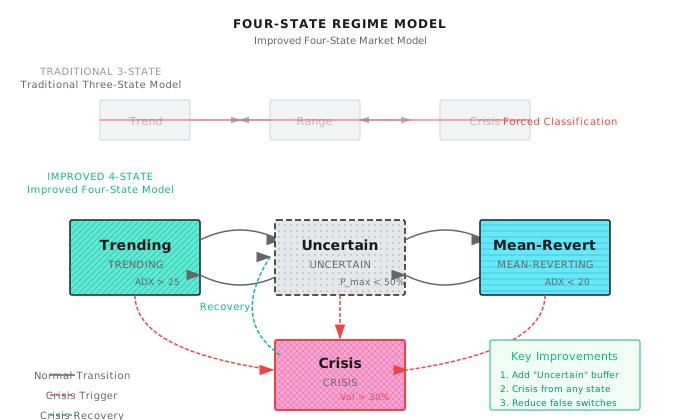
13.4.2 Definition of "Uncertain" State
| Trigger Condition | Explanation |
|---|---|
| HMM max probability < 50% | No state is dominant |
| Multiple indicators contradict | ADX says trending, volatility says ranging |
| Just after state switch | Stay uncertain for N days after switching |
| Near threshold boundary | ADX between 22-28 |
13.4.3 Strategy During "Uncertain" State
+-------------------------------------------------------------+
|                  Uncertain State Handling Strategies          |
+-------------------------------------------------------------+
|                                                             |
|  Strategy 1: Reduce and Wait                                |
|  +---------------------------------------------+            |
|  | Position in certain state: 100%              |            |
|  | Position in uncertain state: 50%             |            |
|  | Wait until state is clear to restore         |            |
|  +---------------------------------------------+            |
|                                                             |
|  Strategy 2: Strategy Mix                                   |
|  +---------------------------------------------+            |
|  | Trend prob 40%, Ranging prob 40%, Crisis 20% |            |
|  | Trend strategy weight: 40%                   |            |
|  | Mean reversion weight: 40%                   |            |
|  | Defense strategy weight: 20%                 |            |
|  +---------------------------------------------+            |
|                                                             |
|  Strategy 3: Worst-Case Preparation                         |
|  +---------------------------------------------+            |
|  | Uncertain = possible crisis precursor        |            |
|  | Proactively start hedging                    |            |
|  | Tighten stop-loss                            |            |
|  | Better miss opportunity than amplify risk    |            |
|  +---------------------------------------------+            |
|                                                             |
+-------------------------------------------------------------+
13.4.4 State Switching Confirmation Mechanism
To reduce oversensitive misjudgment, introduce confirmation delay:
State Switching Rules:
1. Single trigger: Record but don't switch
2. N consecutive days triggered: Enter "pending confirmation"
3. No reversal during pending period: Confirm switch
4. Reversal during pending period: Restore original state

Parameter Suggestions:
- N = 3 (fast response) to N = 5 (robust)
- Pending confirmation period = 2-3 days
Switching Flow Chart:
Current state: Ranging
      |
      v
Trend signal detected -----------> Record signal
      |                              |
      |                              v
      |                         Counter +1
      |                              |
      |             +----------------+----------------+
      |             |                                 |
      |        Count < 3                        Count >= 3
      |             |                                 |
      |             v                                 v
      |         Stay Ranging                   Enter Pending
      |                                              |
      |                    +-------------------------+-------------------------+
      |                    |                                                   |
      |              Still Trend after 2 days                      Back to Ranging after 2 days
      |                    |                                                   |
      |                    v                                                   v
      |              Confirm Switch to Trend                            Restore Ranging
      |                                                                 Reset Counter
      v
Next signal
13.5 Multi-Agent Perspective
13.5.1 Meta Agent Degradation Strategy
When Regime Detection is unreliable, the system needs fallback mechanisms:
+-------------------------------------------------------------+
|                 Meta Agent Degradation Strategy               |
+-------------------------------------------------------------+
|                                                             |
|  Level 0: Normal Mode                                       |
|  |-- Regime clear (probability >`7`0%)                       |
|  |-- Route to corresponding expert by state                 |
|  +-- Run at normal position                                 |
|                                                             |
|  Level 1: Cautious Mode                                     |
|  |-- Regime fuzzy (50% < probability < 70%)                 |
|  |-- Multiple experts parallel, weights mixed               |
|  +-- Position reduced to 70%                                |
|                                                             |
|  Level 2: Defensive Mode                                    |
|  |-- Regime detection failing (consecutive contradictory signals) |
|  |-- Activate defense strategy as primary                   |
|  +-- Position reduced to 50%                                |
|                                                             |
|  Level 3: Safe Mode                                         |
|  |-- System detects anomaly (data quality, latency)         |
|  |-- Stop all active trading                                |
|  +-- Only maintain hedges and stop-loss execution           |
|                                                             |
+-------------------------------------------------------------+
13.5.2 Regime Agent's Own Health Monitoring
Regime Agent Health Indicators:

1. Stability Indicators
   - State switching frequency < 3 times/week (otherwise may be oversensitive)
   - Average state duration >`5` days (otherwise may be noise)

2. Consistency Indicators
   - Agreement rate between multiple detection methods >`7`0%
   - Match rate with market performance (ex-post)

3. Timeliness Indicators
   - Crisis detection lag < 3 days
   - Major turning point capture rate >`6`0%

4. Self-Check Mechanism
   - Daily compare prediction vs actual
   - Auto-degrade when cumulative misjudgment exceeds threshold
13.5.3 Attribution and Learning After Misjudgment
Handling Process After Misjudgment:

1. Identify Misjudgment
   |-- Strategy loss + Regime change = Suspected misjudgment
   +-- Confirm actual state ex-post

2. Attribution Analysis
   |-- Is it detection method or parameter issue?
   |-- Too much lag or too sensitive?
   +-- Single indicator failure or systemic issue?

3. Feedback Learning
   |-- Record misjudgment case
   |-- Update detection parameters (online learning)
   +-- Consider method change if frequent failures

4. Notify Other Agents
   |-- Risk Agent: Update risk assessment
   |-- Signal Agent: Adjust signal thresholds
   +-- Evolution Agent: Include in training data
Acceptance Criteria
After completing this lesson, use these standards to verify learning:
| Checkpoint | Standard | Self-Test Method |
|---|---|---|
| Understand lag | Can explain why Regime Detection always has lag | List lag sources |
| Identify five misjudgments | Can describe characteristics and loss sources of each | Give examples |
| Quantify misjudgment cost | Can estimate return impact using framework | Complete paper exercise |
| Design uncertain state | Can state trigger conditions and handling strategies | Design a rule |
| Understand degradation | Can describe Meta Agent's four-level degradation | Draw degradation flow |
Lesson Deliverables
After completing this lesson, you will have:
- Regime misjudgment classification framework - Identify five typical misjudgment patterns
- Misjudgment cost quantification method - Evaluate return impact of misjudgment
- Four-state model - Improved design with "uncertain" state
- Degradation strategy template - How Meta Agent handles unreliable Regime
Lesson Summary
- Regime Detection will always have lag - this is determined by its methodology
- Five typical misjudgments: False Positive, False Negative, Lagged, Oversensitive, Boundary Oscillation
- Maximum drawdown often comes from: wrong state + wrong strategy activated
- Adding "Uncertain" state can reduce forced classification errors
- Meta Agent needs comprehensive degradation strategies
Further Reading
- Lesson 12: Regime Detection - Basic methods of Regime Detection
- Lesson 15: Risk Control and Money Management - How risk control handles Regime misjudgment
- Background: Famous Quant Disasters - Real cases of Regime misjudgment
Next Lesson Preview
Lesson 14: LLM Applications in Quant
Regime Detection tells us "what market we're in now," but the "why" behind the market is often hidden in news, earnings reports, and social media. Next lesson we explore how to use LLM to extract this unstructured information and enhance our Regime judgment.