Lesson 16: Portfolio Construction and Exposure Management
Multi-strategy does not equal low risk. Correlation is the essence of risk.
A Typical Scenario (Illustrative)
Note: The following is a synthetic example to illustrate common phenomena; numbers are illustrative and don't correspond to any specific individual/account.
In early 2022, an investor showed me their "diversified portfolio":
| Strategy | Type | Historical Sharpe | Historical Max DD | Allocation |
|---|---|---|---|---|
| Strategy A | US Stock Momentum | 1.5 | 18% | 30% |
| Strategy B | Tech Stock Trend | 1.8 | 22% | 25% |
| Strategy C | Growth Factor | 1.3 | 15% | 25% |
| Strategy D | Long Rotation | 1.4 | 20% | 20% |
They asked me: "These four strategies are all excellent, combining them should be more stable, right?"
I did a simple correlation analysis:
| Strategy A | Strategy B | Strategy C | Strategy D | |
|---|---|---|---|---|
| Strategy A | 1.00 | 0.85 | 0.78 | 0.82 |
| Strategy B | 0.85 | 1.00 | 0.88 | 0.80 |
| Strategy C | 0.78 | 0.88 | 1.00 | 0.75 |
| Strategy D | 0.82 | 0.80 | 0.75 | 1.00 |
Finding: All strategy correlations are above 0.75.
Result: In 2022, this "diversified portfolio" drew down 35% - worse than any single strategy.
Why?
These four strategies look different, but they're all doing the same thing: going long US tech stocks. When tech stocks declined as a group, they all lost simultaneously, correlations approached 1, diversification effect vanished.
This is the cost of lacking a portfolio layer - you think you're diversifying risk, but actually stacking the same bet.
16.1 The Necessity of a Portfolio Layer
16.1.1 Standard Quant Flow
A complete quant system should be:

Signals -> Portfolio Optimization -> Risk Control -> Execution
 |              |                      |              |
 +-- Each       +-- Unified            +-- Secondary  +-- Real
    Strategy       Allocation             Review         Trading
    Signal

Many systems are missing the "Portfolio Optimization" layer:

Signals -> [Missing] -> Risk Control -> Execution
 |                          |              |
 +-- Direct trading         +-- Passive    +-- May
    from signals               checking       explode
16.1.2 What Problems Does the Portfolio Layer Solve?
| Problem | Without Portfolio Layer | With Portfolio Layer |
|---|---|---|
| Weight allocation | Gut feel, equal weight | Based on risk contribution, optimization objective |
| Correlation | Don't know strategy relationships | Explicitly modeled and controlled |
| Factor exposure | Hidden exposures invisible | Monitored and constrained |
| Leverage control | May have hidden leverage | Explicitly calculate true leverage |
| Rebalancing | Random, passive | Rule-based, proactive |
16.1.3 Signal Quality Does Not Equal Portfolio Quality
This is a key distinction many overlook:
Single Strategy View:
  Strong signal -> Big position -> High return

Portfolio View:
  Strong signal + High correlation -> Big position -> Concentrated risk -> May lose big
  Strong signal + Low correlation -> Big position -> Diversified risk -> More robust
16.2 Position Sizing Methods
16.2.1 Four Common Methods Compared
| Method | Formula | Pros | Cons | Use Case |
|---|---|---|---|---|
| Equal Weight | w_i = 1/N | Simple | Ignores risk differences | Similar strategy risks |
| Equal Volatility | w_i proportional to 1/sigma_i | Considers volatility | Ignores correlation | Independent strategies |
| Equal Risk Contribution | RC_i = RC_j | Risk balanced | Complex calculation | Long-term allocation |
| Mean-Variance | max(return/risk) | Theoretically optimal | High estimation error | When expectations are reliable |
16.2.2 Equal Weight vs Equal Risk Contribution
Paper Exercise:
You have two strategies:
- Strategy A: 10% annualized volatility
- Strategy B: 30% annualized volatility
| Method | Strategy A Weight | Strategy B Weight | Portfolio Volatility |
|---|---|---|---|
| Equal Weight | 50% | 50% | ? |
| Equal Volatility | 75% | 25% | ? |
Click to expand answer
Assuming correlation = 0 (independent)
Equal Weight Allocation:
- A volatility contribution = 50% x 10% = 5%
- B volatility contribution = 50% x 30% = 15%
- Portfolio volatility = sqrt(5%^2 + 15%^2) = sqrt(0.25% + 2.25%) = 15.8%
- B contributes 90% of the risk
Equal Volatility Allocation:
- w_A = (1/10%) / (1/10% + 1/30%) = 0.1 / 0.133 = 75%
- w_B = (1/30%) / (1/10% + 1/30%) = 0.033 / 0.133 = 25%
- A volatility contribution = 75% x 10% = 7.5%
- B volatility contribution = 25% x 30% = 7.5%
- Portfolio volatility = sqrt(7.5%^2 + 7.5%^2) = 10.6%
- Both contribute equal risk
Conclusion: Equal weight allocation lets high volatility strategies dominate portfolio risk.
16.2.3 Kelly at the Portfolio Level
Single strategy Kelly:
f* = (p x b - q) / bMulti-strategy Kelly (considering correlation):
f* = Sigma^(-1) x mu

Where:
- f* = Optimal weight vector
- Sigma = Covariance matrix
- mu = Expected return vector

Key:
- High correlation strategies get down-weighted
- Negative correlation strategies get up-weighted
Practical recommendation:
- Use 1/2 Kelly or 1/4 Kelly
- Use robust estimation for covariance matrix (see next section)
- Set single strategy weight caps
16.3 Covariance Estimation and Shrinkage
16.3.1 Problems with Sample Covariance
Mean-variance optimization needs covariance matrix Sigma. The natural approach is to estimate from historical data:
Sample Covariance Matrix:
Sigma_hat = (1/T) x Sum((r_t - mu_hat)(r_t - mu_hat)')

Where:
  r_t = Return vector at time t
  mu_hat = Sample mean vector
  T = Number of samples
Problem: When asset count N approaches sample count T, the sample covariance matrix becomes extremely unstable.
Paper Exercise:
| Scenario | Assets N | Samples T | Problem |
|---|---|---|---|
| 30 stocks, 1 year daily | 30 | 252 | OK, T/N ~ 8 |
| 100 stocks, 1 year daily | 100 | 252 | Dangerous, T/N ~ 2.5 |
| 500 stocks, 1 year daily | 500 | 252 | Disaster, T/N < 1 |
Why small T/N causes problems:
1. High estimation noise
   - Covariance matrix has N x (N+1)/2 parameters
   - 100 stocks = 5,050 parameters
   - 252 samples estimating 5,050 parameters -> extremely unreliable

2. Matrix may be singular
   - When N > T, Sigma_hat is singular (determinant = 0)
   - Cannot invert -> cannot do portfolio optimization

3. Extreme weights
   - Estimation errors get amplified by optimizer
   - Produces unreasonable large weights or short positions
16.3.2 Ledoit-Wolf Shrinkage Estimation
Core idea: "Shrink" the unstable sample covariance matrix toward a stable target matrix.
Shrinkage estimate:
Sigma_shrunk = delta x F + (1-delta) x Sigma_hat

Where:
  F = Target matrix (structured, stable)
  Sigma_hat = Sample covariance matrix (unbiased but noisy)
  delta = Shrinkage intensity (0 <= delta <=1)

When delta ->`1`: Approaches target matrix (stable but biased)
When delta ->`0`: Approaches sample matrix (unbiased but noisy)
Common Target Matrices:
| Target Type | Definition | Use Case |
|---|---|---|
| Single factor model | F = beta x beta' x sigma_m^2 + D | Stock portfolios |
| Constant correlation | All assets have same correlation | Same asset class |
| Diagonal matrix | Keep only variances, correlations = 0 | Weakly correlated assets |
16.3.3 Code Implementation
import numpy as np
from sklearn.covariance import LedoitWolf, OAS

def get_shrunk_covariance(returns: np.ndarray, method: str = 'ledoit_wolf') -> dict:
    """
    Calculate shrinkage covariance matrix

    Parameters:
    -----------
    returns : Returns matrix (T x N), each row is a period, each column is an asset
    method : 'ledoit_wolf' or 'oas' (Oracle Approximating Shrinkage)

    Returns:
    --------
    dict : Contains shrinkage covariance matrix and shrinkage intensity
    """
    if method == 'ledoit_wolf':
        estimator = LedoitWolf()
    elif method == 'oas':
        estimator = OAS()
    else:
        raise ValueError(f"Unknown method: {method}")

    estimator.fit(returns)

    return {
        'covariance': estimator.covariance_,
        'shrinkage': estimator.shrinkage_,
        'sample_cov': np.cov(returns, rowvar=False)
    }


def compare_covariance_stability(returns: np.ndarray, n_splits: int = 5) -> dict:
    """
    Compare stability of sample vs shrinkage covariance

    By splitting data, compare consistency of both methods across subsamples
    """
    T, N = returns.shape
    split_size = T // n_splits

    sample_covs = []
    shrunk_covs = []

    for i in range(n_splits):
        start = i * split_size
        end = start + split_size
        subset = returns[start:end]

        sample_covs.append(np.cov(subset, rowvar=False))

        lw = LedoitWolf()
        lw.fit(subset)
        shrunk_covs.append(lw.covariance_)

    # Calculate differences across subsamples (Frobenius norm)
    sample_diffs = []
    shrunk_diffs = []

    for i in range(n_splits):
        for j in range(i+1, n_splits):
            sample_diffs.append(np.linalg.norm(sample_covs[i] - sample_covs[j], 'fro'))
            shrunk_diffs.append(np.linalg.norm(shrunk_covs[i] - shrunk_covs[j], 'fro'))

    return {
        'sample_cov_variation': np.mean(sample_diffs),
        'shrunk_cov_variation': np.mean(shrunk_diffs),
        'stability_improvement': np.mean(sample_diffs) / np.mean(shrunk_diffs)
    }
16.3.4 Usage Example
import numpy as np
from sklearn.covariance import LedoitWolf

# Simulate 50 stocks, 1 year daily data
np.random.seed(42)
n_assets = 50
n_days = 252

# Generate returns with factor structure (more realistic)
factor_returns = np.random.normal(0.0005, 0.015, n_days)
betas = np.random.uniform(0.5, 1.5, n_assets)
idio_returns = np.random.normal(0, 0.02, (n_days, n_assets))
returns = np.outer(factor_returns, betas) + idio_returns

# Sample covariance
sample_cov = np.cov(returns, rowvar=False)

# Ledoit-Wolf shrinkage covariance
lw = LedoitWolf()
lw.fit(returns)
shrunk_cov = lw.covariance_

print(f"Asset count: {n_assets}")
print(f"Sample count: {n_days}")
print(f"T/N ratio: {n_days/n_assets:.2f}")
print(f"Shrinkage intensity delta: {lw.shrinkage_:.3f}")
print(f"Sample cov condition number: {np.linalg.cond(sample_cov):.0f}")
print(f"Shrunk cov condition number: {np.linalg.cond(shrunk_cov):.0f}")

# Example output:
# Asset count: 50
# Sample count: 252
# T/N ratio: 5.04
# Shrinkage intensity delta: 0.234
# Sample cov condition number: 847
# Shrunk cov condition number: 142Interpretation:
- Shrinkage intensity delta = 0.234 means 23.4% from target matrix, 76.6% from sample matrix
- Condition number dropped from 847 to 142, meaning more stable matrix, more reliable inversion
16.3.5 When to Use Shrinkage Estimation
| Scenario | T/N Ratio | Recommendation |
|---|---|---|
T/N >10 | Comfortable | Sample covariance acceptable, limited shrinkage improvement |
| 5 < T/N <=10 | Borderline | Recommend shrinkage, notable improvement |
| 2 < T/N <=5 | Dangerous | Must use shrinkage |
| T/N <=2 | Disaster | Shrinkage + Dimensionality reduction (factor model) |
Practical recommendations:
1. Default to shrinkage estimation
   - Even with high T/N, shrinkage won't hurt
   - sklearn automatically computes optimal shrinkage intensity

2. Rolling windows need shrinkage even more
   - Rolling window = fewer samples
   - Shrinkage helps smooth covariance changes

3. Combine with factor models
   - Large portfolios (>100 assets) use factor models for dimensionality reduction
   - Apply shrinkage to residual covariance
16.4 Factor Exposure Management
16.4.1 What Is Factor Exposure?
Factors are common sources driving asset returns. Common factors:
| Factor Type | Factor Name | Meaning |
|---|---|---|
| Market Factor | Beta | Sensitivity to overall market |
| Style Factors | Size | Large cap vs Small cap |
| Value | Value stocks vs Growth stocks | |
| Momentum | Past winners vs losers | |
| Quality | High quality vs Low quality | |
| Volatility | Low vol vs High vol | |
| Industry Factors | Sector | Industry exposure |
16.4.2 Hidden Factor Exposure
Problem: You may not know what factors you're betting on.
Case: Four "Different" Strategies

Strategy A: Buy high ROE stocks
Strategy B: Buy low PE stocks
Strategy C: Buy financially solid stocks
Strategy D: Buy high dividend stocks

Looks like: Four different stock selection methods
Actually: All going long "Quality + Value" factor

Result: When Value factor fails (e.g., 2019-2020), all four strategies lose simultaneously
16.4.3 Factor Exposure Calculation
Paper Exercise:
Your portfolio holds:
| Stock | Weight | Size Beta | Value Beta | Momentum Beta |
|---|---|---|---|---|
| AAPL | 30% | 0.8 (large) | -0.5 (growth) | 0.6 |
| MSFT | 25% | 0.7 (large) | -0.3 (growth) | 0.4 |
| JPM | 25% | 0.9 (large) | 0.8 (value) | -0.2 |
| XOM | 20% | 1.0 (large) | 1.2 (value) | -0.5 |
Calculate portfolio factor exposures:
Click to expand answer
Size Exposure: = 30% x 0.8 + 25% x 0.7 + 25% x 0.9 + 20% x 1.0 = 0.24 + 0.175 + 0.225 + 0.2 = 0.84 (tilted large cap)
Value Exposure: = 30% x (-0.5) + 25% x (-0.3) + 25% x 0.8 + 20% x 1.2 = -0.15 - 0.075 + 0.2 + 0.24 = 0.215 (slightly value tilted)
Momentum Exposure: = 30% x 0.6 + 25% x 0.4 + 25% x (-0.2) + 20% x (-0.5) = 0.18 + 0.1 - 0.05 - 0.1 = 0.13 (slightly momentum tilted)
Interpretation:
- Portfolio tilts toward large cap (may passively follow market)
- Portfolio slightly tilts value factor (but not strong)
- Portfolio has slight momentum exposure
16.4.4 Factor Neutralization
If you want a factor-neutral portfolio:
Goal: Factor exposure ~ 0

Method 1: Constrained Optimization
  max  Expected return
  s.t. Factor exposure = 0
       Sum of weights = 1
       Weights >= 0

Method 2: Hedging
  If portfolio has 0.5 Value exposure
  Short 0.5 units of Value factor ETF

Method 3: Pair Trading
  For each Value stock bought
  Also buy a Growth stock (with equal Value Beta)
16.5 Hidden Leverage
16.5.1 What Is Hidden Leverage?
Explicit leverage: Borrow money to buy stocks, $1M capital + $1M borrowed = 2x leverage
Hidden leverage: No borrowing, but portfolio risk exposure exceeds capital
Case: Futures Portfolio

Capital: $1M
Holdings:
  - Stock index futures long: $2M notional (20% margin)
  - Bond futures long: $3M notional (15% margin)
  - Commodity futures long: $1.5M notional (15% margin)

Margin used: $500K
Idle cash: $500K

Appears to be: Only using 50% of capital
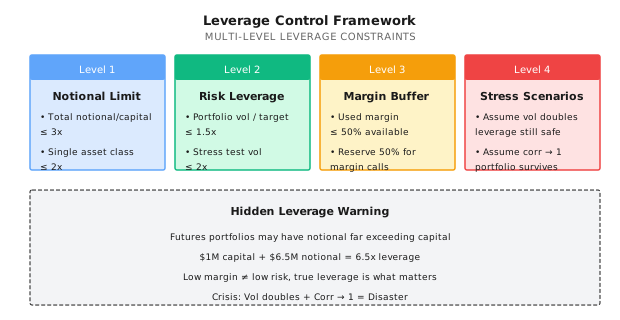
Actually: $6.5M notional exposure = 6.5x leverage!
16.5.2 Calculating True Leverage
True leverage = Sum(|Notional exposure|) / Capital

Or from risk perspective:

Risk leverage = Portfolio volatility / Benchmark volatility

Example:
  Portfolio annualized volatility: 30%
  S&P 500 volatility: 15%
  Risk leverage = 30% / 15% = 2x
16.5.3 Leverage Traps
| Trap | Manifestation | Consequence |
|---|---|---|
| Low margin illusion | "Only using 20% margin" | Actual leverage may be 5x |
| Cross-asset stacking | Futures across multiple asset classes | Hidden leverage stacking |
| Correlation underestimation | "Different assets, diversified risk" | Correlations spike in crisis |
| Volatility underestimation | Calculate leverage using normal volatility | Volatility doubles in crisis |
16.5.4 Leverage Control Framework
16.6 Multi-Strategy Portfolio Pitfalls
16.6.1 The Two Faces of Correlation
Normal period: Strategy correlation = 0.3 (diversification works)
Crisis period: Strategy correlation ->0.9 (diversification fails)
Why does correlation spike in crises?

1. Liquidity squeeze
   Everyone is selling -> All assets drop

2. Risk preference reversal
   "Risk-off" -> Only buy treasuries, sell everything else

3. Leverage liquidation
   Margin calls -> Forced selling -> Prices drop -> More margin calls

4. Panic contagion
   One market crashes -> Investors panic -> Sell all risk assets
16.6.2 Drawdown Synchronization Problem
Paper Exercise:
You have three strategies, each with 15% historical max drawdown.
| Assumption | Portfolio Max Drawdown | Calculation |
|---|---|---|
| Completely independent (correlation = 0) | ? | Won't drawdown simultaneously |
| Partially correlated (correlation = 0.5) | ? | May partially sync |
| Highly correlated (correlation = 0.9) | ? | Almost fully sync |
Click to expand answer
Simplified estimation (equal weight):
-
Completely independent:
- Probability of simultaneous max drawdown is very low
- Portfolio max drawdown ~ 8-10% (single strategy contributes ~15%/3 = 5%, plus some sync)
-
Partially correlated:
- Will have some synchronized drawdown
- Portfolio max drawdown ~ 12-13%
-
Highly correlated:
- Almost fully synchronized
- Portfolio max drawdown ~ 14-15% (approaching single strategy)
Key insight: With high correlation, "diversification" is an illusion.
16.6.3 Strategy Capacity Constraints
| Strategy Type | Typical Capacity | Reason |
|---|---|---|
| HFT market making | $10-100M | Liquidity constraints |
| Statistical arbitrage | $100M-1B | Alpha decay |
| Momentum strategies | $1-10B | Market impact |
| Passive index | Unlimited | Tracking error tolerance |
Problem: When strategy capacity is insufficient, continuing to add capital causes:
- Increased slippage
- Alpha decay
- Diminishing marginal returns
16.7 Multi-Agent Perspective
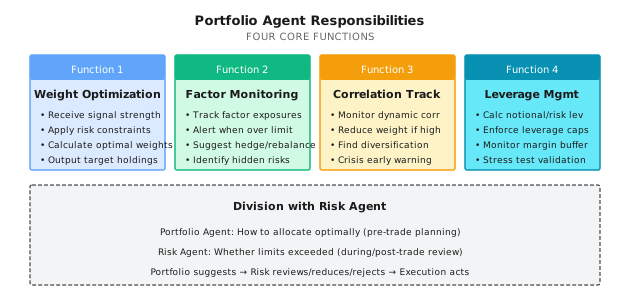
16.7.1 Portfolio Agent Responsibilities
16.7.2 Division with Risk Agent
| Dimension | Portfolio Agent | Risk Agent |
|---|---|---|
| Focus | How to allocate optimally | Whether limits exceeded |
| Timing | Pre-trade (planning stage) | During and post-trade (execution and monitoring) |
| Authority | Recommend weights | Veto power |
| Tools | Optimizer, factor models | Thresholds, circuit breakers |
Collaboration Flow:
Signal Agents --> Portfolio Agent --> Risk Agent --> Execution Agent
                       |                   |
                       v                   v
                  Optimal weights    Review/Reduce/Reject
                  Factor exposures       Leverage check
                  Correlations          Drawdown check
16.7.3 Portfolio Optimization Frequency
| Frequency | Use Case | Cost |
|---|---|---|
| Intraday | HFT strategies | High trading costs |
| Daily | Active strategies | Moderate costs |
| Weekly | Tactical allocation | Low costs |
| Monthly | Strategic allocation | Lowest costs |
Recommendation:
- Only rebalance when weight change exceeds threshold (e.g., 5%)
- Avoid over-trading costs
Acceptance Criteria
After completing this lesson, use these standards to verify learning:
| Checkpoint | Standard | Self-Test Method |
|---|---|---|
| Understand portfolio layer necessity | Can explain signal quality != portfolio quality | Give counterexample |
| Calculate weight allocation | Can calculate weights using equal weight and equal risk methods | Complete paper exercises |
| Analyze factor exposure | Can calculate portfolio factor betas | Complete factor exercise |
| Identify hidden leverage | Can calculate true leverage of futures portfolio | Give example |
| Understand correlation trap | Can explain why crisis correlations spike | Analyze case |
Lesson Deliverables
After completing this lesson, you will have:
- Position Sizing method comparison - Equal weight, equal volatility, equal risk contribution
- Factor exposure calculation framework - Identify hidden risk exposures in portfolio
- Leverage control rules - Notional and risk leverage constraints
- Portfolio Agent design template - Responsibilities and workflow for portfolio optimization
Lesson Summary
- Multi-strategy does not equal diversification, correlation determines diversification effect
- Equal weight allocation lets high volatility strategies dominate portfolio risk
- Factor exposure may be hidden, needs explicit monitoring
- Hidden leverage comes from notional exposure exceeding capital
- Crisis correlations spike, diversification effect fails
Further Reading
- Lesson 08: Beta, Hedging, and Market Neutrality - Basics of Beta and factors
- Lesson 15: Risk Control and Money Management - Risk control and portfolio layer collaboration
- Background: Statistical Traps of Sharpe Ratio - Statistical issues in portfolio evaluation
- Background: Famous Quant Disasters - Cases of leverage out of control
Next Lesson Preview
Lesson 17: Online Learning and Strategy Evolution
After the portfolio is built, markets change, strategies must evolve. How do you enable the system to continuously learn and self-update, rather than waiting until after a big loss to discover problems? Next lesson we explore online learning methods.