Lesson 18: Trading Cost Modeling and Tradability
Alpha exists = (Gross Alpha - Cost) >
0
A Typical Scenario (Illustrative)
Note: The following is a synthetic example to illustrate common phenomena; numbers are illustrative and do not correspond to any specific team/account.
In 2019, a quant team showed me their machine learning strategy:
Backtest Results (2015-2019):
- Annual Return: 45%
- Sharpe Ratio: 2.3
- Maximum Drawdown: 8%
- Monthly Win Rate: 78%
"This is the best strategy we've ever seen!" they said excitedly.
I asked one question: "What's your daily turnover rate?"
Answer: 300%.
This means buying and selling stocks equivalent to 3 times the principal every day.
I asked them to recalculate, adding the following real-world costs:
- Trading commission: 0.03% (round trip)
- Market impact: 0.1% (conservative estimate)
- Slippage: 0.05%
Cost Calculation:
- Daily cost = 300% x (0.03% + 0.1% + 0.05%) = 0.54%
- Annual cost = 0.54% x 252 = 136%

Adjusted Backtest:
- Gross return: 45%
- Cost: -136%
- Net return: -91%
Their "money printer" turned into a "money shredder."
This is why trading cost modeling is so important - it determines whether your Alpha is real or an illusion.
18.1 The True Composition of Costs
18.1.1 Explicit Costs vs. Implicit Costs
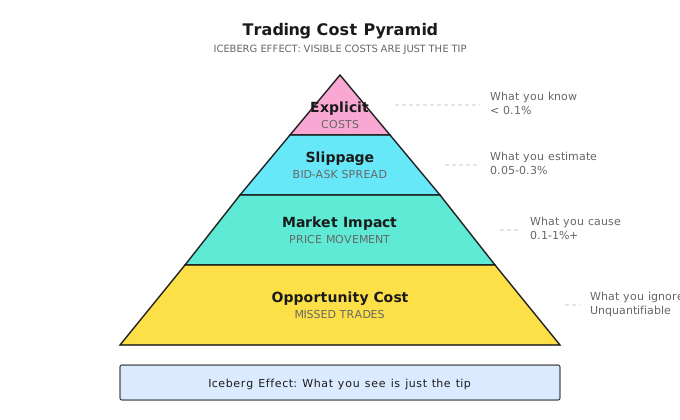
18.1.2 Explicit Costs in Detail
| Cost Type | US Stocks | A-Shares | Cryptocurrency |
|---|---|---|---|
| Commission | 0-0.005% | 0.03% | 0.02-0.1% |
| Stamp Duty | None | 0.1% (sell side) | None |
| Exchange Fees | 0.001% | Included in commission | Included in commission |
| SEC Fees | 0.00008% | None | None |
| Transfer Fees | None | 0.001% | None |
US Stock Explicit Cost Example:
Buying $100,000 of AAPL:
- Commission: $0-5 (depends on broker)
- Exchange fees: ~$1
- Total: ~$5 = 0.005%

Same for selling, round trip about 0.01%
18.1.3 Implicit Costs: The Invisible Killer
Slippage
Definition: The difference between your expected execution price and actual execution price
Expected to buy AAPL at $100.00
Actual execution price $100.05
Slippage = $0.05 = 0.05%
Sources of Slippage:
| Source | Explanation | Influencing Factors |
|---|---|---|
| Bid-Ask Spread | Gap between bid and ask | Liquidity, volatility |
| Price Movement | Time delay from order to execution | Market volatility, network latency |
| Partial Fill | Order split across multiple fills | Order size, order book depth |
Market Impact
Definition: Your trading itself pushes prices in an unfavorable direction
Scenario: You want to buy 10,000 shares of AAPL

Order Book:
  Ask 1: $100.00 x 2,000 shares
  Ask 2: $100.02 x 3,000 shares
  Ask 3: $100.05 x 5,000 shares

If you use a market order to buy all at once:
  First 2,000 shares: $100.00
  Next 3,000 shares: $100.02
  Last 5,000 shares: $100.05

Weighted average price: $100.029
Ideal price: $100.00
Market impact: 0.029%

Moreover: You've consumed Ask 2 and Ask 3
         The next buyer can only buy at higher prices
         This is "permanent impact"
Opportunity Cost
Definition: Potential returns lost due to inability to execute or delayed execution
Scenario:
  Price when signal fired: $100
  Your limit order: $99.50
  Price immediately rises to $105
  Your order never fills

Opportunity cost = $105 - $100 = 5%
18.2 Slippage Modeling
18.2.1 Linear Model
The simplest model assumes slippage is proportional to order size:
Slippage = k x OrderSize / ADV

Where:
- k = empirical coefficient (typically 0.1-0.5)
- OrderSize = order amount
- ADV = Average Daily Volume
Paper Exercise:
You want to buy $500,000 of stock, assuming k = 0.3
| Stock | ADV | Order Ratio | Expected Slippage |
|---|---|---|---|
| AAPL | $10B | 0.005% | 0.3 x 0.005% = 0.0015% |
| TSLA | $3B | 0.017% | 0.3 x 0.017% = 0.005% |
| Small Cap X | $10M | 5% | 0.3 x 5% = 1.5% |
Discovery: On small caps, a $500K order could generate $7,500 in slippage!
18.2.2 Square-Root Model
A more precise model considers nonlinear relationships:
Slippage = k x sigma x sqrt(OrderSize / ADV)

Where:
- sigma = daily volatility
- k = empirical coefficient (typically 0.5-1.5)
Paper Exercise:
| Stock | Volatility sigma | ADV | Order | Slippage (k=1) |
|---|---|---|---|---|
| AAPL | 1.5% | $10B | $1M | 1.5% x sqrt(1M/10B) = 0.015% |
| AAPL | 1.5% | $10B | $100M | 1.5% x sqrt(100M/10B) = 0.15% |
| Small Cap | 3% | $10M | $1M | 3% x sqrt(1M/10M) = 0.95% |
Key Findings:
- Slippage grows sub-linearly with order size (square root relationship)
- High volatility stocks have larger slippage
- Small cap slippage can be 60x that of large caps
18.2.3 Estimating Slippage with Tick Data
With Level-2 data, you can estimate more precisely:
Method: Simulate order walking through the order book

1. Obtain historical order book snapshots
2. Simulate market order consuming each level
3. Calculate weighted average price vs. mid-price
4. Gather slippage distribution for different order sizes
Code Framework (Engineer Reference)
def estimate_slippage(order_size: float,
                     order_book: dict,
                     side: str = 'buy') -> float:
    """
    Estimate slippage based on order book data

    order_book = {
        'bids': [(price1, size1), (price2, size2), ...],
        'asks': [(price1, size1), (price2, size2), ...]
    }
    """
    if side == 'buy':
        levels = order_book['asks']  # Buying consumes asks
    else:
        levels = order_book['bids']  # Selling consumes bids

    mid_price = (order_book['bids'][0][0] + order_book['asks'][0][0]) / 2
    filled = 0
    cost = 0

    for price, size in levels:
        if filled >= order_size:
            break
        fill_amount = min(size, order_size - filled)
        cost += fill_amount * price
        filled += fill_amount

    if filled < order_size:
        # Order book depth insufficient for full execution
        return float('inf')

    avg_price = cost / order_size
    slippage = (avg_price - mid_price) / mid_price

    return slippage if side == 'buy' else -slippage
18.3 Market Impact Modeling
18.3.1 Temporary Impact vs. Permanent Impact
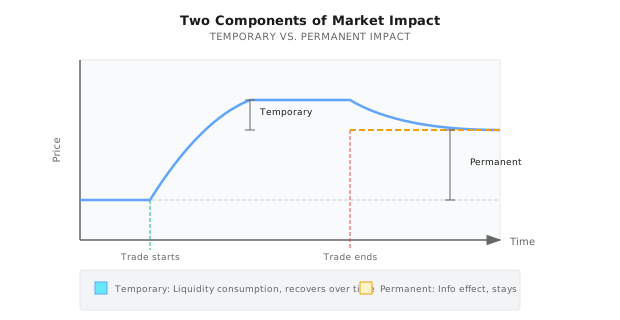
18.3.2 Almgren-Chriss Model
This is the most famous market impact model:
Total Cost = Temporary Impact + Permanent Impact + Volatility Risk

Where:
  Temporary impact is proportional to trading speed (volume per unit time)
  Permanent impact is proportional to total trading volume
  Volatility risk is proportional to execution time x volatility

Trade-off:
  Trade fast -> High temporary impact, but low volatility risk
  Trade slow -> Low temporary impact, but high volatility risk
Intuitive Explanation:
Imagine pouring a bucket of water into a pond. Pour fast (all at once) -> Big splash (temporary impact), but water settles quickly Pour slow (drop by drop) -> Small splash, but wind and rain may occur during (volatility risk)
18.3.3 Paper Exercise: Execution Strategy Selection
You want to buy $10M of AAPL (ADV = $10B), volatility = 1.5%/day
| Execution Strategy | Execution Time | Temporary Impact | Volatility Risk | Total Cost |
|---|---|---|---|---|
| Single market order | Instant | High | None | High |
| 10 orders (1 day) | 1 day | Low | 1.5% | Medium |
| 50 orders (5 days) | 5 days | Very low | 3.4% | Potentially higher |
Optimal Solution: Balance based on urgency and risk preference
18.4 Tradability Assessment
18.4.1 Fill Probability Modeling
The Limit Order Problem: Your orders may not get filled
Fill probability P(fill) depends on:
1. Distance of limit price from current price
2. Queue depth at the price level
3. Price volatility range
4. Waiting time

Estimation formula (simplified):
P(fill) ~ 1 - exp(-lambda x time)

Where lambda relates to price distance and volatility
Paper Exercise:
You place a $99 limit buy order on a $100 stock (1% below market)
| Scenario | Daily Volatility | Expected Fill Probability |
|---|---|---|
| Low volatility | 0.5% | ~20% (hard to reach -1%) |
| Medium volatility | 1.5% | ~60% (often reaches) |
| High volatility | 3% | ~85% (almost certainly reaches) |
Problem: High fill probability means prices often drop - might not be a good signal
18.4.2 Liquidity Cost Metrics
| Metric | Formula | Meaning |
|---|---|---|
| Order Ratio | Order / ADV | Lower is better |
| Liquidity Consumption | Order / Order Book Depth | Lower is better |
| Waiting Cost | Signal Decay x Wait Time | Lower is better |
| Total Cost | Slippage + Impact + Opportunity Cost | Total cost |
18.4.3 Alpha Purification: From Gross to Net
Gross Alpha: Predicted return (from backtest)

Minus:
  - Explicit costs (commission, taxes)
  - Slippage (Bid-Ask + latency)
  - Market impact
  - Opportunity cost

Equals:
  Net Alpha: Actually achievable return

Key Formula:
  Strategy viable <=> Net Alpha >`0`
  Strategy viable <=> Gross Alpha > Total Cost
Paper Exercise:
| Strategy | Gross Alpha | Turnover | Cost Per Trade | Annual Cost | Net Alpha |
|---|---|---|---|---|---|
| A | 15% | 50% | 0.2% | 2% | 13% |
| B | 20% | 200% | 0.2% | 8% | 12% |
| C | 30% | 500% | 0.2% | 20% | 10% |
| D | 40% | 1000% | 0.2% | 40% | 0% |
| E | 50% | 2000% | 0.2% | 80% | -30% |
Findings:
- Strategy E has highest gross Alpha but lowest net return
- Strategy A has lowest gross Alpha but highest net return
- High turnover is the Alpha killer
18.5 Strategy Crowding: When Everyone Trades the Same Signal
Cost modeling focuses on your own orders. But there is a systemic cost that no individual model can estimate: what happens when hundreds of funds hold the same positions and try to exit at the same time.
Case Study: 2024 China Small-Cap Quant Crisis
In early 2024, many of China's top quantitative funds suffered simultaneous drawdowns of 8-13% within weeks. Ubiquant, Lingjun, and High-Flyer -- firms managing tens of billions -- all posted double-digit losses in their CSI 500 enhanced products. The cause was not a single bad trade but strategy homogenization: most funds had overweighted small and micro-cap stocks using similar momentum and size factors. When regulatory tightening restricted micro-cap trading, forced liquidations triggered a positive feedback loop -- selling compressed liquidity, which forced more selling. Backtested slippage models, calibrated on normal conditions, wildly underestimated the impact.
The lesson: your cost model must account for crowding risk. If your strategy uses widely published factors on capacity-constrained stocks, your true cost includes the tail risk of correlated unwinding.
For a deeper analysis of strategy homogenization dynamics, capacity estimation methods, and countermeasures, see Background: Strategy Homogenization and Capacity Bottlenecks.
18.6 Why Many ML Alphas Are Untradable
18.6.1 Signal Decay Rate vs. Execution Delay
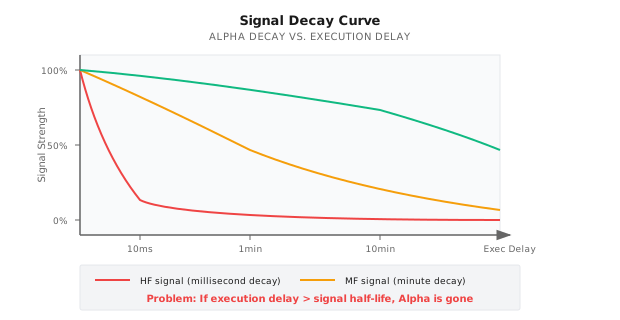
18.6.2 Capacity Constraints of High-Frequency Alpha
| Alpha Type | Typical Decay | Capacity | Viability |
|---|---|---|---|
| Market Making | Milliseconds | $1-10M | Requires HFT infrastructure |
| Statistical Arbitrage | Seconds-minutes | $10-100M | Requires low latency |
| Technical Momentum | Minutes-hours | $100M-1B | Retail possibly viable |
| Fundamental Factors | Days-weeks | $1B+ | Ample capacity |
Key Insight:
ML models easily discover short-term Alpha (because signal-to-noise ratio is high) But these Alphas often decay too fast for retail traders to execute
18.6.3 Case Study: High Win-Rate Strategy's Live Trading Collapse
Backtest Results:
- Daily win rate 65%
- Daily average return 0.3%
- Sharpe 3.0
Strategy Characteristics:
- Signal decay half-life: 2 minutes
- Average execution delay: 5 minutes
Problem:
When signal fires: Expected return +0.5%
After 2 minutes: Expected return +0.25% (50% decay)
After 5 minutes (actual execution): Expected return +0.06%

Minus 0.1% cost: Net return -0.04%

65% win rate x (-0.04%) = Continuous losses
18.7 Multi-Agent Perspective
18.7.1 Cost Estimator Agent
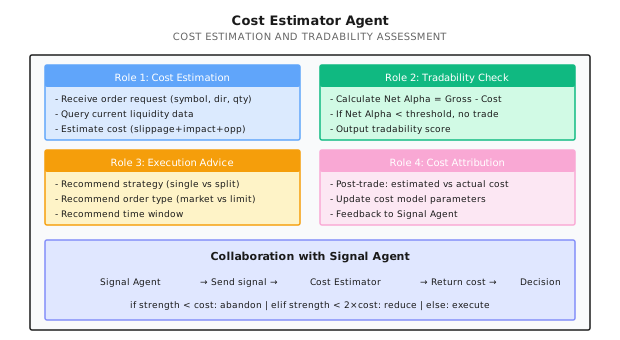
18.7.2 Cost-Aware Strategy Design
| Design Principle | Implementation |
|---|---|
| Reduce turnover | Extend holding period, raise signal threshold |
| Select high liquidity assets | Filter stocks with ADV < threshold |
| Avoid high volatility periods | No trading at open/close/events |
| Use smart orders | TWAP, VWAP, algorithmic trading |
| Capacity management | Strategy capacity = f(liquidity, impact) |
Acceptance Criteria
After completing this lesson, use the following criteria to verify learning:
| Criterion | Standard | Self-Test Method |
|---|---|---|
| Understand cost composition | Can list explicit and implicit costs | Draw cost pyramid |
| Estimate slippage | Can calculate slippage using square-root model | Complete paper exercises |
| Understand market impact | Can explain temporary and permanent impact | Give examples |
| Assess tradability | Can calculate Net Alpha | Evaluate a strategy |
| Understand ML Alpha traps | Can explain signal decay problem | Analyze a high-frequency strategy |
Lesson Deliverables
After completing this lesson, you will have:
- Cost Classification Framework - Explicit, implicit, opportunity costs
- Slippage Estimation Models - Linear and square-root models
- Tradability Assessment Method - Gross Alpha to Net Alpha
- Cost Estimator Agent Design - Cost estimation and decision collaboration
Key Takeaways
- Trading cost = Explicit cost + Slippage + Market impact + Opportunity cost
- Slippage has a square-root relationship with order size/ADV
- Strategy viability = Net Alpha >
0= Gross Alpha > Total Cost - High turnover is the Alpha killer
- ML Alpha easily discovers short-term signals, but execution delay may make them uncapturable
Further Reading
- Lesson 19: Execution System - From Signal to Real Fill - More details on execution
- Background: HFT and Market Microstructure - Market microstructure basics, Kyle's Lambda
- Background: Execution Simulator Implementation - Code implementation of 4-level execution simulator
- Appendix A: Live Trading Logging Standards - What data to record
Next Lesson Preview
Lesson 19: Execution System - From Signal to Real Fill
Cost modeling tells us "how expensive trading is." In the next lesson, we dive into execution: How to design orders? How to handle slippage? How to turn signals into actual fills in real markets?