Background: Statistical Traps of Sharpe Ratio
"Your Sharpe 2.0 strategy might just be statistical noise."
1. Estimation Error of Sharpe Ratio
1.1 Why Sample Sharpe Is Unreliable
The definition of Sharpe ratio is simple:
SR = (μ - rf) / σ

Where:
  μ  = Mean return
  rf = Risk-free rate
σ = Standard deviation of returnsProblem: Both μ and σ are estimated from finite samples, and both have estimation error.
1.2 Standard Error of Sharpe Ratio
Lo (2002) derived the approximate standard error of the Sharpe ratio:
SE(SR) ≈ √[(1 + SR²/2) / N]

Where:
N = Number of observations (e.g., trading days)Note: This formula assumes IID (independent and identically distributed) returns. If returns exhibit autocorrelation (e.g., momentum effects, mean reversion), the standard error needs adjustment. Lo (2002) also provides formulas for the autocorrelation-adjusted standard error, which can be significantly larger than the IID version for strategies with persistent return patterns.
Paper exercise:
| True Sharpe | Observations N | Standard Error SE | 95% Confidence Interval |
|---|---|---|---|
| 1.0 | 252 (1 year) | 0.077 | [0.85, 1.15] |
| 1.0 | 756 (3 years) | 0.045 | [0.91, 1.09] |
| 2.0 | 252 (1 year) | 0.109 | [1.79, 2.21] |
| 2.0 | 756 (3 years) | 0.063 | [1.88, 2.12] |
Key findings:
- 1 year of data has Sharpe estimation error of about ±0.15 (95% confidence)
- Even if true Sharpe is 0, the probability of sample Sharpe exceeding 0.06 is about 16% (exceeding 0.12 is only ~3%)
1.3 Code Implementation
import numpy as np
from scipy import stats

def sharpe_ratio(returns: np.ndarray,
                 rf: float = 0.0,
                 periods_per_year: int = 252) -> float:
    """Calculate annualized Sharpe ratio"""
    excess_returns = returns - rf / periods_per_year
    return np.sqrt(periods_per_year) * excess_returns.mean() / excess_returns.std()


def sharpe_standard_error(sr: float, n: int) -> float:
    """Calculate standard error of Sharpe ratio"""
    return np.sqrt((1 + sr**2 / 2) / n)


def sharpe_confidence_interval(sr: float, n: int,
                                confidence: float = 0.95) -> tuple:
    """Calculate confidence interval for Sharpe ratio"""
    se = sharpe_standard_error(sr, n)
    z = stats.norm.ppf((1 + confidence) / 2)
    return (sr - z * se, sr + z * se)


def sharpe_p_value(sr: float, n: int) -> float:
    """
    Test whether Sharpe ratio is significantly greater than 0
    H0: True Sharpe = 0
    """
    se = sharpe_standard_error(0, n)  # Standard error under H0
    z = sr / se
    return 1 - stats.norm.cdf(z)
Usage example:
# Assume you have 1 year of backtest data, sample Sharpe = 1.5
sr = 1.5
n = 252

se = sharpe_standard_error(sr, n)
ci = sharpe_confidence_interval(sr, n)
p = sharpe_p_value(sr, n)

print(f"Sample Sharpe: {sr:.2f}")
print(f"Standard Error: {se:.3f}")
print(f"95% Confidence Interval: [{ci[0]:.2f}, {ci[1]:.2f}]")
print(f"p-value: {p:.4f}")

# Output:
# Sample Sharpe: 1.50
# Standard Error: 0.081
# 95% Confidence Interval: [1.34, 1.66]
# p-value: 0.0000
2. Multiple Testing Problem
2.1 The Curse of Strategy Mining
Scenario: You tested 100 strategies and selected the one with the highest Sharpe.
Problem:
  - Each strategy is independent, all have true Sharpe of 0
  - After testing 100, expected maximum sample Sharpe ≈ 0.19 (pure noise!)

This is the statistical trap of "strategy mining"
2.2 Mathematical Principle
If testing K independent strategies, the expected value of maximum Sharpe:
E[max(SR₁, SR₂, ..., SRₖ)] ≈ SE × √(2 × ln(K))

Where SE is the standard error of a single Sharpe
Paper exercise:
| Strategies Tested K | Expected Max Sharpe when SE = 0.063 |
|---|---|
| 10 | 0.063 × √(2×ln(10)) = 0.135 |
| 100 | 0.063 × √(2×ln(100)) = 0.191 |
| 1,000 | 0.063 × √(2×ln(1000)) = 0.234 |
| 10,000 | 0.063 × √(2×ln(10000)) = 0.270 |
Conclusion: The more strategies you test, the higher the sample Sharpe of the "best strategy"—even if they're all noise.
3. Deflated Sharpe Ratio
3.1 What Is Deflated Sharpe
A correction method proposed by Bailey & Lopez de Prado (2014), considering:
- Multiple testing: How many strategies were tested
- Data length: Sample size
- Skewness and kurtosis: Non-normality of return distribution
3.2 Calculation Formula
DSR = Φ[(SR - SR* × √(1 + (γ₃/6)×SR + ((γ₄-3)/24)×SR²)) /
        √(1/N + (γ₃²/6)/N + ((γ₄-3)²/24)/N)]

Where:
  Φ = Standard normal CDF
  SR = Sample Sharpe
  SR* = Benchmark Sharpe (accounting for multiple testing)
  γ₃ = Skewness of returns
  γ₄ = Kurtosis of returns
  N = Sample size
SR calculation* (expected maximum Sharpe):
SR* = √(2 × ln(K)) × √(1/N) × (1 - γ × √(2 × ln(K)) + ...)

Simplified version:
SR* ≈ √(Var[SR]) × [(1-γ)×Z_K + γ×Z_K×exp(-Z_K²/2)]

Where Z_K = Φ⁻¹(1 - 1/K)
3.3 Full Implementation
import numpy as np
from scipy import stats

def deflated_sharpe_ratio(
    returns: np.ndarray,
    n_trials: int,
    rf: float = 0.0,
    periods_per_year: int = 252
) -> dict:
    """
    Calculate Deflated Sharpe Ratio

    Parameters:
    -----------
    returns : Return series
    n_trials : Number of strategies/parameter combinations tested
    rf : Risk-free rate
    periods_per_year : Annualization factor

    Returns:
    --------
    dict : Contains original Sharpe, DSR, p-value, etc.
    """
    n = len(returns)
    excess = returns - rf / periods_per_year

    # Basic statistics
    mu = excess.mean()
    sigma = excess.std(ddof=1)
    skew = stats.skew(excess)
    kurt = stats.kurtosis(excess)  # Excess kurtosis

    # Annualized Sharpe
    sr = np.sqrt(periods_per_year) * mu / sigma

    # Expected maximum Sharpe (based on multiple testing)
    if n_trials >`1`:
        z = stats.norm.ppf(1 - 1 / n_trials)
        euler_gamma = 0.5772156649
        sr_star = np.sqrt(1/n) * (
            (1 - euler_gamma) * z +
            euler_gamma * z * np.exp(-z**2 / 2)
        ) * np.sqrt(periods_per_year)
    else:
        sr_star = 0

    # Standard error of Sharpe ratio (accounting for non-normality)
    # Note: scipy.stats.kurtosis() returns EXCESS kurtosis (already subtracts 3),
    # so we use kurt/24 directly, not (kurt-3)/24
    sr_var = (1 + (skew/6)*sr + (kurt/24)*sr**2) / n
    sr_std = np.sqrt(sr_var) * np.sqrt(periods_per_year)

    # Deflated Sharpe test statistic
    if sr_std >`0`:
        z_stat = (sr - sr_star) / sr_std
        p_value = 1 - stats.norm.cdf(z_stat)
    else:
        z_stat = np.nan
        p_value = 1.0

    # DSR = Probability that strategy Sharpe significantly exceeds benchmark
    dsr = 1 - p_value

    return {
        'sharpe_ratio': sr,
        'expected_max_sr': sr_star,
        'deflated_sr': dsr,
        'p_value': p_value,
        'z_statistic': z_stat,
        'n_observations': n,
        'n_trials': n_trials,
        'skewness': skew,
        'kurtosis': kurt,
        'is_significant': p_value < 0.05
    }
3.4 Usage Example
# Simulate strategy returns
np.random.seed(42)
daily_returns = np.random.normal(0.0005, 0.01, 252)  # 1 year of data

# Assume we tested 50 parameter combinations
result = deflated_sharpe_ratio(daily_returns, n_trials=50)

print(f"Original Sharpe: {result['sharpe_ratio']:.2f}")
print(f"Expected Max Sharpe (50 trials): {result['expected_max_sr']:.2f}")
print(f"Deflated SR: {result['deflated_sr']:.2%}")
print(f"p-value: {result['p_value']:.4f}")
print(f"Is Significant: {result['is_significant']}")
4. Practical Guidelines
4.1 When to Worry
| Situation | Risk Level | Recommendation |
|---|---|---|
| Sample Sharpe < 1.0, tested < 10 strategies | Low | Possibly valid, continue verification |
| Sample Sharpe 1.0-2.0, tested 10-100 strategies | Medium | Calculate DSR, beware of overfitting |
Sample Sharpe >2.0, tested >100 strategies | High | Almost certainly overfitting |
Sample Sharpe >3.0 | Very High | Check for data errors or look-ahead bias |
4.2 How to Report Sharpe Ratio
Wrong approach:
"My strategy has Sharpe 2.5"
Correct approach:
"Based on 3 years of daily data (756 observations), sample Sharpe is 2.5,
95% confidence interval [2.3, 2.7], after testing 30 parameter combinations, Deflated SR = 0.92, p-value = 0.04"
4.3 Methods to Mitigate Multiple Testing
1. Pre-determine the number of strategies to test
   - Write down the list of strategies to test
   - Don't add strategies as you go

2. Out-of-sample validation
   - Reserve 20-30% of data not used in development
   - Only test the final strategy once on this data

3. Bonferroni correction
   - Significance level = 0.05 / K
   - K strategies require p < 0.05/K to be significant

4. Record all tests
   - Record even failed strategies
   - Use for calculating true n_trials
5. Common Misconceptions
Misconception 1: Higher Sharpe is always better
Extremely high Sharpe (>3) usually means:
- Data errors (duplicate calculations, look-ahead information)
- Overfitting
- Strategy capacity too small
Misconception 2: 3 years of data is enough to accurately estimate Sharpe
3 years of data (756 days) has standard error of about 0.04-0.05, meaning:
- A strategy with true Sharpe 1.0 may show sample Sharpe between 0.9-1.1
- Distinguishing between Sharpe 1.0 and 1.2 strategies is nearly impossible
Misconception 3: Backtest Sharpe = Live Sharpe
Backtests typically overestimate:
- Ignore slippage and market impact
- Subtle look-ahead bias
- Survivorship bias
Rule of thumb: Live Sharpe ≈ Backtest Sharpe × 0.5-0.7
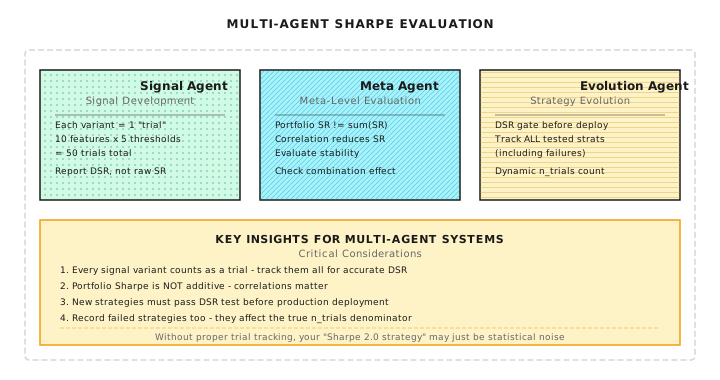
6. Multi-Agent Perspective
In multi-agent architecture, the statistical issues of Sharpe ratio require special attention:
7. Summary
| Key Point | Description |
|---|---|
| Estimation error | 1 year of data has Sharpe standard error ≈ 0.07-0.08 |
| Multiple testing | Testing 100 strategies, expected max Sharpe ≈ 0.19 (pure noise) |
| Deflated SR | Significance test accounting for multiple testing |
| Practical advice | Report confidence intervals, calculate DSR, maintain skepticism |
Further Reading
- Lesson 03: Math and Statistics Fundamentals - Statistics basics
- Lesson 07: Backtest System Pitfalls - Other biases in backtesting
- Bailey, D. H., & Lopez de Prado, M. (2014). The Deflated Sharpe Ratio
- Lo, A. W. (2002). The Statistics of Sharpe Ratios