Background: Tick-Level Backtest Framework
"Using daily bars to backtest a minute strategy is like using a world map to navigate city streets—the resolution is completely inadequate."
1. Why Tick-Level Backtesting?
1.1 Use Cases for Different Data Granularities
| Data Granularity | Suitable Strategies | Precision | Data Volume |
|---|---|---|---|
| Daily | Trend following, Value investing | Low | Small |
| Minute | Intraday momentum, Mean reversion | Medium | Medium |
| Tick/L2 | Market making, HFT arbitrage, Precise execution | High | Large |
1.2 Limitations of Minute-Bar Backtesting
Scenario: A 5-minute bar shows
  Open: $100.00
  High: $100.50
  Low:  $99.80
  Close: $100.20

Question: What was the price path during these 5 minutes?

Possibility 1: Up then down then up
  $100.00 → $100.50 → $99.80 → $100.20

Possibility 2: Down then up
  $100.00 → $99.80 → $100.50 → $100.20

Possibility 3: Volatile oscillation
  Multiple touches of high and low

Would your stop-loss at $99.90 be triggered? Can't tell from bars.
1.3 Questions Tick Data Can Answer
| Question | Bar Backtest | Tick Backtest |
|---|---|---|
| Will limit order fill? | Can only guess | Precise determination |
| Exact fill time? | Unknown | Millisecond precision |
| Queue position impact? | Cannot simulate | Can estimate |
| Path-dependent stop-loss? | Inaccurate | Accurate |
| True slippage distribution? | Fixed assumption | Actual calculation |
2. Tick Data Structures
2.1 Trade Tick Data
@dataclass
class TradeTick:
    """Trade-by-trade data"""
    timestamp: float      # Unix timestamp (seconds with decimal fraction)
    symbol: str           # Symbol code
    price: float          # Trade price
    size: float           # Trade size
    side: str             # 'buy' or 'sell' (aggressor side)
    trade_id: str         # Trade ID
Sample data:
timestamp,symbol,price,size,side,trade_id
1704067200.123,AAPL,185.50,100,buy,T001
1704067200.156,AAPL,185.51,50,buy,T002
1704067200.189,AAPL,185.50,200,sell,T003
1704067200.201,AAPL,185.49,150,sell,T004
2.2 Order Book Snapshot
@dataclass
class OrderBookSnapshot:
    """Order book snapshot"""
    timestamp: float
    symbol: str
    bids: List[Tuple[float, float]]  # [(price, size), ...]
    asks: List[Tuple[float, float]]  # [(price, size), ...]

    @property
    def mid_price(self) -> float:
        if self.bids and self.asks:
            return (self.bids[0][0] + self.asks[0][0]) / 2
        return 0.0

    @property
    def spread(self) -> float:
        if self.bids and self.asks:
            return self.asks[0][0] - self.bids[0][0]
        return float('inf')
2.3 Order Book Delta
@dataclass
class OrderBookDelta:
    """Order book incremental update"""
    timestamp: float
    symbol: str
    side: str           # 'bid' or 'ask'
    price: float
    size: float         # New quantity (0 means delete price level)
    action: str         # 'add', 'modify', 'delete'
3. Event-Driven vs Vectorized Backtesting
3.1 Vectorized Backtesting
Characteristics:
- Batch computation with NumPy/Pandas
- Fast (seconds to process years of data)
- Suitable for simple strategies
Limitations:
- Hard to simulate order states
- Cannot handle complex execution logic
- Path-dependent logic hard to express
# Vectorized backtest example
import pandas as pd
import numpy as np

def vectorized_backtest(df: pd.DataFrame,
                        signal_col: str,
                        price_col: str = 'close') -> pd.Series:
    """
    Simple vectorized backtest
    signal_col: 1=long, -1=short, 0=flat
    """
    # Shift signal by 1 period (avoid lookahead)
    position = df[signal_col].shift(1).fillna(0)

    # Calculate returns
    returns = df[price_col].pct_change()
    strategy_returns = position * returns

    # Cumulative returns
    cumulative = (1 + strategy_returns).cumprod()

    return cumulative
3.2 Event-Driven Backtesting
Characteristics:
- Process event by event
- Can precisely simulate order lifecycle
- Suitable for complex strategies and tick data
Costs:
- Slower speed
- Higher code complexity
Event stream:
  t=0.001: MarketData(AAPL, bid=185.50, ask=185.51)
  t=0.002: Signal(BUY, size=100)
  t=0.002: OrderSubmit(LIMIT, 185.50, 100)
  t=0.005: MarketData(AAPL, bid=185.49, ask=185.50)
  t=0.010: Trade(185.50, 50)  ← Partial fill
  t=0.015: MarketData(AAPL, bid=185.50, ask=185.51)
  t=0.020: Trade(185.50, 50)  ← Remaining fill
  t=0.020: OrderFilled(complete)
4. Event-Driven Framework Implementation
4.1 Core Components
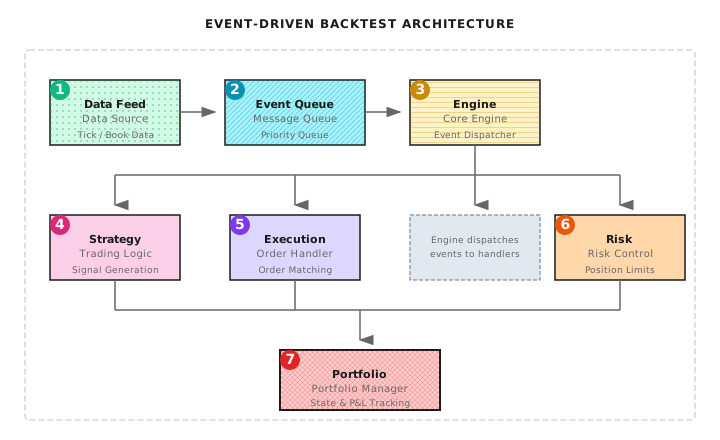
4.2 Event Type Definitions
from enum import Enum
from dataclasses import dataclass
from typing import Optional, List

class EventType(Enum):
    MARKET_DATA = "market_data"
    SIGNAL = "signal"
    ORDER = "order"
    FILL = "fill"
    CANCEL = "cancel"

@dataclass
class Event:
    """Base event"""
    timestamp: float
    event_type: EventType

@dataclass
class MarketDataEvent(Event):
    """Market data event"""
    symbol: str
    bid: float
    ask: float
    bid_size: float
    ask_size: float
    last_price: Optional[float] = None
    last_size: Optional[float] = None

    def __post_init__(self):
        self.event_type = EventType.MARKET_DATA

@dataclass
class SignalEvent(Event):
    """Strategy signal event"""
    symbol: str
    direction: int      # 1=buy, -1=sell, 0=close
    strength: float     # Signal strength [0, 1]

    def __post_init__(self):
        self.event_type = EventType.SIGNAL

@dataclass
class OrderEvent(Event):
    """Order event"""
    symbol: str
    order_type: str     # 'market', 'limit'
    side: str           # 'buy', 'sell'
    quantity: float
    price: Optional[float] = None  # Limit order price
    order_id: Optional[str] = None

    def __post_init__(self):
        self.event_type = EventType.ORDER

@dataclass
class FillEvent(Event):
    """Fill event"""
    symbol: str
    order_id: str
    side: str
    quantity: float
    price: float
    commission: float

    def __post_init__(self):
        self.event_type = EventType.FILL
4.3 Event Queue
import heapq
from typing import List

class EventQueue:
    """Priority event queue (sorted by timestamp)"""

    def __init__(self):
        self._queue: List[tuple] = []
        self._counter = 0  # For ordering events at same timestamp

    def push(self, event: Event):
        """Add event"""
        heapq.heappush(self._queue,
                       (event.timestamp, self._counter, event))
        self._counter += 1

    def pop(self) -> Optional[Event]:
        """Pop earliest event"""
        if self._queue:
            _, _, event = heapq.heappop(self._queue)
            return event
        return None

    def is_empty(self) -> bool:
        return len(self._queue) == 0

    def peek(self) -> Optional[Event]:
        """View earliest event (without removing)"""
        if self._queue:
            return self._queue[0][2]
        return None
4.4 Execution Simulator
class TickExecutionSimulator:
    """Tick-level execution simulator"""

    def __init__(self,
                 commission_rate: float = 0.0003,
                 latency_ms: float = 1.0):
        self.commission_rate = commission_rate
        self.latency_ms = latency_ms
        self.pending_orders = {}
        self.order_counter = 0

    def submit_order(self, order: OrderEvent,
                     current_book: OrderBookSnapshot) -> List[Event]:
        """
        Submit order, return generated events
        """
        events = []
        self.order_counter += 1
        order.order_id = f"ORD_{self.order_counter:06d}"

        # Simulate latency
        exec_time = order.timestamp + self.latency_ms / 1000

        if order.order_type == 'market':
            # Market order attempts immediate fill
            fill = self._execute_market_order(order, current_book, exec_time)
            if fill:
                events.append(fill)
        else:
            # Limit order enters pending queue
            self.pending_orders[order.order_id] = {
                'order': order,
                'remaining': order.quantity,
                'submit_time': order.timestamp
            }

        return events

    def on_market_data(self, md: MarketDataEvent) -> List[Event]:
        """
        Check pending orders on market data update
        """
        events = []

        for order_id, pending in list(self.pending_orders.items()):
            order = pending['order']
            remaining = pending['remaining']

            # Check if fillable
            fill_qty, fill_price = self._check_limit_fill(
                order, remaining, md
            )

            if fill_qty > 0:
                fill = FillEvent(
                    timestamp=md.timestamp,
                    symbol=order.symbol,
                    order_id=order_id,
                    side=order.side,
                    quantity=fill_qty,
                    price=fill_price,
                    commission=fill_qty * fill_price * self.commission_rate
                )
                events.append(fill)

                pending['remaining'] -= fill_qty
                if pending['remaining'] <= 0:
                    del self.pending_orders[order_id]

        return events

    def _execute_market_order(self, order: OrderEvent,
                              book: OrderBookSnapshot,
                              exec_time: float) -> Optional[FillEvent]:
        """Execute market order"""
        if order.side == 'buy':
            if not book.asks:
                return None
            # Simplified: take ask level 1
            fill_price = book.asks[0][0]
        else:
            if not book.bids:
                return None
            fill_price = book.bids[0][0]

        return FillEvent(
            timestamp=exec_time,
            symbol=order.symbol,
            order_id=order.order_id,
            side=order.side,
            quantity=order.quantity,
            price=fill_price,
            commission=order.quantity * fill_price * self.commission_rate
        )

    def _check_limit_fill(self, order: OrderEvent,
                          remaining: float,
                          md: MarketDataEvent) -> tuple:
        """Check if limit order can fill"""
        if order.side == 'buy':
            # Buy order: if ask level 1 <= limit price, can fill
            if md.ask <= order.price:
                fill_qty = min(remaining, md.ask_size)
                return fill_qty, md.ask
        else:
            # Sell order: if bid level 1 >= limit price, can fill
            if md.bid >= order.price:
                fill_qty = min(remaining, md.bid_size)
                return fill_qty, md.bid

        return 0, 0
4.5 Backtest Engine
class TickBacktestEngine:
    """Tick-level backtest engine"""

    def __init__(self, strategy, execution_sim: TickExecutionSimulator):
        self.strategy = strategy
        self.execution = execution_sim
        self.event_queue = EventQueue()
        self.portfolio = Portfolio()
        self.current_book = None

    def load_data(self, data_source):
        """Load tick data into event queue"""
        for tick in data_source:
            if isinstance(tick, TradeTick):
                event = self._trade_to_event(tick)
            elif isinstance(tick, OrderBookSnapshot):
                event = self._book_to_event(tick)
            self.event_queue.push(event)

    def run(self) -> dict:
        """Run backtest"""
        while not self.event_queue.is_empty():
            event = self.event_queue.pop()
            self._process_event(event)

        return self._calculate_results()

    def _process_event(self, event: Event):
        """Process single event"""
        if event.event_type == EventType.MARKET_DATA:
            self._on_market_data(event)
        elif event.event_type == EventType.SIGNAL:
            self._on_signal(event)
        elif event.event_type == EventType.ORDER:
            self._on_order(event)
        elif event.event_type == EventType.FILL:
            self._on_fill(event)

    def _on_market_data(self, md: MarketDataEvent):
        """Handle market data"""
        # Update current order book
        self.current_book = md

        # Check pending order fills
        fills = self.execution.on_market_data(md)
        for fill in fills:
            self.event_queue.push(fill)

        # Strategy processing
        signal = self.strategy.on_data(md, self.portfolio)
        if signal:
            self.event_queue.push(signal)

    def _on_signal(self, signal: SignalEvent):
        """Handle strategy signal"""
        order = self.strategy.signal_to_order(signal, self.portfolio)
        if order:
            self.event_queue.push(order)

    def _on_order(self, order: OrderEvent):
        """Handle order"""
        fills = self.execution.submit_order(order, self.current_book)
        for fill in fills:
            self.event_queue.push(fill)

    def _on_fill(self, fill: FillEvent):
        """Handle fill"""
        self.portfolio.update(fill)
        self.strategy.on_fill(fill)

    def _calculate_results(self) -> dict:
        """Calculate backtest results"""
        return {
            'total_return': self.portfolio.total_return,
            'sharpe_ratio': self.portfolio.sharpe_ratio,
            'max_drawdown': self.portfolio.max_drawdown,
            'total_trades': self.portfolio.trade_count,
            'total_commission': self.portfolio.total_commission,
            'equity_curve': self.portfolio.equity_curve
        }
5. Order Queue Simulation
5.1 Why Queue Position Matters?
Scenario: You placed a limit buy order at $100.00

Order Book:
  Bid Level 1: $100.00 × 10,000 shares (you're in position 5,000)

Trade Flow:
  Seller market sells 3,000 shares → First 3,000 filled, you're still 2,000 behind
  Seller market sells 1,500 shares → First 4,500 filled, you're still 500 behind
  Price jumps to $100.05            → Your order will never fill

Conclusion: Even if price "touches" your limit, you may not get filled
5.2 Queue Position Estimation
class QueuePositionEstimator:
    """Queue position estimator"""

    def __init__(self, queue_position_pct: float = 0.5):
        """
        queue_position_pct: Your assumed relative position in queue
                           0 = front, 1 = back
        """
        self.queue_pct = queue_position_pct

    def estimate_queue_ahead(self,
                             order: OrderEvent,
                             book: OrderBookSnapshot) -> float:
        """Estimate order quantity ahead of you"""
        if order.side == 'buy':
            # Find your price level in bid side
            for price, size in book.bids:
                if price == order.price:
                    return size * self.queue_pct
            # Price not in current book, probably all ahead of you
            return float('inf')
        else:
            for price, size in book.asks:
                if price == order.price:
                    return size * self.queue_pct
            return float('inf')

    def update_queue_on_trade(self,
                              queue_ahead: float,
                              trade: TradeTick,
                              order: OrderEvent) -> float:
        """Update queue position based on trade"""
        if order.side == 'buy' and trade.side == 'sell':
            # Seller aggressor, consumes bid side
            if trade.price == order.price:
                queue_ahead = max(0, queue_ahead - trade.size)
        elif order.side == 'sell' and trade.side == 'buy':
            if trade.price == order.price:
                queue_ahead = max(0, queue_ahead - trade.size)

        return queue_ahead

    def can_fill(self, queue_ahead: float, order_size: float) -> tuple:
        """Determine if can fill"""
        if queue_ahead <= 0:
            fill_qty = order_size
            return True, fill_qty
        return False, 0
5.3 Complete Limit Order Simulation
class RealisticLimitOrderSimulator:
    """Limit order simulator considering queue position"""

    def __init__(self,
                 queue_estimator: QueuePositionEstimator,
                 commission_rate: float = 0.0003):
        self.queue_est = queue_estimator
        self.commission = commission_rate
        self.orders = {}  # order_id -> order state

    def submit_limit_order(self,
                           order: OrderEvent,
                           book: OrderBookSnapshot) -> str:
        """Submit limit order"""
        order_id = f"LMT_{len(self.orders):06d}"

        queue_ahead = self.queue_est.estimate_queue_ahead(order, book)

        self.orders[order_id] = {
            'order': order,
            'queue_ahead': queue_ahead,
            'remaining': order.quantity,
            'status': 'pending'
        }

        return order_id

    def on_trade(self, trade: TradeTick) -> List[FillEvent]:
        """Process market trade, update queue positions"""
        fills = []

        for order_id, state in list(self.orders.items()):
            if state['status'] != 'pending':
                continue

            order = state['order']

            # Update queue position
            state['queue_ahead'] = self.queue_est.update_queue_on_trade(
                state['queue_ahead'],
                trade,
                order
            )

            # Check if can fill
            can_fill, fill_qty = self.queue_est.can_fill(
                state['queue_ahead'],
                state['remaining']
            )

            if can_fill and fill_qty > 0:
                # Actual fill quantity depends on counterparty
                actual_fill = min(fill_qty, trade.size)

                fill = FillEvent(
                    timestamp=trade.timestamp,
                    symbol=order.symbol,
                    order_id=order_id,
                    side=order.side,
                    quantity=actual_fill,
                    price=order.price,
                    commission=actual_fill * order.price * self.commission
                )
                fills.append(fill)

                state['remaining'] -= actual_fill
                if state['remaining'] <= 0:
                    state['status'] = 'filled'

        return fills
6. Performance Optimization
6.1 Data Storage Formats
| Format | Read Speed | Compression | Random Access | Recommended For |
|---|---|---|---|---|
| CSV | Slow | None | Poor | Small data, debugging |
| Parquet | Fast | High | Good | Large-scale backtests |
| HDF5 | Fast | Medium | Good | Time series data |
| Arrow/Feather | Very Fast | Medium | Good | Memory mapping |
# Parquet example
import pandas as pd

# Write
df.to_parquet('ticks.parquet', compression='snappy')

# Read (only load needed columns)
df = pd.read_parquet('ticks.parquet',
                     columns=['timestamp', 'price', 'size'])
6.2 Memory Optimization
import numpy as np

# Use smaller data types
dtype_mapping = {
    'price': np.float32,      # 4 bytes vs 8 bytes
    'size': np.int32,         # 4 bytes
    'side': np.int8,          # 1 byte (0=sell, 1=buy)
}

# Pre-allocate arrays
n_ticks = 1_000_000
prices = np.empty(n_ticks, dtype=np.float32)
sizes = np.empty(n_ticks, dtype=np.int32)
6.3 Parallel Processing
from concurrent.futures import ProcessPoolExecutor
from typing import List

def backtest_single_day(date: str, strategy_params: dict) -> dict:
    """Single day backtest"""
    # Load day's data
    # Run backtest
    # Return results
    pass

def parallel_backtest(dates: List[str],
                      strategy_params: dict,
                      n_workers: int = 4) -> List[dict]:
    """Parallel backtest multiple days"""
    with ProcessPoolExecutor(max_workers=n_workers) as executor:
        futures = [
            executor.submit(backtest_single_day, date, strategy_params)
            for date in dates
        ]
        results = [f.result() for f in futures]

    return results
7. Common Misconceptions
Misconception 1: Tick backtest is always more accurate than minute backtest
Not necessarily. If:
- Strategy is inherently minute-level decisions
- Queue and slippage not properly simulated
- Data quality issues
Then tick backtest may introduce more noise rather than precision.
Misconception 2: Having tick data means you can do HFT
Tick data is necessary but not sufficient. You also need:
- Low-latency execution capability
- Correct fee/rebate assumptions
- Consider your order's market impact
Misconception 3: Ignoring data cleaning
Common tick data issues:
- Duplicate records
- Timestamp errors
- Abnormal prices (negative, extreme jumps)
- Garbage data during exchange maintenance
def clean_ticks(df: pd.DataFrame) -> pd.DataFrame:
    """Clean tick data"""
    # Remove duplicates
    df = df.drop_duplicates(subset=['timestamp', 'trade_id'])

    # Sort
    df = df.sort_values('timestamp')

    # Filter abnormal prices
    median_price = df['price'].median()
    df = df[df['price'].between(median_price * 0.9,
                                 median_price * 1.1)]

    # Filter abnormal sizes
    df = df[df['size'] > 0]

    return df
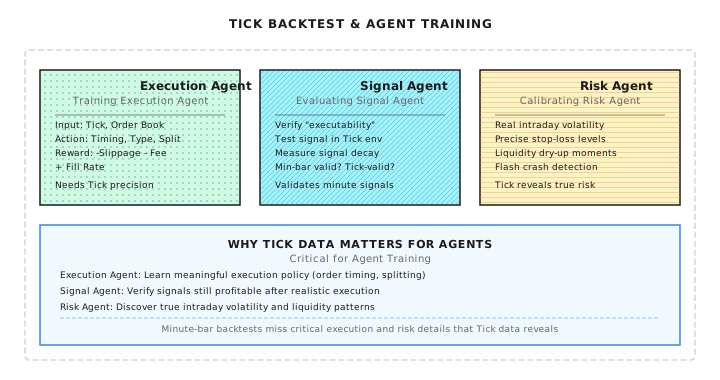
8. Multi-Agent Perspective
Role of tick-level backtesting in multi-agent systems:
9. Practical Recommendations
9.1 Progressive Adoption
Stage 1: Validate strategy logic
  - Use minute/hourly data
  - Fixed slippage assumption
  - Fast iteration

Stage 2: Refine execution assumptions
  - Use tick data for key signals
  - Square-root slippage model
  - Verify strategy is still profitable

Stage 3: Full tick backtest
  - Order book replay
  - Queue simulation
  - Compare with live data to calibrate
9.2 Key Metrics Comparison
def compare_granularity(minute_result: dict,
                        tick_result: dict) -> dict:
    """Compare backtest results at different granularities"""
    return {
        'return_diff': tick_result['return'] - minute_result['return'],
        'sharpe_diff': tick_result['sharpe'] - minute_result['sharpe'],
        'fill_rate': tick_result.get('fill_rate', 1.0),
        'avg_slippage': tick_result.get('avg_slippage', 0),
        'verdict': 'tick_worse' if tick_result['return'] < minute_result['return'] * 0.8 else 'acceptable'
    }
10. Summary
| Key Point | Description |
|---|---|
| Use Cases | HFT strategies, Precise execution simulation, Limit order strategies |
| Core Advantages | Queue simulation, Precise slippage, Path-dependent logic |
| Implementation | Event-driven architecture |
| Key Challenges | Large data volume, Complex queue simulation, High computation cost |
| Progressive Adoption | Validate logic with minutes first, then verify execution with ticks |
Further Reading
- Background: Execution Simulator Implementation - Detailed execution simulation
- Background: Exchanges and Order Book Mechanics - Order book fundamentals
- Lesson 07: Backtest System Pitfalls - Common backtest issues