Background: Time Series Cross-Validation (Purged CV)
"Using standard K-Fold on financial data is like using tomorrow's newspaper to predict today's stock price."
Why Standard Cross-Validation Fails in Finance?
Standard K-Fold Assumption: Samples are mutually independent.
Financial Data Reality:
- Today's return is highly correlated with yesterday's (autocorrelation)
- Features used to predict day 100 may include information from days 99, 98
- Labels (returns) often involve multi-day windows
Result: Information "leaks" from test set to training set, causing severe overfitting.
A Concrete Leakage Case
Scenario: Predicting 5-day future returns
Data: Days 1-100
Label: ret_5d[t] = (close[t+5] - close[t]) / close[t]

Sample 95's label uses: Days 95-100 prices
Sample 96's label uses: Days 96-101 prices (partial overlap!)
Standard K-Fold might:
- Training set includes sample 95 (label involves days 95-100)
- Test set includes sample 96 (label involves days 96-101)
- Days 96-100 information is in both training and testing!
Three Time Series CV Methods
Method 1: Simple Time Split (Walk-Forward)
Fold 1: Train [1-60]  -> Test [61-70]
Fold 2: Train [1-70]  -> Test [71-80]
Fold 3: Train [1-80]  -> Test [81-90]
Fold 4: Train [1-90] -> Test [91-100]Pros: Simple, no future information leakage Cons: Training set grows larger, early data may be stale
Method 2: Rolling Window
Fold 1: Train [1-60]   -> Test [61-70]
Fold 2: Train [11-70]  -> Test [71-80]
Fold 3: Train [21-80]  -> Test [81-90]
Fold 4: Train [31-90] -> Test [91-100]Pros: Fixed training set size, uses most recent data Cons: Low sample utilization
Method 3: Purged K-Fold (Recommended)
On top of standard K-Fold:
- Time Ordering: Split K folds in chronological order
- Purge: Remove training samples whose labels overlap with test set
- Embargo: Add safety buffer beyond the purge zone
Purged CV Explained
Problem Setup:
- Feature window: Past 20 days
- Label window: Future 5 days
- Data: Days 1-100
Steps:
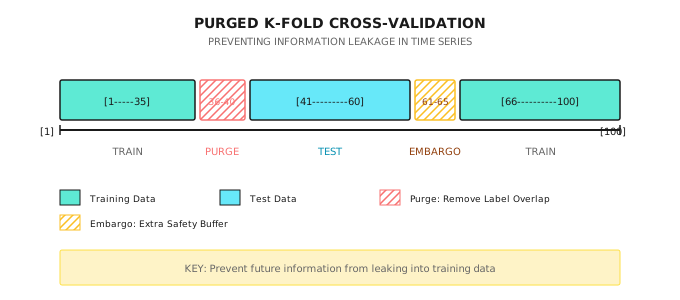
1. Split Folds (assume 5 folds)
   Fold 3 test set: Days 41-60

2. Identify Leakage Zone
   Test labels involve: Days 41-65 (41+5-1 to 60+5-1)
   Training features involve: Days 21-40 may also affect test

3. Purge
   Remove training samples whose labels overlap with test set
   Remove: Days 36-40 (labels involve 36-45, overlaps with 41-65)

4. Embargo
   Remove N additional samples after the Purge boundary
If Embargo = 5 days, remove training samples from days 41-45Visualization:
The Role of Embargo
Why is Embargo Needed?
Even after purging label overlap, there may still be:
- Feature autocorrelation (today's MA20 and tomorrow's MA20 are nearly identical)
- Information propagation delay (news impact lasts several days)
- Market state persistence (trends don't disappear overnight)
Suggested Embargo Length:
| Data Frequency | Label Window | Suggested Embargo |
|---|---|---|
| Daily | 5 days | 3-5 days |
| Daily | 20 days | 10-20 days |
| Minute | 1 hour | 30-60 minutes |
| Tick | 100 Ticks | 50-100 Ticks |
Rule of Thumb: Embargo ≈ 0.5 x Label Window
Practical Calculation Example
Setup:
- Data: 1000 samples (4 years daily)
- Label: 10-day future return
- K = 5 folds
- Embargo = 5 days
Fold Allocation:
| Fold | Original Test Range | Purge Removal | Embargo Removal | Effective Training Samples |
|---|---|---|---|---|
| 1 | 1-200 | None | None | 210-1000 (790) |
| 2 | 201-400 | 191-200 | 401-405 | 1-190, 406-1000 (785) |
| 3 | 401-600 | 391-400 | 601-605 | 1-390, 606-1000 (785) |
| 4 | 601-800 | 591-600 | 801-805 | 1-590, 806-1000 (785) |
| 5 | 801-1000 | 791-800 | None | 1-790 (790) |
Note: Each fold loses about 15 samples to prevent leakage.
Comparison with Other Methods
| Method | Info Leakage | Sample Utilization | Compute Complexity | Suitable For |
|---|---|---|---|---|
| Standard K-Fold | Severe | High | Low | Not for finance |
| Simple Time Split | None | Medium | Low | Quick validation |
| Rolling Window | None | Low | Medium | Strategy stability testing |
| Purged K-Fold | None | Higher | Medium | Model selection, hyperparameter tuning |
| Purged + Embargo | None | Medium | Medium | Most rigorous validation |
Multi-Agent Perspective
In multi-agent systems, different Agents need different CV strategies:
Signal Agent (predicting 5-day returns):
  - Purge: 5-day label window
  - Embargo: 3 days
  - Conservative model performance estimate

Regime Agent (identifying market states):
  - Purge: Usually not needed (state is current)
  - Embargo: Longer (state transitions have inertia)
  - Focus on accuracy during state transitions

Risk Agent (predicting volatility):
  - Purge: Volatility window (e.g., 20 days)
  - Embargo: 5 days
  - Volatility clustering requires longer Embargo
Common Misconceptions
Misconception 1: Using Purged CV prevents overfitting
Wrong. Purged CV only prevents information leakage, it cannot prevent:
- Overfitting from too many features
- Data snooping (repeatedly testing until finding good results)
- Excessive model complexity
Misconception 2: Longer Embargo is always better
Not entirely true. Too long Embargo:
- Wastes effective training samples
- May make training data too stale
- Increases computational cost
Misconception 3: Only need Purged CV for final testing
Wrong. Hyperparameter tuning must also use Purged CV, otherwise you'll select overfitting parameters.
Practical Recommendations
1. Check if Purging is Needed
Need Purging when:
- Labels involve multi-day windows (e.g., future N-day returns)
- Features involve long windows (e.g., 60-day moving average)
- Samples have overlap

Less Need for Purging when:
- Labels are instantaneous (e.g., next tick direction)
- Samples are completely independent (e.g., cross-section of different stocks)
2. Validate Purge Effectiveness
Comparison Experiment:
1. Train with standard K-Fold, record test accuracy
2. Train with Purged K-Fold, record test accuracy
3. Larger difference indicates more severe original leakage
3. Reserve Completely Independent Test Set
Data Allocation:
- 70%: Purged K-Fold for model selection and hyperparameter tuning
- 30%: Completely isolated final test set, use only once
Summary
| Key Point | Explanation |
|---|---|
| Core Problem | Time series samples are not independent, standard CV causes leakage |
| Purge Function | Remove training samples whose labels overlap with test set |
| Embargo Function | Add safety buffer beyond Purge boundary |
| Recommended Method | Purged K-Fold + Embargo |
| Validation Method | Compare standard CV and Purged CV results |